On this page
Redox Reactions is Unit 7 in the NCERT Class 11 Chemistry textbook, Part 2 (reprint 2026-27). The CBSE Chemistry curriculum for 2026-27 lists four parts: the classical idea, electron transfer, oxidation number, and electrode processes. For worked balancing, see our Redox Reactions Class 11 chapter guide.
What do oxidation and reduction mean?
Oxidation (classical idea): adding oxygen or another electronegative element to a substance, or removing hydrogen or an electropositive element from it. Example: 2Mg + O2 → 2MgO.
Reduction (classical idea): the reverse: removing oxygen or an electronegative element, or adding hydrogen or an electropositive element. Example: CH2=CH2 + H2 → CH3CH3.
Redox reaction: oxidation and reduction happening together; one never occurs alone. Example: in H2S + Cl2 → 2HCl + S, H2S is oxidised and chlorine is reduced.
Oxidation (electron view): a species losing electrons. Example: Na → Na+ + e–.
Reduction (electron view): a species gaining electrons. Example: Cl2 + 2e– → 2Cl–.
Half reaction: the oxidation or reduction step written alone, electrons shown; the two add up to the full equation.
Oxidising agent (oxidant): the species that accepts electrons, so it is itself reduced. Example: chlorine reacting with sodium.
Reducing agent (reductant): the species that gives away electrons, so it is itself oxidised. Example: sodium in that reaction. Don't confuse with: the oxidising agent, which is reduced.
Competitive electron transfer: metals competing to give up electrons. Example: zinc in copper nitrate solution gets coated with copper as the blue fades; copper in zinc sulphate shows no change. Order: Zn > Cu > Ag.
Activity series: metals ranked by how readily they release electrons.
What is an oxidation number?
Oxidation number: the charge an atom would carry if each shared electron pair went wholly to the more electronegative atom; also called oxidation state. Example: in H2O, hydrogen is +1 and oxygen –2.
Rules for assigning it: zero in a free element (O2, P4, Na); the charge, for a one-atom ion; fluorine always –1; hydrogen +1, but –1 in metal hydrides like NaH; oxygen –2, except in peroxides, superoxides and oxygen fluorides; the total is zero for a molecule and the charge for an ion.
Peroxide and superoxide: compounds with oxygen atoms bonded together. Example: oxygen is –1 in H2O2 and –½ in KO2. Don't confuse with: OF2, where oxygen is +2.
Stock notation: a Roman numeral in brackets after a metal's symbol shows its oxidation number. Example: FeO is Fe(II)O, Fe2O3 is Fe2(III)O3.
Fractional oxidation number: an average over atoms of one element in different states. Example: sulphur averages 2.5 in S4O6²⁻; the real values are +5, 0, 0, +5.
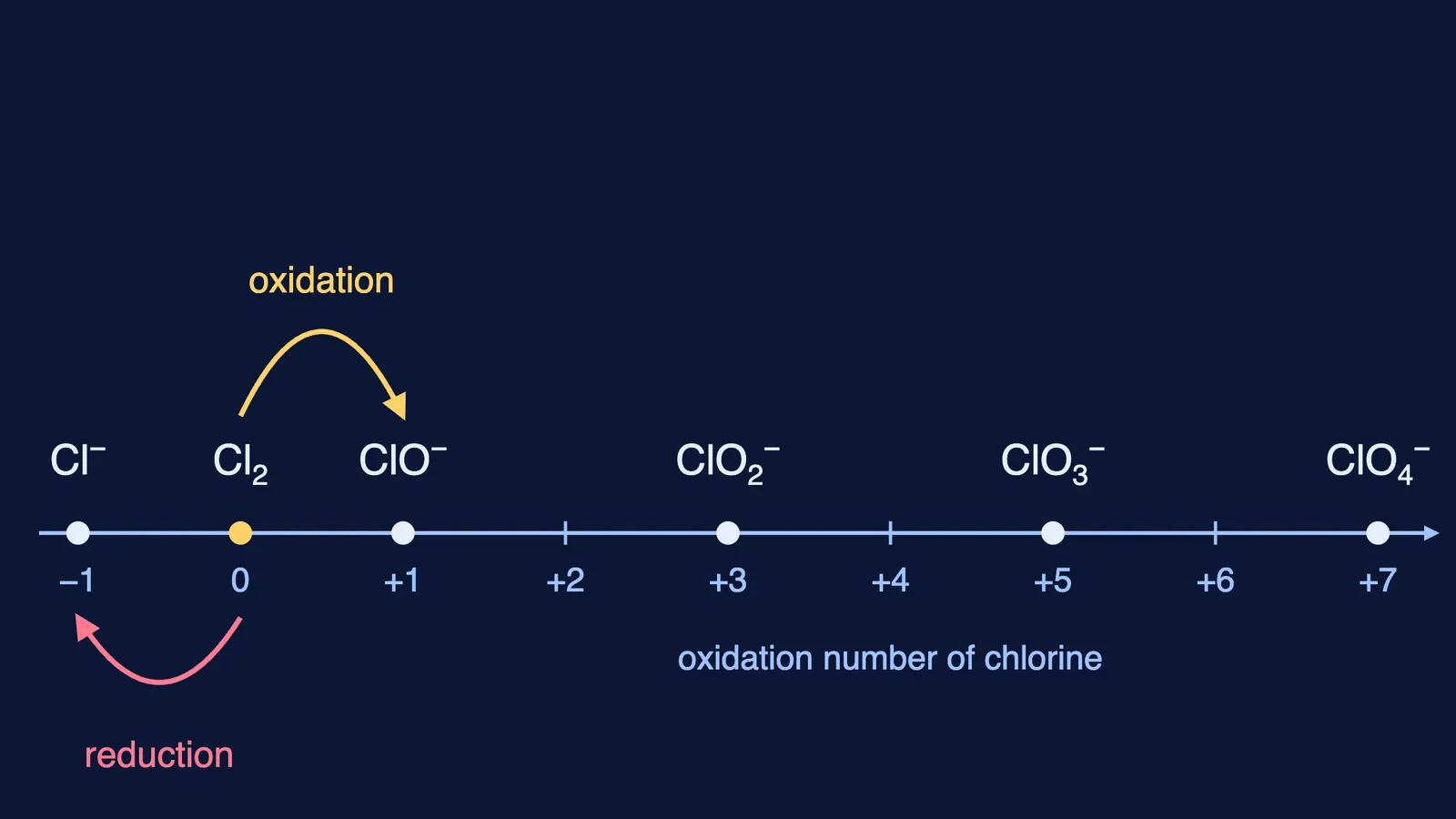
Oxidation and reduction (oxidation-number view): an increase or a decrease in an element's oxidation number. Example: in 2Cu2O + Cu2S → 6Cu + SO2, copper drops from +1 to 0 and sulphur rises from –2 to +4.
What are the types of redox reactions?
Combination reaction: A + B → C; redox only when A, B or both are elements. Example: C + O2 → CO2.
Decomposition reaction: a compound breaks into parts, at least one an element. Example: 2H2O → 2H2 + O2. Don't confuse with: CaCO3 → CaO + CO2, where no oxidation number changes, so it is not redox.
Metal displacement: a free metal pushes another metal out of a compound. Example: Zn + CuSO4 → ZnSO4 + Cu.
Non-metal displacement: a non-metal such as hydrogen or a halogen is pushed out. Example: 2Na + 2H2O → 2NaOH + H2; Cl2 + 2KBr → 2KCl + Br2.
Disproportionation: the same element, starting from a single oxidation state, ends up both higher and lower; it needs at least three possible states, starting in the middle. Example: Cl2 + 2OH– → ClO– + Cl– + H2O (chlorine: 0 to +1 and –1). ClO4– cannot, as its chlorine is already at the highest state, +7.
How are redox equations balanced?
Oxidation number method: make the total rise in oxidation number equal the total fall, then balance charge with H+ (acidic) or OH– (basic), and hydrogen with water.
Half reaction (ion-electron) method: balance each half (other atoms, O with H2O, H with H+, charge with electrons), equalise electrons and add. Example: 6Fe2+ + Cr2O7²⁻ + 14H+ → 6Fe3+ + 2Cr3+ + 7H2O.
Basic medium: balance as if acidic, then add one OH– to both sides for each H+ and combine them into water.
Redox titration: finding an oxidant's or reductant's strength using a redox-sensitive indicator.
Self-indicator: a reagent coloured enough to show its own end point. Example: permanganate turns lasting pink once the reductant runs out.
Equivalence point: where oxidant and reductant have reacted in exact mole ratio. Don't confuse with: the end point, the visible colour change that signals it.
What happens in electrode processes?
Redox couple: the oxidised and reduced forms of one substance in a half reaction, oxidised form first. Example: Zn2+/Zn, Cu2+/Cu.
Salt bridge: a U-tube of potassium chloride or ammonium nitrate set in agar jelly; it connects the two solutions without mixing them.
Daniell cell: zinc in zinc sulphate and copper in copper sulphate, joined by a wire and a salt bridge. Electrons flow from zinc (anode, oxidation) to copper (cathode, reduction); current flows opposite.
Electrode potential: the potential of each electrode in such a cell. Its standard value, E°, is measured with every species at unit concentration, gases at 1 atm and 298 K; the hydrogen electrode is set at 0.00 V. Example: NCERT Table 7.1 gives –0.76 V for Zn2+/Zn and +0.34 V for Cu2+/Cu. Negative E° means a stronger reducing agent than H+/H2.
How to learn these terms
Learn oxidation in its three views side by side: oxygen added, electrons lost, oxidation number up. Then reduction.
Pair each agent with its fate: the oxidising agent is reduced, the reducing agent oxidised.
Draw the Daniell cell from memory: anode, cathode, salt bridge, electron flow.
Test yourself with our Redox reactions case study questions for Class 11 and check your balancing with practise redox balancing with AI.
If an idea still feels shaky, the Fermi Concept Library has a lesson for every concept in chemistry, each with its place in the map.