On this page
Three original passages, easiest first, each with four parts and worked answers.
What do Redox Reactions case-study questions test?
The CBSE Chemistry curriculum for 2026-27 lists Unit 7, Redox Reactions, with four topics: the classical idea of redox, electron transfer, oxidation number, and redox reactions and electrode processes. Class 11 papers are set by schools, so treat these cases as practice, not a fixed exam pattern.
Every fact used here is in the current NCERT Chemistry Part II, Unit 7 (Reprint 2026-27); the scenarios and numbers are our own. Atomic masses: H = 1, O = 16, Na = 23, Cl = 35.5, Fe = 55.8, Ni = 58.7, Ag = 107.9. For the theory, read our Redox Reactions Class 11 guide.
Case 1: A nickel strip in three beakers
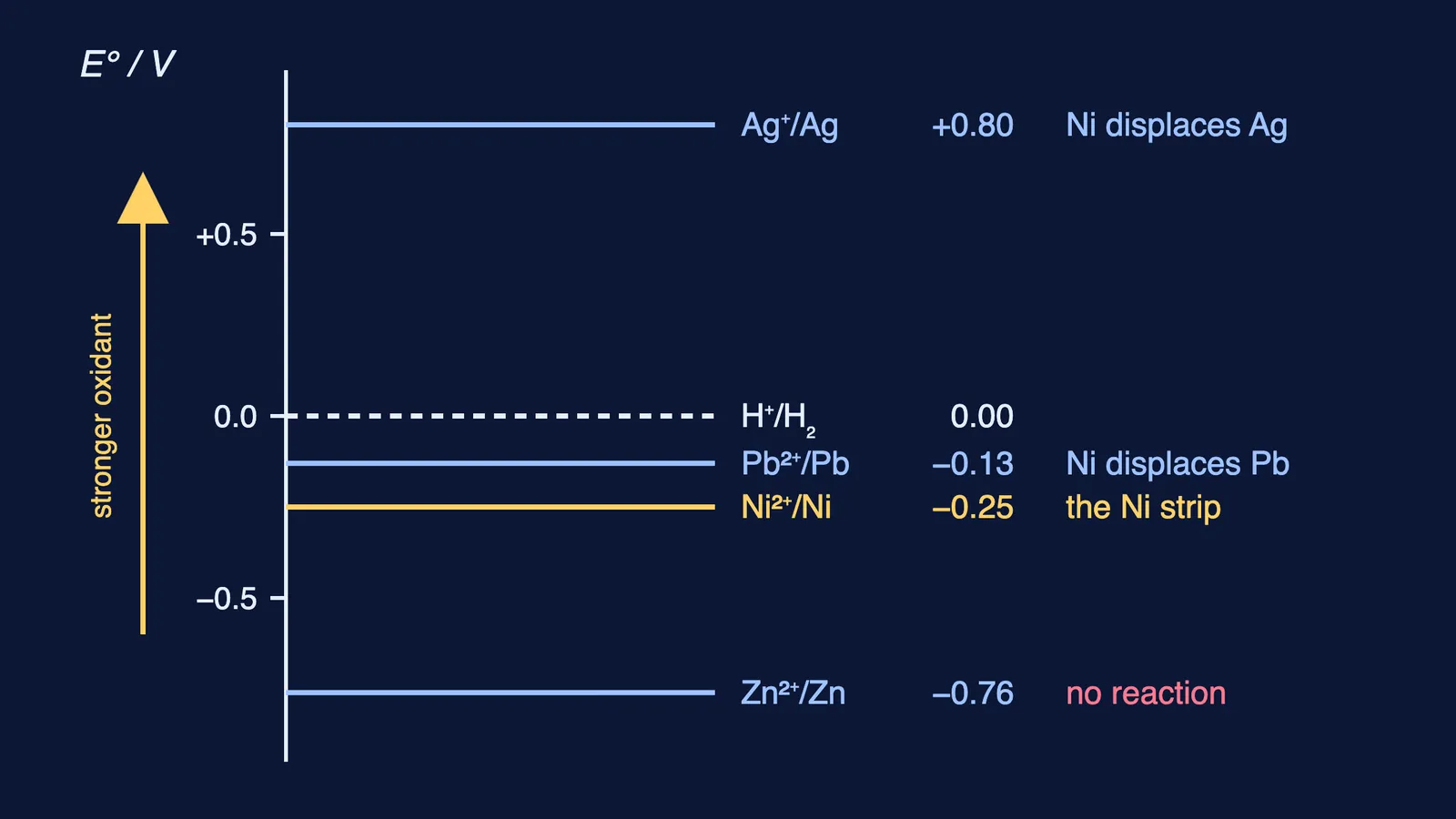
At a school science fair in Lucknow, Kabir dips three clean nickel strips into three beakers: silver nitrate solution, lead nitrate solution and zinc sulphate solution. After an hour, the strip in silver nitrate is covered with a grey, shiny deposit. The strip in lead nitrate has a dull grey coating. The strip in zinc sulphate looks unchanged. NCERT Table 7.1 gives: Ag⁺/Ag +0.80 V, Pb²⁺/Pb −0.13 V, Ni²⁺/Ni −0.25 V and Zn²⁺/Zn −0.76 V. Weighing shows that 0.587 g of nickel dissolved from the strip in silver nitrate.
(i) In which beaker does no redox reaction take place? (a) silver nitrate (b) lead nitrate (c) zinc sulphate (d) all three react
(ii) Write the oxidation half-reaction and the reduction half-reaction for the silver nitrate beaker.
(iii) Arrange Zn, Ni, Pb and Ag in decreasing order of strength as reducing agents, and say how the E° values show it.
(iv) If all the silver sticks to the strip, what mass is deposited, and by how much does this strip's mass change?
Answers.
(i) (c) Zinc sulphate. Zinc is a stronger reducing agent than nickel, so nickel cannot reduce Zn²⁺.
(ii) Oxidation: Ni(s) → Ni²⁺(aq) + 2e⁻. Reduction: Ag⁺(aq) + e⁻ → Ag(s) (×2).
(iii) Zn > Ni > Pb > Ag. The more negative the E° of a couple, the stronger its metal is as a reducing agent.
(iv) 0.587 ÷ 58.7 = 0.0100 mol Ni, giving 0.0200 mol electrons and so 0.0200 mol Ag. Mass = 0.0200 × 107.9 = 2.158 g. The strip gains 2.158 − 0.587 = 1.571 g.
Case 2: Making liquid bleach in Vadodara
A small chemical unit in Vadodara makes household liquid bleach. In each batch, chlorine gas is bubbled through cold, dilute sodium hydroxide solution in a stirred tank until 142 kg of chlorine has been absorbed. The reaction is Cl₂ + 2NaOH → NaCl + NaOCl + H₂O. The hypochlorite ion it forms oxidises coloured stains to colourless compounds. Each batch is then diluted, bottled and sold to shops across Gujarat. A trainee asks whether fluorine could make a similar bleach.
(i) The oxidation number of chlorine in NaOCl is: (a) −1 (b) 0 (c) +1 (d) +3
(ii) Which type of redox reaction is this? Give the reason.
(iii) Why will fluorine not give a hypofluorite bleach in the same way?
(iv) For one batch, find the masses of NaOH used and NaOCl formed, and the moles of electrons transferred.
Answers.
(i) (c) +1. Na is +1 and O is −2, so +1 + x − 2 = 0 gives x = +1.
(ii) Disproportionation. Chlorine starts at 0 and is both reduced to −1 (in NaCl) and oxidised to +1 (in NaOCl) in the same reaction.
(iii) Fluorine, the most electronegative element, cannot show a positive oxidation state, so no F(+1) hypofluorite forms. With alkali it gives F⁻ and OF₂ instead.
(iv) 142,000 g ÷ 71 g/mol = 2,000 mol Cl₂. NaOH = 2 × 2,000 × 40 = 160 kg. NaOCl = 2,000 × 74.5 = 149 kg. In each Cl₂ one atom gives one electron to the other, so 2,000 mol of electrons are transferred.
Case 3: Checking iron tablets in a quality lab
A quality-control lab at a pharmaceutical plant in Baddi tests iron tablets that contain ferrous sulphate. The label claims 60 mg of iron per tablet. An analyst dissolves one tablet in dilute sulphuric acid and titrates it with 0.0200 M potassium permanganate, adding no indicator. The end point comes at 10.40 mL, when the first lasting pale pink colour appears. Two repeat titrations give the same reading. In the reaction, Fe²⁺ is oxidised to Fe³⁺ and MnO₄⁻ is reduced to Mn²⁺.
(i) Why is no separate indicator needed? (a) Fe³⁺ is colourless (b) MnO₄⁻ is intensely coloured and acts as its own indicator (c) the acid changes colour (d) Mn²⁺ is deep purple
(ii) By how much does the oxidation number of manganese change, and how many electrons does each MnO₄⁻ ion gain?
(iii) Balance the reaction in acidic medium by the half-reaction method.
(iv) Find the mass of iron in the tablet and express it as a percentage of the label claim.
Answers.
(i) (b). After the last Fe²⁺ is oxidised, the next drop of MnO₄⁻ stays and shows its colour.
(ii) Mn goes from +7 to +2, a fall of 5, so each MnO₄⁻ gains 5 electrons.
(iii) Reduction: MnO₄⁻ + 8H⁺ + 5e⁻ → Mn²⁺ + 4H₂O. Oxidation (×5): Fe²⁺ → Fe³⁺ + e⁻. Sum: MnO₄⁻ + 5Fe²⁺ + 8H⁺ → Mn²⁺ + 5Fe³⁺ + 4H₂O. Charge is +17 on both sides.
(iv) MnO₄⁻ used = 0.0200 × 0.01040 = 2.08 × 10⁻⁴ mol. Fe²⁺ = 5 × 2.08 × 10⁻⁴ = 1.04 × 10⁻³ mol. Mass = 1.04 × 10⁻³ × 55.8 = 0.0580 g = 58.0 mg, which is 96.7% of the 60 mg claim.
How should you attack case-study questions on Redox Reactions?
Write oxidation numbers over every symbol first. Reaction type and electrons transferred both follow.
Read E° as a ladder. A metal reduces the ions of any couple above it.
Count electrons, not just atoms. One Ni deposits two Ag; that 2 decides the mass.
End every balanced equation with a charge check.
In titrations, go volume to moles to mole ratio to mass.
For passage-reading habits, see how to answer case-based questions; for more practice, try our redox practice questions with solutions. Stuck on the mole steps? The Fermi Problem Library has worked problems with a step-by-step solver that explains the reasoning rather than printing an answer.