On this page
Eight original JEE Main-style ray optics questions, easy to hard, each with a worked solution and a trap line naming the most tempting wrong option.
How should you use this ray optics question set?
Unit 16 of NTA's Syllabus for JEE (Main) - 2027 lists mirrors, refraction at plane and spherical surfaces, thin lenses, the lens maker formula, prisms, and the microscope and astronomical telescope. Every question stays inside that list and inside NCERT Class 12 Physics Chapter 9, Ray Optics and Optical Instruments (Reprint 2026-27).
Allow 25 minutes, on paper, without a calculator.
Write u, v, f and R with their signs before any arithmetic.
Read every trap line, even where you were right.
New to the chapter? Start with our guide on how to prepare ray optics for JEE Main.
Easy: can you handle mirrors, lens shape and the telescope?
Q1 (easy). A concave make-up mirror has focal length 20 cm. How far from it should your face be for an upright image four times larger?
(A) 5 cm (B) 15 cm (C) 25 cm (D) 80 cm
Answer: (B). Upright means virtual, so m = −v/u = +4 and v = −4u. Then 1/v + 1/u = 1/f gives 3/(4u) = −1/20, so u = −15 cm. Trap: (C), which solves m = −4 and gives a real, inverted image.
Q2 (easy). A plano-convex glass lens (n = 1.6) has a focal length of 30 cm. The radius of its curved face is:
(A) 18 cm (B) 36 cm (C) 48 cm (D) 50 cm
Answer: (A). With one flat face, the lens maker formula becomes 1/f = (n − 1)/R, so R = 0.6 × 30 = 18 cm. Trap: (D), which divides by (n − 1) instead of multiplying.
Q3 (easy). An astronomical telescope in normal adjustment has a magnifying power of 20 and a tube length of 105 cm. The focal lengths of its objective and eyepiece are:
(A) 105 cm and 5.25 cm (B) 100 cm and 5 cm (C) 110.5 cm and 5.5 cm (D) 5 cm and 100 cm
Answer: (B). In normal adjustment fo/fe = 20 and fo + fe = 105 cm, so 21fe = 105 and fe = 5 cm, fo = 100 cm. Trap: (C), which uses fo − fe = 105 cm.
Medium: can you work through instruments, prisms and curved surfaces?
Q4 (medium). A compound microscope has objective and eyepiece focal lengths of 1.6 cm and 2.5 cm. An object sits 2.0 cm from the objective and the final image is at infinity. With D = 25 cm, the magnifying power is:
(A) 40 (B) 44 (C) 66 (D) 10
Answer: (A). For the objective, 1/v = 1/1.6 − 1/2.0, so v = 8 cm and mo = v/u = −4. With the image at infinity, me = D/fe = 10, so the magnitude is 4 × 10 = 40. Trap: (B), which uses 1 + D/fe, the eyepiece formula for an image at the near point.
Q5 (medium). A thin 5° prism (n = 1.54) is paired, inverted, with a thin prism of n = 1.72. For zero net deviation, the second prism's angle must be:
(A) 6.7° (B) 4.5° (C) 3.75° (D) 5°
Answer: (C). A thin prism deviates light by (n − 1)A. Setting 0.54 × 5° = 0.72 × A gives A = 3.75°. Trap: (B), which balances n × A instead of (n − 1) × A.
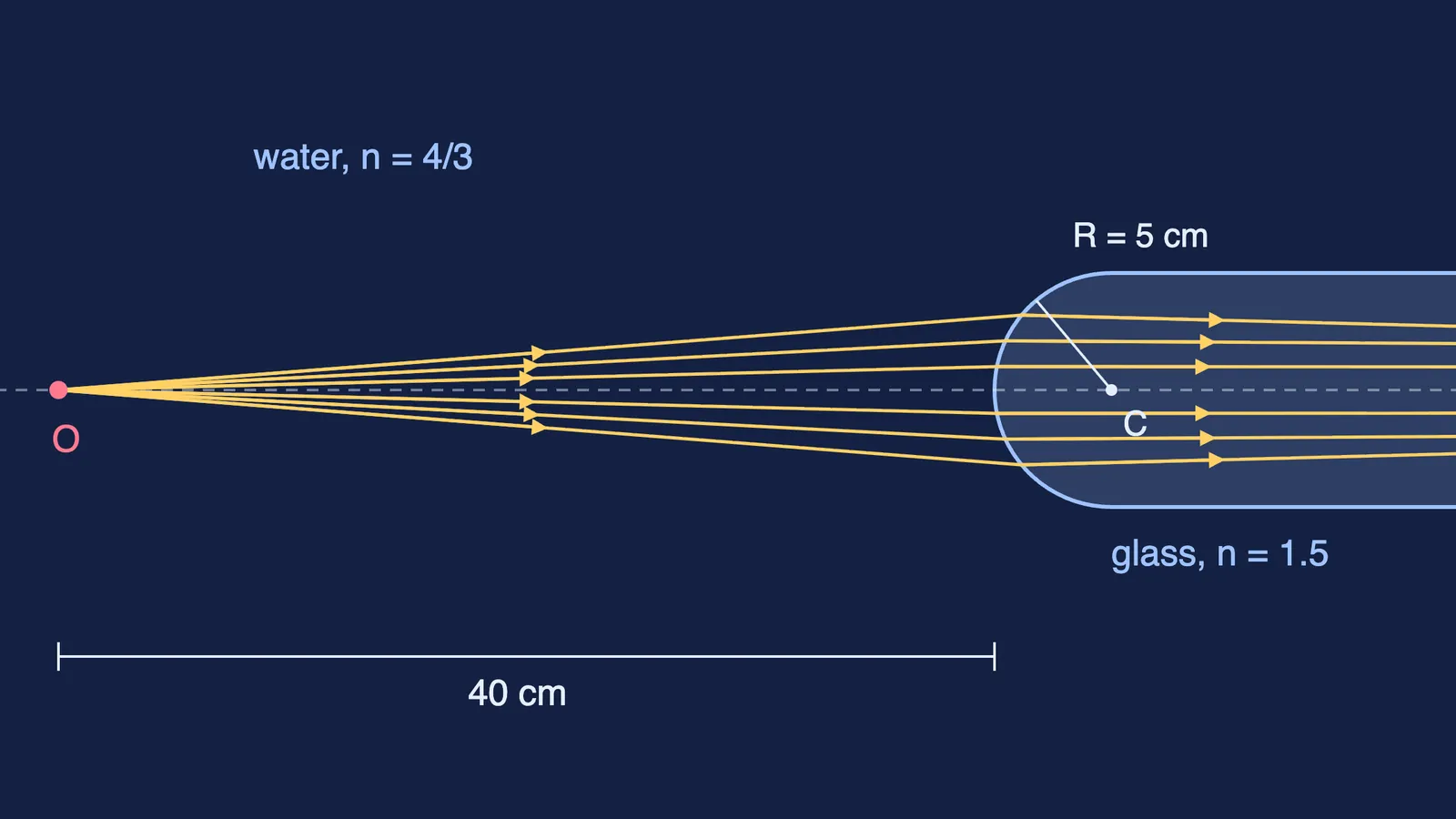
Q6 (medium). A long glass rod (n = 1.5) with a convex hemispherical end of radius 5 cm lies in water (n = 4/3). A point object in the water sits on the axis, 40 cm from the curved end. Where is its image?
(A) 20 cm inside the rod (B) 22.5 cm inside the rod (C) At infinity: the rays travel parallel inside the rod (D) 40 cm in front of the face, virtual
Answer: (C). Use n₂/v − n₁/u = (n₂ − n₁)/R with u = −40 cm and R = +5 cm: 1.5/v = (1/6)/5 − (4/3)/40 = 1/30 − 1/30 = 0. So v is infinite. Trap: (A), which forgets the water and takes n₁ = 1.
Hard: can you handle a silvered lens and a moving image?
Q7 (hard, numerical value). An equiconvex lens (n = 1.5) has both radii equal to 40 cm. One face is silvered. How far from the lens, in cm, must an object sit for its image to form on the object itself?
Answer: 20. The lens alone has f = 40 cm. Light crosses it twice and reflects once from a concave mirror of focal length 20 cm, so P = 2/0.40 + 1/0.20 = 10 D: a concave mirror of focal length 10 cm. The image falls on the object at its centre of curvature, 20 cm away. Trap: 40, which treats the silvered face as a plain mirror and ignores the lens.
Q8 (hard). An object is 20 cm in front of a concave mirror of focal length 15 cm and moves towards the mirror at 2 cm/s. At that instant, the image moves at:
(A) 18 cm/s, away from the mirror (B) 18 cm/s, towards the mirror (C) 6 cm/s, away from the mirror (D) 0.22 cm/s, towards the mirror
Answer: (A). First, v = −60 cm, so m = −3. Differentiating the mirror formula gives dv/dt = −(v²/u²)(du/dt) = −9 × 2 = −18 cm/s, so the image moves away from the mirror. Trap: (C), which multiplies the speed by |m| instead of m².
What should you do after this set?
Sort your misses into three piles: sign errors (Q1, Q6, Q8), formula choice (Q3, Q4, Q5) and set-up (Q2, Q7). The biggest pile is what to revise first. If you cannot see where your working went wrong, the Fermi Problem Library has worked problems with a step-by-step solver that explains the reasoning rather than printing an answer.
For more on Q6-style set-ups, read a lens with different media on each side. Then try the companion set of wave optics JEE Main practice questions.