On this page
Propositions and their Converses is Chapter 9 of Ganita Manjari, NCERT's new Class 9 maths textbook, and the first chapter of Part II (NCERT prelims). The CBSE 2026-27 Class IX Mathematics curriculum places it in Unit IV, Geometry, beside the congruence theorems for triangles. The chapter uses terms from number theory and geometry, explained here in plain words. For worked proofs, see our chapter guide to Propositions and their Converses.
What is a proposition?
Proposition: a sentence that can be judged true or judged false, with no third option. Example: "1 + 1 = 3" is a (false) proposition; "Is 7 prime?" is a question, not a proposition.
"If X then Y": the usual shape of a proposition here. X is the condition; Y must follow whenever X holds.
"X implies Y": another way of writing "if X then Y". The book uses the two interchangeably.
"Y when X": a third way of saying the same thing. "A number is even when it ends in 4" means "if a number ends in 4, then it is even". Don't confuse with: "X when Y", which reverses the meaning.
What is the converse of a proposition?
Converse: swap the condition and the conclusion, and "if X then Y" turns into "if Y then X". Example: "if a number ends in 0, then it is divisible by 10" has the converse "if a number is divisible by 10, then it ends in 0".
Keeping the first sentence: if a proposition starts by fixing the objects ("let a, b, c be the sidelengths of a triangle"), keep that sentence in the converse and swap only the "if" and "then" parts.
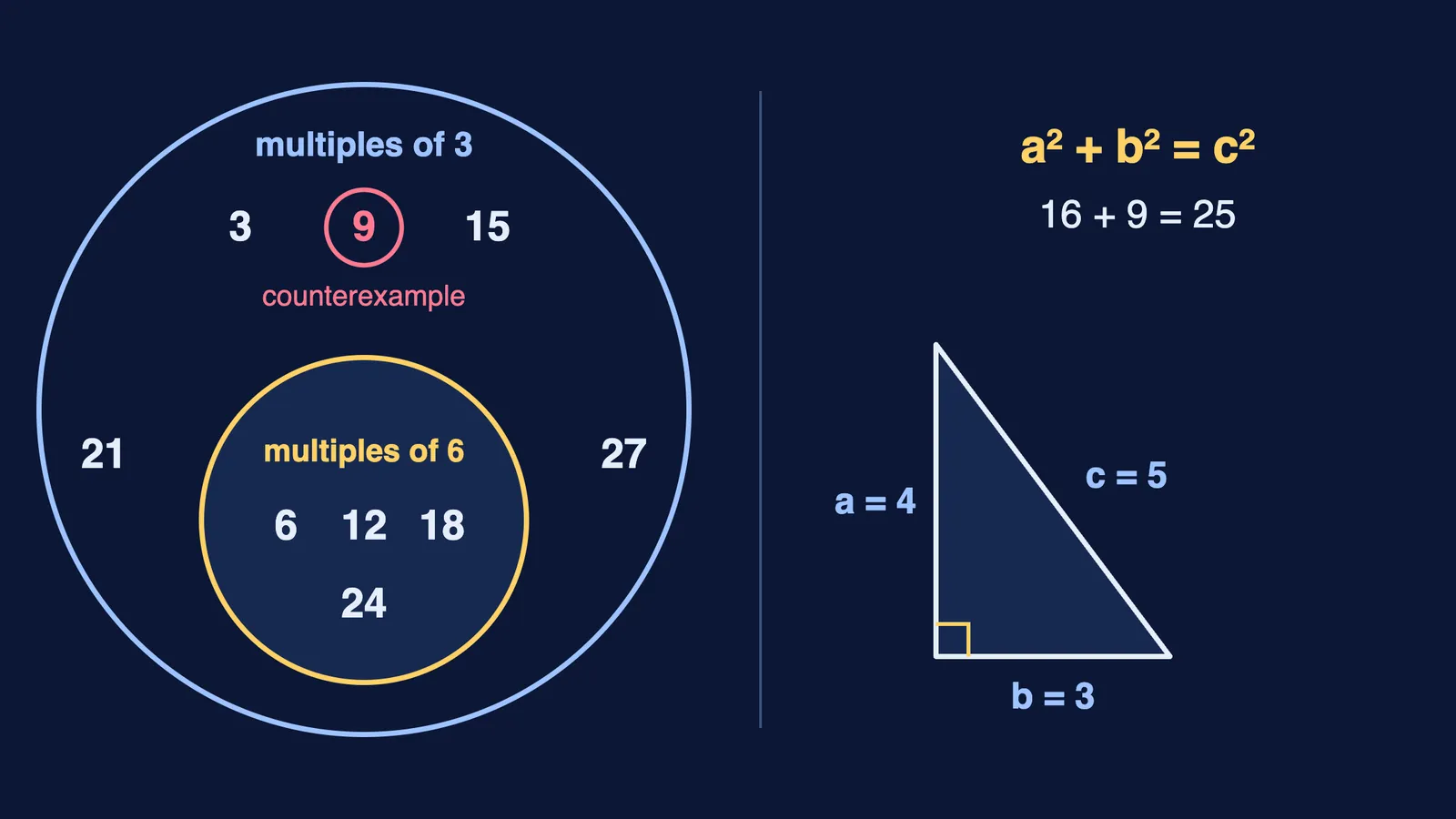
True proposition, false converse: "if a number is a multiple of 6, then it is a multiple of 3" is true, but its converse fails, since 9 is a multiple of 3 and not of 6.
Both true: when a proposition and its converse are both true, the two conditions imply each other. Each direction needs its own proof.
Both false: this can happen too. Example: "if a number is prime, then it is odd" fails for 2; its converse "if a number is odd, then it is prime" fails for 9.
Class 11 Applied Maths has a Mathematical Logic chapter, but it covers reasoning puzzles such as syllogisms and coding-decoding, not converses; see our Class 11 Applied Maths guide to mathematical logic.
How does a counterexample disprove a claim?
Counterexample: one case that shows a proposition is false. For "if X then Y", it must satisfy X and fail Y. Example: 10 disproves "if a number is divisible by 5, it ends in 5"; 7 does not, since it is not divisible by 5.
Justify (prove): give reasoning that works for every case allowed by the condition, not just a few examples.
Fermat's claim: the chapter recalls that Fermat claimed every number of the form 2^(2^n) + 1 is prime, and that Euler showed the case n = 5 is composite. That number is 2^32 + 1 = 4,294,967,297 = 641 × 6,700,417.
Which number words does the chapter use?
Multiple and divisible: 18 is a multiple of 6 because 18 = 6 × 3; equivalently, 18 is divisible by 6, with no remainder.
Factor: a whole number that divides a given number exactly. Example: the factors of 12 are 1, 2, 3, 4, 6 and 12. Don't confuse with: multiple.
Factor-partner pair: two factors whose product is the number, such as (3, 4) for 12.
Perfect square: a number of the form f × f for a whole number f. Example: 36 = 6 × 6. Pairs (1, 36), (2, 18), (3, 12), (4, 9), (6, 6) give 9 factors, an odd number. The chapter shows that "n is a perfect square" and "n has an odd number of factors" imply each other.
Prime number: a number with exactly two factors, 1 and itself. Don't confuse with: odd number; 2 is prime and even.
Composite number: a number greater than 1 with more than two factors. Example: 9 = 3 × 3.
Which geometry terms appear in this chapter?
Equal sides and equal opposite angles: the chapter's first proposition: if two sides of a triangle are equal, the angles opposite them are equal. Its converse is also true.
Altitude: the perpendicular segment from a vertex to the line of the opposite side.
Congruent triangles: triangles with the same shape and size, with corresponding sides and angles equal. Don't confuse with: equal area. Right triangles with legs 3, 4 and legs 2, 6 both have area 6 but are not congruent.
SSS criterion: if the three sides of one triangle equal the three sides of another, the triangles are congruent.
Baudhāyana–Pythagoras theorem: if a triangle with sides a, b, c is right-angled, with c opposite the right angle, then a² + b² = c². Example: 3, 4, 5 gives 9 + 16 = 25.
Converse of the Baudhāyana–Pythagoras theorem: if a² + b² = c², then the triangle is right-angled. The chapter proves it with a second right triangle and SSS. Example: 25 + 144 = 169, so a 5, 12, 13 triangle is right-angled. Our Class 11 Knowledge Traditions guide to Mathematics in India covers Baudhāyana's Sulbasūtra.
Transversal and corresponding angles: a transversal crosses two lines at different points; corresponding angles sit in matching positions at the two crossings.
Incentre: the point where a triangle's three angle bisectors meet.
Diagonal: a segment joining opposite vertices of a quadrilateral. A rectangle's diagonals are equal, but equal diagonals alone do not make a rectangle.
How to learn these terms
Rewrite every proposition as "if X then Y" first, even when it says "implies" or "when".
Keep two columns, proposition and converse, marking each "proof" or "counterexample".
Learn the pairs that get mixed up: multiple and factor, prime and odd, congruent and equal area, "Y when X" and "X when Y".
Draw a 3-4-5 triangle to scale, measure the angle, then explain why the converse needed its own proof.
If one of these words still feels shaky, the Fermi Concept Library gives every mathematics concept its own lesson and its place in the map.