On this page
Mathematical Logic is Chapter 3 of the CBSE book Applied Mathematics XI, second edition (April 2026), and it is a reasoning chapter, not a symbols chapter. It has four sections: odd man out, syllogism, blood relations, coding-decoding. Here is what 2026-27 keeps, how marks work, worked examples and practice.
What does Mathematical Logic cover in Class 11 Applied Maths?
The CBSE Applied Mathematics (241) curriculum for 2026-27 lists Mathematical Logic as topic 2.6 in Unit II, Algebra, with four items: logical problems on odd man out, syllogisms, blood relations and coding-decoding. The book's chapter has the same four sections.
Many guides to this chapter mention statements, connectives and truth tables. These do not appear in the 2026-27 curriculum row for this topic or in the chapter's four sections, so leave them out of your revision for this paper.
How many marks is Mathematical Logic worth?
The curriculum gives Unit II, Algebra, 18 marks out of 80 in the Class 11 theory paper, with 20 more for internal assessment. That 18 is shared by everything in the unit: Sets, Relations, Mathematical Logic, and Sequences and Series. CBSE prints no separate figure for Mathematical Logic, so any per-chapter figure is a guess.
How is this different from core Maths?
The core Mathematics (041) curriculum for 2026-27 has no logic or reasoning unit in Class 11; its Unit I is Sets and Functions. So this chapter is one place where Applied Maths covers ground core Maths does not. The style is closer to aptitude-test reasoning than to proofs: read a short puzzle, find the rule, pick an option. For how the whole subject is built and who takes it, see our guide to CBSE Applied Mathematics.
How do you solve each question type?
Odd man out. Find the rule most items share, then the one that breaks it. Example: 121, 144, 169, 196, 210. The first four are 11², 12², 13² and 14². 210 lies between 14² = 196 and 15² = 225, so it is not a perfect square. Answer: 210.
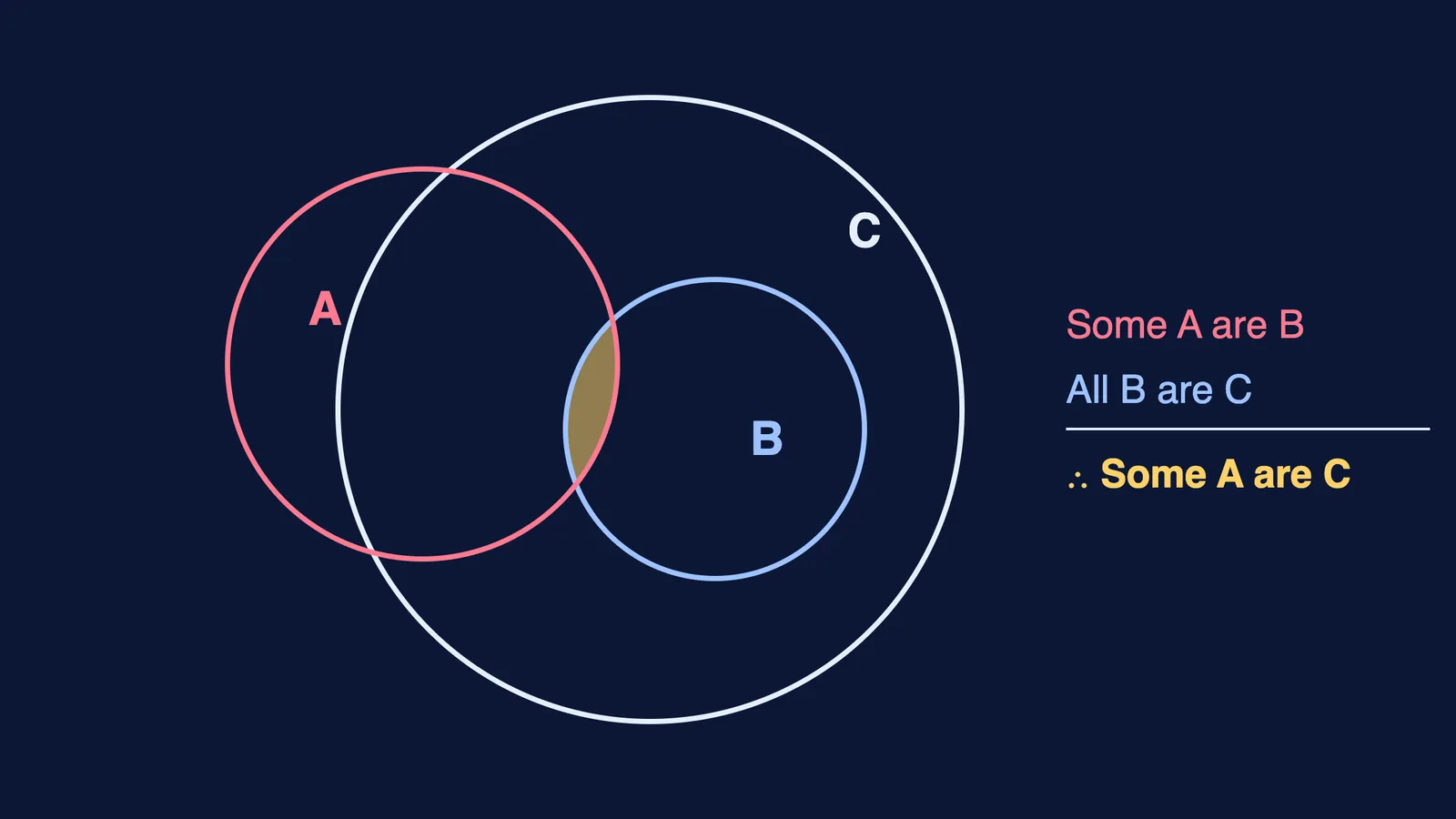
Syllogism. Treat the statements as true even if they sound odd, and draw circles (Euler or Venn diagrams). Example: All traders are taxpayers. Some taxpayers are savers. Conclusion I: Some traders are savers. Conclusion II: Some savers are taxpayers.
Draw the traders circle inside the taxpayers circle.
The savers circle must touch taxpayers, but it can sit entirely in the part outside traders. So I is possible, not certain: it does not follow.
"Some taxpayers are savers" means the two circles overlap, and overlap works both ways. So II follows.
Answer: only II follows. The book's worked examples also read "All X are Y" as giving "some Y are X", which assumes every group has members. The circle trick has a long history; our piece on John Venn and his diagrams tells it.
Blood relations. Draw a family tree, one generation per row, and mark M or F. Example: Pointing to a girl, Neha said, "She is the only daughter of my father's only son." Neha is a woman, so her father's only son is her brother. His daughter is Neha's niece. Answer: the girl is Neha's niece.
Coding-decoding. Test one rule at a time: shifts, reversed order, letter positions.
Letter shift: if PROFIT is written QSPGJU, each letter moves one place forward, so LOSS becomes MPTT.
Reverse positions: count Z as 1 and A as 26. T is 7, A is 26 and X is 3, so a code that adds them turns TAX into 7 + 26 + 3 = 36.
We checked every answer by hand and with a short Python script that tests each syllogism against every possible circle arrangement.
Practice questions
These are our own, and the mark labels are our suggestion, not CBSE's.
(1 mark) Find the odd man out: 27, 64, 125, 200, 343.
(1 mark) If BANK is coded DCPM, how is CASH coded?
(2 marks) Statements: Some receipts are bills. No bill is a coupon. Conclusions: I. Some receipts are not coupons. II. No receipt is a coupon. Which follow?
(2 marks) Using Z = 1 and A = 26, and adding the values, find the code for FEE.
(3 marks) Pointing to a man, Ravi said, "His mother is the only daughter of my mother." Ravi is male. How is the man related to Ravi? Draw the tree.
Answers: 1. 200 (the rest are 3³, 4³, 5³ and 7³). 2. ECUJ. 3. Only I: receipts that are bills cannot be coupons, but other receipts could be. 4. 21 + 22 + 22 = 65. 5. Ravi's mother's only daughter is Ravi's sister, so the man is her son: Ravi's nephew, and Ravi is his maternal uncle.
For more syllogism puzzles, see our piece on Lewis Carroll's logic games.
Stuck on a conclusion that looks right but does not follow? Fermi's AI tutor holds a line of reasoning across a whole session, notices where a student is stuck, and decides whether to explain, ask, or show.