On this page
Projectile motion and relative velocity sit in the Kinematics unit of both the NTA's syllabus for JEE (Main) and the NMC's updated syllabus for NEET (UG) 2026. Below are eight frequent slips, each with the wrong working, why it fails, a fix on fresh numbers, and a habit that stops it. Take g = 10 m/s² and ignore air resistance throughout.
Sign conventions and distance versus displacement are not repeated here. New to the chapter? Read the Kinematics guide for NEET or the Kinematics guide for JEE Main first.
Why do projectile formulas fail when the ball is launched from a height?
Using R = u² sin 2θ / g when the ball lands lower than it started
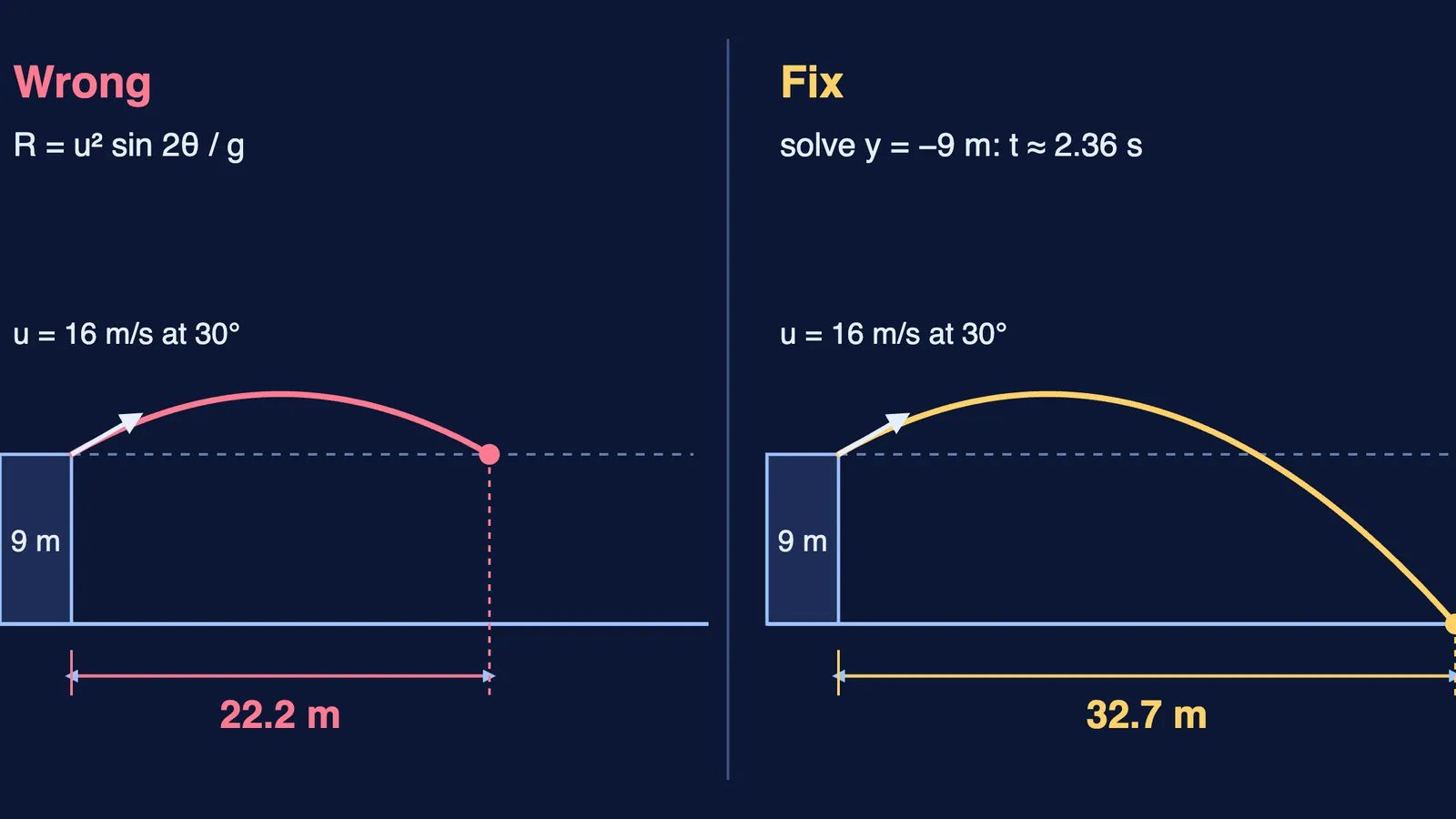
Wrong: a stone leaves a 9 m ledge at 16 m/s, 30° above the horizontal. R = 256 × sin 60° / 10 ≈ 22.2 m.
Why it fails: the shortcuts T = 2u sin θ / g and R = u² sin 2θ / g come from setting the final height equal to the launch height, as the derivation in NCERT Class 11, Chapter 3 shows. Here the stone falls 9 m further.
Fix: uₓ = 16 cos 30° ≈ 13.86 m/s and uᵧ = 8 m/s. With up as positive, −9 = 8t − 5t², so 5t² − 8t − 9 = 0 and t ≈ 2.36 s. Range = 13.86 × 2.36 ≈ 32.7 m, about 10 m more than the shortcut.
Habit: before using T, H or R, ask "does it land at the height it left?"
Assuming 45° always gives the longest range
Wrong: a ball is thrown at 10 m/s from a 15 m wall, so you pick 45° for maximum range.
Why it fails: 45° is the best angle only on level ground. From a height, a flatter throw does better.
Fix: at 45°, the ball lands after about 2.58 s, 18.2 m out. At 30°, it lands after about 2.30 s, 19.9 m out. The best angle here is close to 27°, for a range of 20.0 m.
Habit: treat "45° is best" as a level-ground result, never a general rule.
Putting the horizontal speed into the vertical equation
Wrong: a marble rolls off a 1.8 m shelf at 2.5 m/s. You write 1.8 = 2.5t + 5t², get t = 0.4 s and land it 1.0 m out.
Why it fails: the 2.5 m/s is horizontal. Vertically, the marble starts from rest.
Fix: 1.8 = 5t², so t = 0.6 s. Horizontal distance = 2.5 × 0.6 = 1.5 m, and the vertical speed at landing is 6 m/s.
Habit: write two columns, x and y, and let each number go into one column only.
Which component errors cost marks in projectile questions?
Taking the angle with the vertical as the launch angle
Wrong: a ball is thrown at 18 m/s at 30° to the vertical. H = (18 sin 30°)² / 20 ≈ 4.05 m.
Why it fails: the standard formulas for H, T and R use θ measured from the horizontal. 30° to the vertical is 60° above the horizontal.
Fix: uᵧ = 18 cos 30° ≈ 15.59 m/s, so H = 15.59² / 20 ≈ 12.15 m, three times the wrong value. Time of flight is 2 × 15.59 / 10 ≈ 3.12 s, not 1.8 s.
Habit: redraw the velocity arrow and mark θ from the ground before you resolve it.
Subtracting gt from the speed instead of from the vertical component
Wrong: a ball leaves level ground at 15 m/s with uₓ = 12 m/s and uᵧ = 9 m/s. After 1.5 s you write v = u − gt = 15 − 15 = 0.
Why it fails: gravity acts only on the vertical component.
Fix: vᵧ = 9 − 10 × 1.5 = −6 m/s (now falling) and vₓ stays 12 m/s. Speed = √(12² + 6²) ≈ 13.4 m/s, at about 27° below the horizontal.
Habit: find vₓ and vᵧ separately, then combine them with Pythagoras.
Stuck on why your answer is off? The Fermi Problem Library has worked problems with a step-by-step solver that explains the reasoning rather than printing an answer.
What mistakes do students make in relative velocity?
Subtracting speeds when the velocities are not along one line
Wrong: a car drives north at 14 m/s and a bike rides east at 10 m/s. Relative speed = 14 − 10 = 4 m/s.
Why it fails: relative velocity is a vector difference, v_AB = v_A − v_B. Subtracting speeds works only along one line.
Fix: relative to the bike, the car moves 14 m/s north and 10 m/s west. Relative speed = √(14² + 10²) ≈ 17.2 m/s, at about 35.5° west of north.
Habit: reverse the observer's arrow, then add it head-to-tail to the other arrow.
Measuring the umbrella angle from the wrong line
Wrong: rain falls vertically at 5 m/s and you walk at 3 m/s. You write tan θ = 5/3 and tilt the umbrella 59° from the vertical.
Why it fails: the umbrella should point along the rain's velocity relative to you. Its tilt from the vertical uses the horizontal part over the vertical part.
Fix: relative to you, the rain has 3 m/s backwards and 5 m/s down. tan θ = 3/5, so θ ≈ 31° from the vertical, tilted forward, in the direction you walk.
Habit: say which line θ is measured from before you write tan θ.
Using the resultant speed to find the crossing time
Wrong: a boat heads straight across an 80 m river at 2.5 m/s relative to the water, in a 1.5 m/s current. t = 80 / √(2.5² + 1.5²) ≈ 27.4 s.
Why it fails: the current runs parallel to the banks, so it only carries the boat downstream. Our post on crossing a river in the shortest time works through the drift.
Fix: t = 80 / 2.5 = 32 s. Drift = 1.5 × 32 = 48 m downstream.
Habit: divide the width by the velocity component across the river, and nothing else.
A 60-second self-check before you mark
If an answer fails one question, you know which line to rewrite.