On this page
This glossary follows the NCERT Class 12 Mathematics Probability chapter (Reprint 2026-27) and the CBSE Mathematics curriculum for 2026-27, whose Unit VI lists conditional probability, the multiplication theorem, independent events, total probability and Bayes' theorem. Random variables, probability distributions with their mean and variance, Bernoulli trials and the binomial distribution are not in that unit, so they are left out here; the reprint keeps only a remark defining a random variable. For board-answer layout, see our Probability Class 12 board exam guide.
Which Class 11 words does this chapter build on?
Random experiment: an action with several possible outcomes that cannot be predicted in advance, such as tossing three coins.
Sample space (S): the set of all possible outcomes. Example: one die gives S = {1, 2, 3, 4, 5, 6}.
Event: any subset of S, such as "even" = {2, 4, 6}; a one-outcome event like {5} is an elementary event.
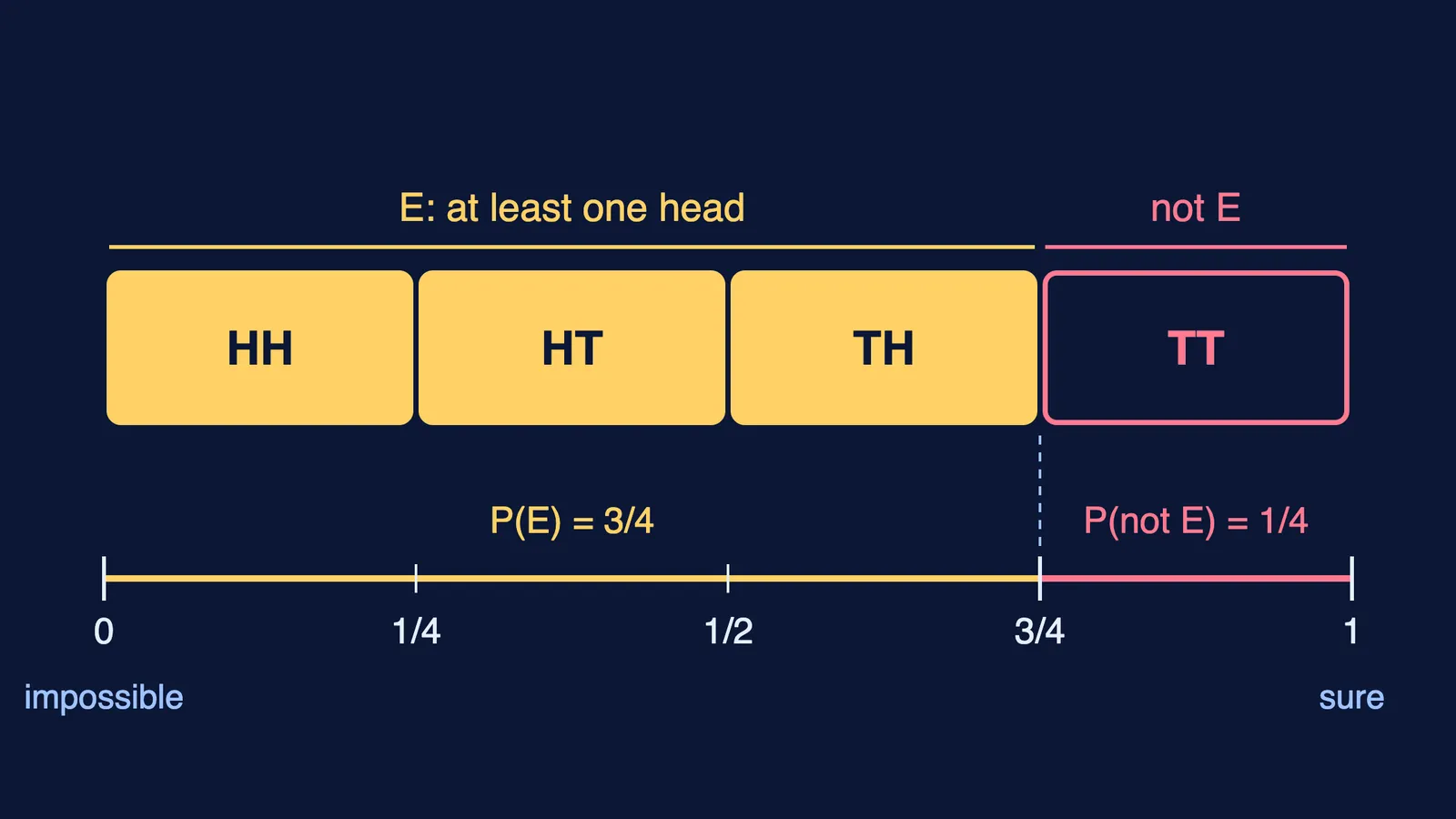
Complement (E′): the outcomes of S not in E, so P(E′) = 1 − P(E). Example: "even" has complement {1, 3, 5}.
E ∩ F (also written EF): the event that E and F both occur. Example: "even" and "greater than 3" gives {4, 6}.
Mutually exclusive (disjoint) events: events with no common outcome, so E ∩ F = φ. Example: {1, 2} and {5, 6}.
Exhaustive events: events whose union is S. Example: "at most 3" and "at least 3". Don't confuse with: mutually exclusive; these two share the outcome 3.
Equally likely outcomes: outcomes with the same probability, as on a fair die. Counter-example: with two dice, P(sum 2) = 1/36 but P(sum 7) = 6/36.
Shaky? Revise sample space and types of events from Class 11 first.
What does conditional probability mean?
Conditional probability P(E|F): the probability of E once you know F has happened: P(E|F) = P(E ∩ F) / P(F), defined only when P(F) ≠ 0. Example: on a die, P(6 | even) = (1/6) ÷ (1/2) = 1/3.
F as the new sample space: knowing F occurred, you count only outcomes inside F. Example: given "even", one of {2, 4, 6} is 6.
Properties of P(E|F): P(S|F) = P(F|F) = 1, 0 ≤ P(E|F) ≤ 1, and P(E′|F) = 1 − P(E|F). Example: P(not 6 | even) = 2/3.
Conditional addition rule: P((A ∪ B)|F) = P(A|F) + P(B|F) − P((A ∩ B)|F); the last term is 0 for disjoint A and B.
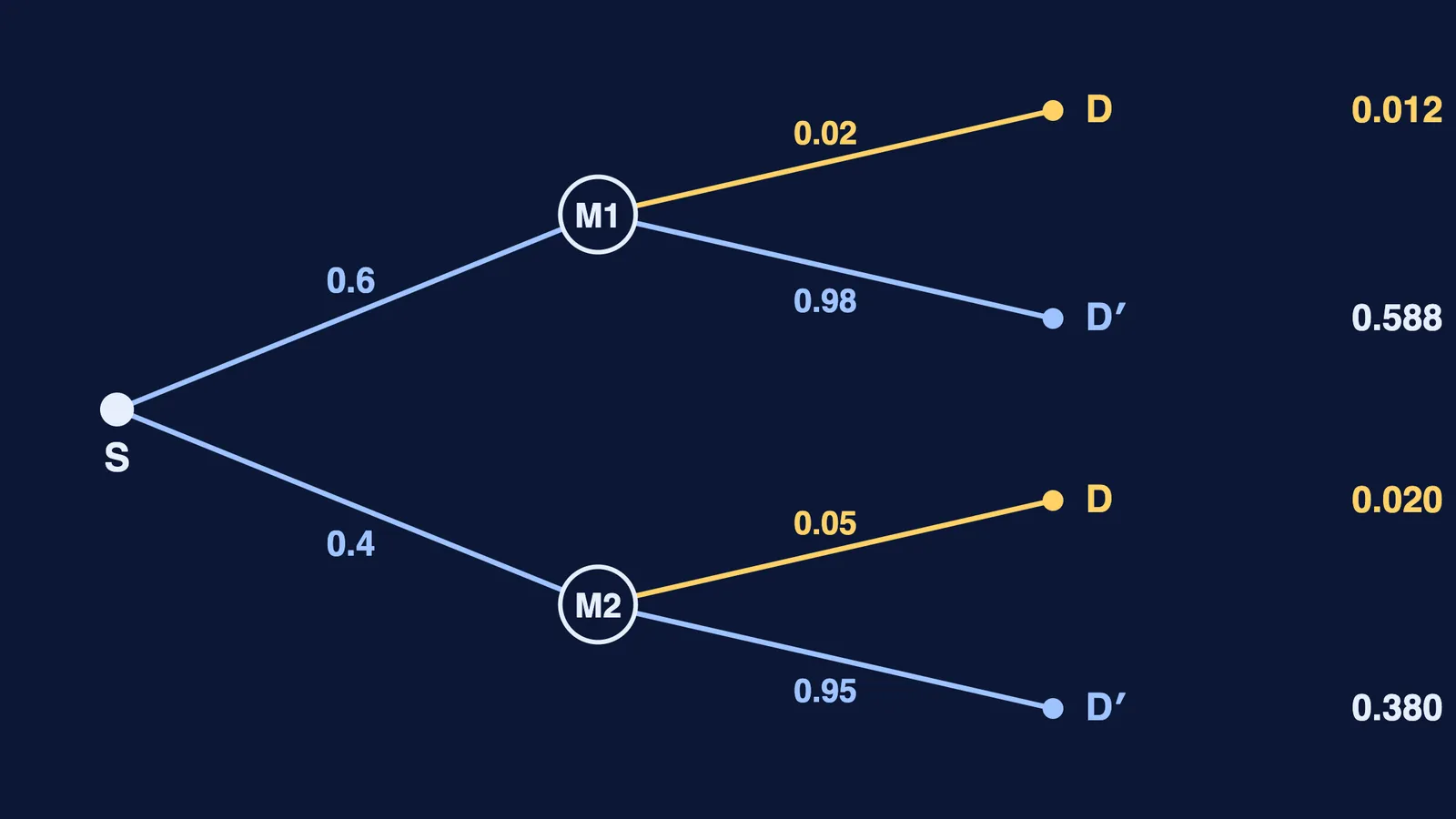
Tree diagram: a multi-stage experiment drawn as branches, each carrying a probability; multiply along a path to get that path's probability.
Don't confuse P(E|F) with P(F|E). Example: P(even | 6) = 1, but P(6 | even) = 1/3.
What is the multiplication theorem?
Multiplication rule: P(E ∩ F) = P(E) P(F|E) when P(E) ≠ 0, or P(F) P(E|F) when P(F) ≠ 0. Example: from 3 red and 2 blue balls, drawing two without replacement, P(both red) = 3/5 × 2/4 = 3/10.
Multiplication rule for three events: P(E ∩ F ∩ G) = P(E) P(F|E) P(G|E ∩ F). Example: three kings in three draws without replacement: 4/52 × 3/51 × 2/50 = 1/5525.
Without vs with replacement: without replacement the second draw depends on the first; with replacement it does not, so P(both red) = 3/5 × 3/5 = 9/25.
How are independent events different from mutually exclusive events?
Independent events: one occurring does not change the other's probability, so P(E ∩ F) = P(E) P(F). Example: on a die, "even" and {1, 2} give P({2}) = 1/6 = 1/2 × 1/3, so they are independent.
Dependent events: events that are not independent. Example: "even" and "at most 3" give 1/6, not 1/4.
Don't confuse independent with mutually exclusive: independence concerns probabilities, exclusivity concerns shared outcomes; events with non-zero probabilities cannot be both.
Complements of independent events: if E and F are independent, so are E and F′, E′ and F, and E′ and F′. Example: P(neither) = P(E′) P(F′).
Independent experiments: every event of one experiment multiplies with every event of the other. Example: coin and die, P(head and 6) = 1/12.
Mutually independent (three events): every pair multiplies and P(A ∩ B ∩ C) = P(A) P(B) P(C). Counter-example: toss two coins; A = first head, B = second head, C = both alike. Each pair gives 1/4, but P(A ∩ B ∩ C) = 1/4, not 1/8.
What do total probability and Bayes' theorem mean?
Partition of S: events E1, ..., En that are pairwise disjoint, together make up S, and each have non-zero probability. Example: {1, 2}, {3, 4}, {5, 6}.
Theorem of total probability: for a partition E1, ..., En and any event A, P(A) = P(E1) P(A|E1) + ... + P(En) P(A|En). Example: M1 makes 60% of bolts, 2% defective; M2 makes 40%, 5% defective; P(defective) = 0.012 + 0.020 = 0.032.
Bayes' theorem (the formula for the probability of "causes"): for such a partition and P(A) ≠ 0, P(Ei|A) = P(Ei) P(A|Ei) divided by the total-probability sum. Example: P(M2 | defective) = 0.020 ÷ 0.032 = 5/8.
Hypotheses: the partition events Ei, here "made by M1" and "made by M2".
Prior (a priori) probability: P(Ei), known before the result; here 0.6 and 0.4.
Posterior (a posteriori) probability: P(Ei|A), updated after A is seen; here 3/8 and 5/8, which still add to 1.
Don't confuse total probability with Bayes: the first gives P(A); Bayes divides one branch by that total.
How to learn these terms
Learn in pairs: exclusive vs exhaustive, exclusive vs independent, P(E|F) vs P(F|E), prior vs posterior.
Write each condition with its formula: P(F) ≠ 0 for P(E|F), non-zero probabilities for a partition.
Draw a tree for every Bayes problem and mark the leaves that make up A.
Test independence with numbers, not by feel: check whether P(E ∩ F) equals P(E) P(F).
Keep one small example per term, and check yourself against common probability reasoning mistakes. If a term needs a longer explanation, the Fermi Concept Library gives every mathematics concept its own lesson.