On this page
This sheet covers Chapter 13, Probability, of the NCERT Class 12 Mathematics Part II textbook in its Reprint 2026-27 edition. The CBSE 2026-27 Mathematics syllabus lists five topics for this unit: conditional probability, the multiplication theorem, independent events, total probability and Bayes' theorem. The 2026-27 chapter has no sections on probability distributions, mean, variance or the binomial distribution (random variables appear only in a short closing remark), and the syllabus does not list them, so they are left out here.
Symbols used throughout: S is the sample space, E, F, G, A and B are events in S, E′ is the complement of E (E does not happen), E ∩ F means both happen, E ∪ F means at least one happens, and P(E|F) is the probability of E given that F has happened.
What is the formula for conditional probability?
Definition: P(E|F) = P(E ∩ F) / P(F), valid only when P(F) ≠ 0.
Equally likely outcomes: P(E|F) = n(E ∩ F) / n(F), where n counts outcomes, again with F non-empty.
Range: 0 ≤ P(E|F) ≤ 1.
Property 1: P(S|F) = P(F|F) = 1.
Property 2: P((A ∪ B)|F) = P(A|F) + P(B|F) − P((A ∩ B)|F), for any events A and B with P(F) ≠ 0.
If A and B are disjoint: P((A ∪ B)|F) = P(A|F) + P(B|F).
Property 3: P(E′|F) = 1 − P(E|F).
Class 11 rules you still need: P(A ∪ B) = P(A) + P(B) − P(A ∩ B) and P(E′) = 1 − P(E). If these feel shaky, our Class 11 guide to events and the 'or' rule goes over them.
Worked example. P(A) = 0.5, P(B) = 0.4 and P(A ∩ B) = 0.15. Then P(A|B) = 0.15 / 0.4 = 0.375, but P(B|A) = 0.15 / 0.5 = 0.3. The complement rule gives P(A′|B) = 1 − 0.375 = 0.625.
Watch for: dividing by the wrong event. The event after the bar ("given that") always goes in the denominator, so P(A|B) and P(B|A) are usually different numbers.
What is the multiplication theorem on probability?
Two events: P(E ∩ F) = P(E) · P(F|E), when P(E) ≠ 0.
Same result the other way: P(E ∩ F) = P(F) · P(E|F), when P(F) ≠ 0.
Three events: P(E ∩ F ∩ G) = P(E) · P(F|E) · P(G|E ∩ F). The same pattern extends to four or more events.
Worked example. A bag holds 6 red and 4 blue balls. Three balls are drawn one after another without replacement. P(all three red) = (6/10) × (5/9) × (4/8) = 120/720 = 1/6.
Watch for: keeping the original counts after each draw. Without replacement, the red count and the total both drop by one at each step.
How do you check if two events are independent?
Definition: E and F are independent if P(E ∩ F) = P(E) · P(F).
Equivalent form: P(E|F) = P(E) when P(F) ≠ 0, and P(F|E) = P(F) when P(E) ≠ 0.
Dependent events: P(E ∩ F) ≠ P(E) · P(F).
If E and F are independent, so are E and F′, E′ and F, and E′ and F′.
At least one of two independent events: P(A ∪ B) = 1 − P(A′) · P(B′).
Three events A, B and C are mutually independent only if all four hold: P(A ∩ B) = P(A)P(B), P(A ∩ C) = P(A)P(C), P(B ∩ C) = P(B)P(C) and P(A ∩ B ∩ C) = P(A)P(B)P(C).
Worked example. Two independent events have P(A) = 0.2 and P(B) = 0.35. Then P(A ∩ B) = 0.07, and P(at least one) = 1 − (0.8)(0.65) = 0.48. The addition rule agrees: 0.2 + 0.35 − 0.07 = 0.48.
Watch for: treating "independent" and "mutually exclusive" as the same thing. The NCERT chapter points out that two events with non-zero probabilities cannot be both: mutually exclusive means P(E ∩ F) = 0, while independence needs P(E ∩ F) = P(E)P(F), which is positive.
What are the total probability and Bayes' theorem formulas?
Partition: events E₁, E₂, …, Eₙ form a partition of S if Eᵢ ∩ Eⱼ = φ for i ≠ j, E₁ ∪ E₂ ∪ … ∪ Eₙ = S, and P(Eᵢ) > 0 for every i. Any event E with 0 < P(E) < 1, together with its complement E′, is a partition.
Theorem of total probability: P(A) = P(E₁)P(A|E₁) + P(E₂)P(A|E₂) + … + P(Eₙ)P(A|Eₙ), for any event A and a partition E₁, …, Eₙ.
Bayes' theorem: P(Eᵢ|A) = P(Eᵢ)P(A|Eᵢ) / [P(E₁)P(A|E₁) + … + P(Eₙ)P(A|Eₙ)], for i = 1, 2, …, n, with P(A) ≠ 0.
Terms: the Eᵢ are hypotheses, P(Eᵢ) are prior probabilities and P(Eᵢ|A) are posterior probabilities.
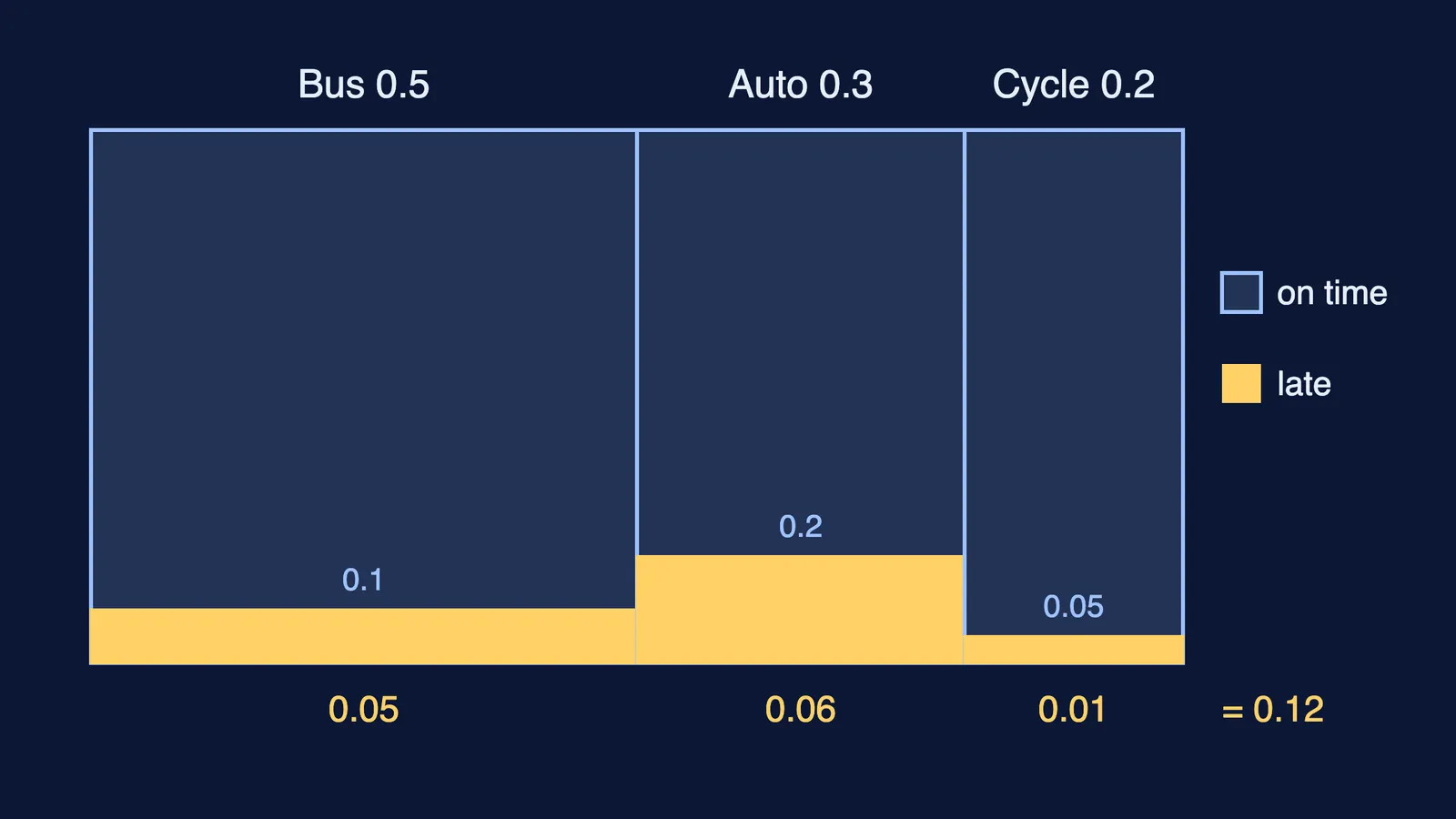
Worked example. A student gets to school by bus, auto or cycle with probabilities 0.5, 0.3 and 0.2. The chance of being late is 0.1 by bus, 0.2 by auto and 0.05 by cycle. By total probability, P(late) = 0.05 + 0.06 + 0.01 = 0.12. If the student was late, Bayes gives P(auto | late) = 0.06 / 0.12 = 0.5, P(bus | late) = 0.05 / 0.12 = 5/12 and P(cycle | late) = 0.01 / 0.12 = 1/12.
Watch for: using only the given P(A|Eᵢ) as the answer. A Bayes question asks for P(Eᵢ|A), the reverse direction, and it needs the prior weights and the full denominator.
How to revise this formula sheet
Write every formula with its condition, such as P(F) ≠ 0 or "partition".
For each Bayes question, draw the tree first: priors on the first branches, P(A|Eᵢ) on the second, then multiply along each path.
Test independence by computing P(E ∩ F) and P(E)P(F) separately and comparing, instead of guessing from the story.
Redo the worked examples above with your own numbers and check that the posteriors sum to 1.
Read the Probability Class 12 board exam guide for how answers are set out, and our list of common probability reasoning mistakes to test yourself on traps.
If a problem keeps going wrong at the same step, the Fermi Problem Library has worked problems with a step-by-step solver that explains the reasoning rather than printing an answer.