On this page
Every formula below comes from Chapter 14, Probability, of the rationalised NCERT Class 11 Mathematics textbook (2026-27 reprint), and the topics match the Probability entry in the CBSE Class XI Mathematics syllabus for 2026-27. Conditional probability, independent events and Bayes' theorem are in the Class XII syllabus, not this chapter.
Symbols: S is the sample space of an experiment, A, B, C and E are events, ω (omega) is one outcome, n(A) is the number of outcomes in A, and φ is the empty set.
How are events written as sets?
In NCERT's words, any subset E of a sample space S is called an event (NCERT Chapter 14, section 14.1).
Impossible event: φ. Sure event: S.
Not A (complement): A′ = S − A, the outcomes of S that are not in A.
A or B: A ∪ B, outcomes in A, in B, or in both.
A and B: A ∩ B, outcomes in both.
A but not B: A − B = A ∩ B′.
Mutually exclusive: A ∩ B = φ (they cannot happen together).
Exhaustive: E₁ ∪ E₂ ∪ ... ∪ Eₙ = S (at least one must happen).
Mutually exclusive and exhaustive: the union is S and Eᵢ ∩ Eⱼ = φ for every i ≠ j.
Worked example: a card is drawn from 12 cards numbered 1 to 12. Let A = "multiple of 3" = {3, 6, 9, 12} and B = "even" = {2, 4, 6, 8, 10, 12}. Then A ∪ B = {2, 3, 4, 6, 8, 9, 10, 12}, A ∩ B = {6, 12}, A − B = {3, 9} and A′ = {1, 2, 4, 5, 7, 8, 10, 11}.
Watch for: "A or B" includes outcomes in both; reading it as "exactly one" drops 6 and 12 here.
What are the axioms of probability?
NCERT defines P as a function on the events of S, with values in [0, 1], satisfying three axioms (NCERT section 14.2):
Axiom 1: P(E) ≥ 0 for any event E.
Axiom 2: P(S) = 1.
Axiom 3: if E and F are mutually exclusive, P(E ∪ F) = P(E) + P(F).
Consequence: P(φ) = 0.
For S = {ω₁, ω₂, ..., ωₙ}: 0 ≤ P(ωᵢ) ≤ 1 for each i, and P(ω₁) + P(ω₂) + ... + P(ωₙ) = 1.
For any event A: P(A) = sum of P(ωᵢ) over all ωᵢ in A.
Worked example: S = {ω₁, ω₂, ω₃, ω₄}. The assignment 1/5, 1/10, 3/10, 2/5 is valid: each value lies in [0, 1] and they add to 1, so P({ω₁, ω₃}) = 1/5 + 3/10 = 1/2. The assignment 1/2, 1/4, 1/4, 1/8 is not valid, because the sum is 9/8. The assignment 3/5, 1/2, −1/10, 0 adds to 1 but fails because one value is negative.
Watch for: checking only the sum. Every value must also lie between 0 and 1.
How do you find probability when outcomes are equally likely?
Each outcome: P(ωᵢ) = 1/n, where n = n(S).
Any event: P(E) = n(E)/n(S) = (number of outcomes favourable to E) / (total possible outcomes).
Condition: S is finite and every outcome is equally likely (NCERT section 14.2.2).
Counting often uses combinations from the Permutations and Combinations chapter: ⁿCᵣ = n! / (r! (n − r)!) is the number of ways to choose r objects from n when order does not matter.
Worked example: three cards are drawn together from 10 cards numbered 1 to 10. Find P(all three are even). n(S) = ¹⁰C₃ = 120 and n(E) = ⁵C₃ = 10, so P(E) = 10/120 = 1/12.
Watch for: counting S and E in different ways. If S counts unordered selections (combinations), E must too.
How do you find P(A or B), P(not A) and P(A but not B)?
All of these follow from the axioms. The two-event addition rule, the mutually exclusive case and P(not A) are stated in NCERT sections 14.2.3 and 14.2.4 and the chapter Summary, and the three-event rule is proved there as Example 11. The last three lines below are short consequences of the same set algebra (A = (A − B) ∪ (A ∩ B), with the two parts mutually exclusive).
Addition rule, any two events: P(A ∪ B) = P(A) + P(B) − P(A ∩ B).
Mutually exclusive events (A ∩ B = φ): P(A ∪ B) = P(A) + P(B).
Three events: P(A ∪ B ∪ C) = P(A) + P(B) + P(C) − P(A ∩ B) − P(A ∩ C) − P(B ∩ C) + P(A ∩ B ∩ C).
Not A: P(A′) = 1 − P(A).
A but not B: P(A − B) = P(A ∩ B′) = P(A) − P(A ∩ B).
Neither A nor B: P(A′ ∩ B′) = 1 − P(A ∪ B).
Exactly one of A, B: P(A) + P(B) − 2P(A ∩ B).
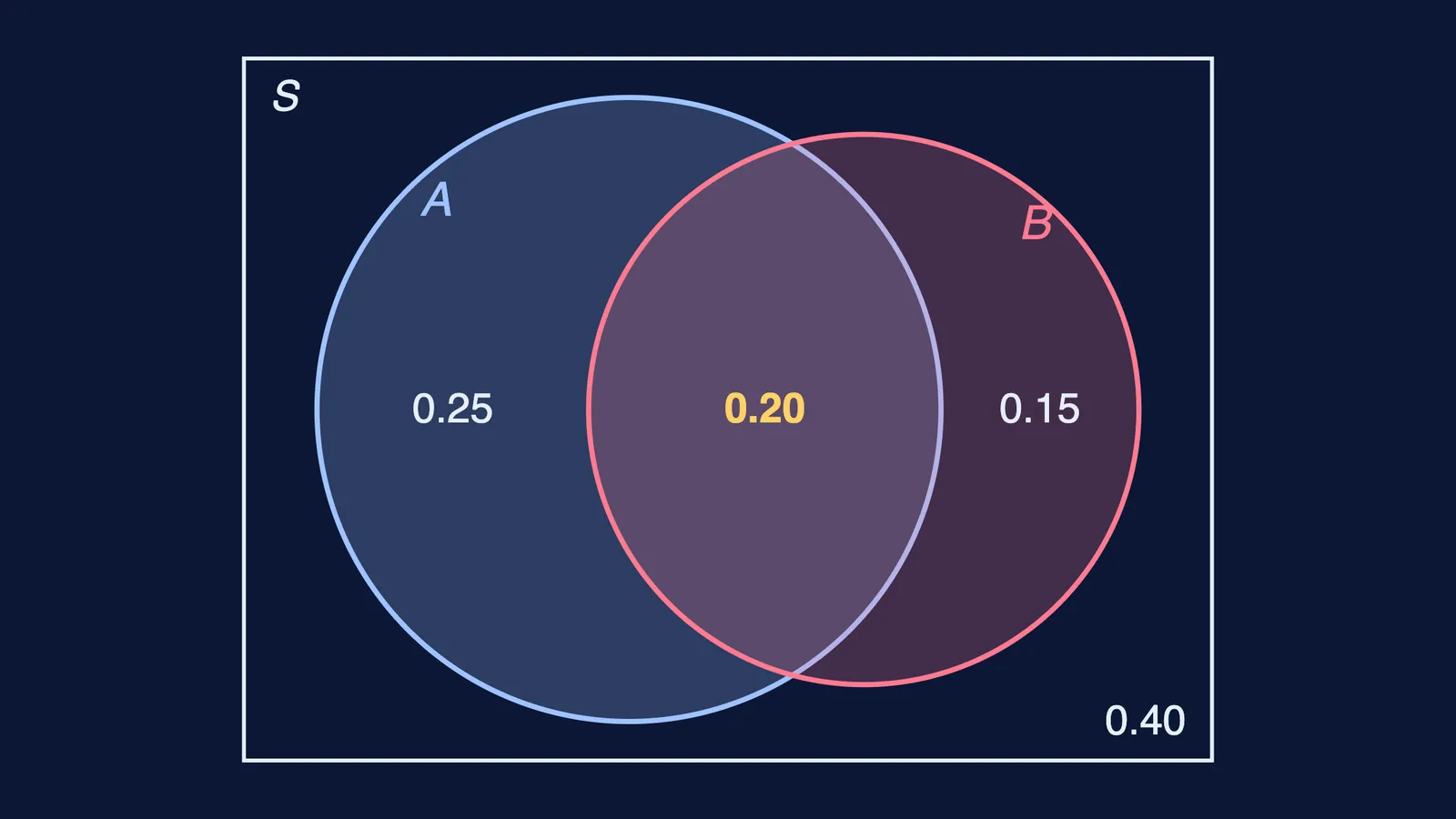
Worked example: P(A) = 0.45, P(B) = 0.35 and P(A ∪ B) = 0.6. Rearranging the addition rule, P(A ∩ B) = 0.45 + 0.35 − 0.6 = 0.20. Then P(A but not B) = 0.45 − 0.20 = 0.25, P(B but not A) = 0.15, and P(neither) = 1 − 0.6 = 0.40. The hero diagram draws these regions to scale.
Watch for: adding P(A) + P(B) for overlapping events. Use that shortcut only once you have shown A ∩ B = φ. If you keep picking the wrong rule, the Fermi Problem Library has worked problems with a step-by-step solver that explains the reasoning rather than printing an answer.
How to revise this formula sheet
Derive P(φ) = 0, P(A′) = 1 − P(A) and the addition rule from the axioms yourself once.
Fill a Venn diagram "both" first, then the "only" regions, then "neither", and check they add to 1.
Translate words into sets before using numbers: "at least one" means a union, "both" an intersection, "not" a complement.
Practise mixed questions with the Probability Class 11 case study questions with answers and test the theory with the Probability Class 11 assertion-reason questions.
For the chapter explained topic by topic, read our Probability Class 11 maths guide on events, axioms and the 'or' rule.