On this page
Ten original questions on Class 11 Probability, aimed at common mix-ups: event types, mutually exclusive versus exhaustive, the axioms and the "or" rule. They are practice items, not a forecast of any paper.
How do you answer assertion-reason questions in probability?
Every item stays inside the CBSE 2026-27 Mathematics syllabus and the NCERT Class 11 Probability chapter (Reprint 2026-27).
Keys for Q1 to Q6:
(A) Both A and R are true and R is the correct explanation of A.
(B) Both A and R are true but R is NOT the correct explanation of A.
(C) A is true but R is false.
(D) A is false but R is true.
Keys for Q7 to Q10:
(A) Both statements are correct.
(B) Both statements are incorrect.
(C) Statement I is correct, Statement II is incorrect.
(D) Statement I is incorrect, Statement II is correct.
Judge each statement alone first; only then ask whether R is the rule that makes A true. More in our assertion-reason strategy guide.
Assertion-reason questions with answers
Q1 (easy). A die is thrown. Assertion (A): The event "a number greater than 6 appears" is an impossible event. Reason (R): An event that contains no sample point is the empty set φ, which is called the impossible event.
Answer: (A). No face shows more than 6, so the event is φ. R is the NCERT definition that makes A true.
Trap: calling it a "simple event" because it sounds small.
Q2 (easy). Two coins are tossed, S = {HH, HT, TH, TT}. Assertion (A): The event "at least one head" is a compound event. Reason (R): This experiment has exactly four simple events.
Answer: (B). "At least one head" is {HH, HT, TH}, more than one sample point, so A is true. R is true too ({HH}, {HT}, {TH}, {TT}), but it counts simple events and does not explain why this event is compound.
Trap: picking (A) because R sounds related.
Q3 (medium). A die is thrown. E: a prime number appears. F: a multiple of 4 appears. Assertion (A): E and F are mutually exclusive. Reason (R): Two events are mutually exclusive if their union is the whole sample space.
Answer: (C). E = {2, 3, 5} and F = {4}, so E ∩ F = φ and A is true. R describes exhaustive events instead.
Trap: swapping the meanings of "mutually exclusive" and "exhaustive".
Q4 (medium). Assertion (A): If P(A) = 0.55, P(B) = 0.35 and P(A ∩ B) = 0.15, then P(A or B) = 0.9. Reason (R): For any two events, P(A ∪ B) = P(A) + P(B) − P(A ∩ B).
Answer: (D). R is the NCERT "or" rule, and it gives 0.55 + 0.35 − 0.15 = 0.75, so A is false.
Trap: ignoring the overlap.
Q5 (hard). S = {ω1, ω2, ω3}. Assertion (A): The assignment P(ω1) = 0.5, P(ω2) = 0.6, P(ω3) = −0.1 is not a valid probability assignment. Reason (R): Under the axiomatic approach, each P(ωi) must lie between 0 and 1, and the P(ωi) must add up to 1.
Answer: (A). The values add up to 1, but −0.1 is below 0, so the first condition fails. R states the conditions that make A true.
Trap: checking only the sum.
Q6 (hard). Assertion (A): If P(A) = 0.6 and P(B) = 0.7, then A and B cannot be mutually exclusive. Reason (R): If A and B are mutually exclusive, then P(A) + P(B) = 1.
Answer: (C). If they were mutually exclusive, P(A ∪ B) would be 0.6 + 0.7 = 1.3, which is more than 1, so A is true. R is false: that sum needs the events to be exhaustive too; getting a 1 and getting a 2 on a die are mutually exclusive, with total 1/3.
Trap: treating "mutually exclusive" as "mutually exclusive and exhaustive".
Statement I and Statement II questions with answers
Q7 (medium). A card is drawn from a well-shuffled pack of 52. Statement I: P(a king or a heart) = 17/52. Statement II: P(a red face card) = 3/26.
Answer: (D). With the king of hearts counted once, it is (4 + 13 − 1)/52 = 4/13. There are 6 red face cards, and 6/52 = 3/26.
Trap: counting the king of hearts twice.
Q8 (medium). Statement I: If E1, E2 and E3 are mutually exclusive and exhaustive, then P(E1) + P(E2) + P(E3) = 1. Statement II: Any two exhaustive events are mutually exclusive.
Answer: (C). Statement I follows from the axioms, since the events are disjoint and their union is S. Statement II fails on a die: {1, 2, 3, 4} and {3, 4, 5, 6} cover S but share 3 and 4.
Trap: reading "covers everything" as "no overlap".
Q9 (hard). P(A) = 0.6, P(B) = 0.45 and P(A ∩ B) = 0.25. Statement I: P(A and not B) = 0.35. Statement II: P(exactly one of A and B occurs) = 0.55.
Answer: (A). P(A − B) = 0.6 − 0.25 = 0.35. P(B − A) = 0.45 − 0.25 = 0.20, so exactly one has probability 0.35 + 0.20 = 0.55.
Trap: giving P(A ∪ B) = 0.8, which also counts both.
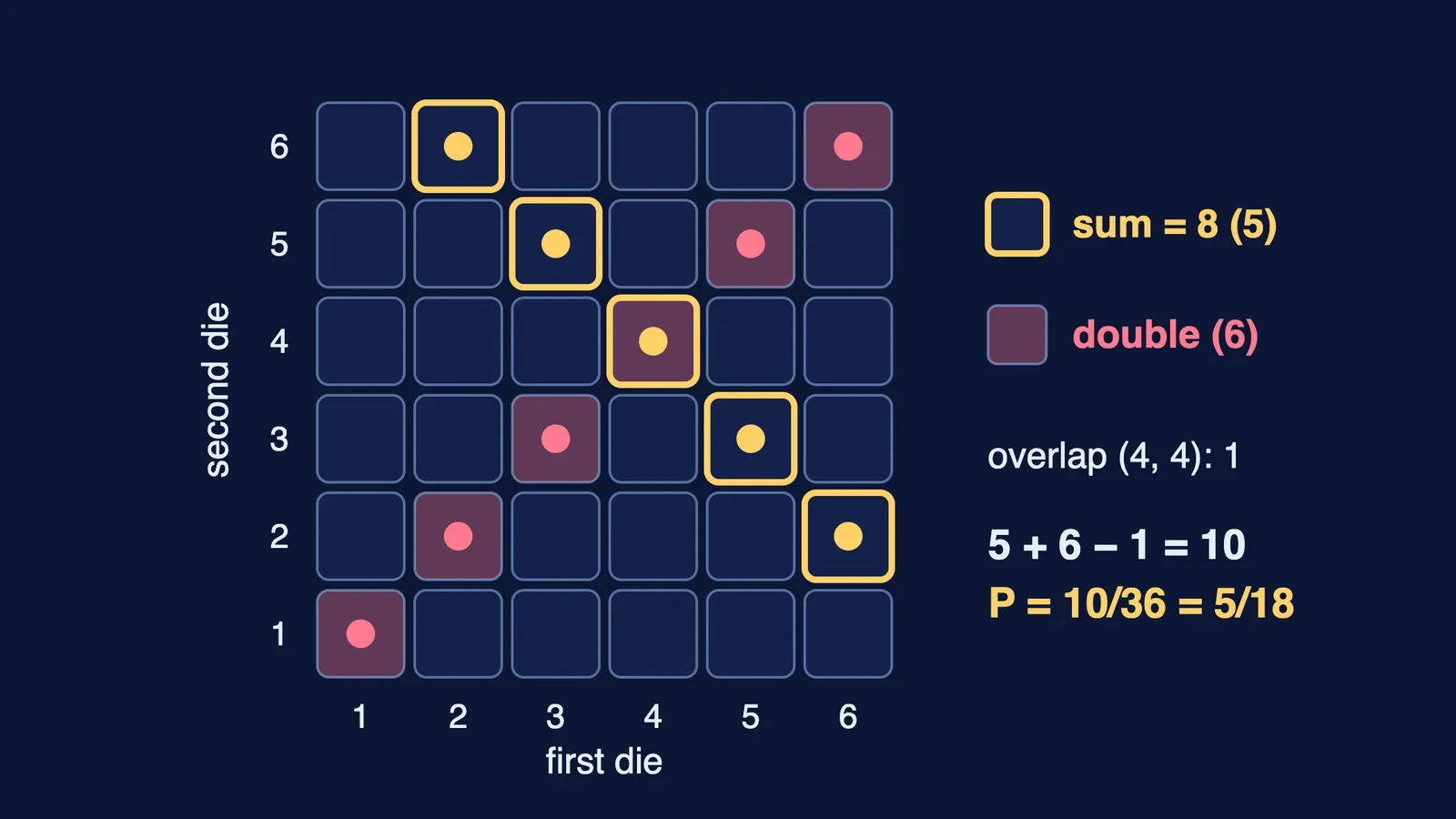
Q10 (hard). Two dice are thrown. Statement I: P(the sum is 8 or a double appears) = 11/36. Statement II: P(at least one six) = 1/3.
Answer: (B). Sum 8 has 5 outcomes and doubles have 6, but (4, 4) is in both, so the event has 10 outcomes: 10/36 = 5/18. At least one six has 11 outcomes, so 11/36, not 1/6 + 1/6.
Trap: adding without removing the shared outcome.
How should you use this set?
Cover the answers; mark each statement true or false first.
For every (A) or (B), write the definition or rule that links R to A, or "no rule".
For every false statement, write the counter-example or the corrected number.
Redo misses two days later.
For the full chapter, read our Probability Class 11 maths guide and our post on sample space and types of events. If you got a key right but cannot say why, the Fermi Concept Library has a lesson for every concept in mathematics, each with its place in the map.