On this page
Price elasticity of demand tells you how strongly buyers react to a price change. It is easiest to learn through one worked numerical, so this guide builds one from scratch.
What does the 2026-27 CBSE syllabus include?
The CBSE Economics curriculum for 2026-27 places price elasticity of demand inside Unit 5, "Consumer's Equilibrium and Demand", which carries 14 marks in the Class 11 theory paper.
It lists the factors affecting elasticity and its measurement by the "percentage-change method and total expenditure method". The geometric method is not named, though the NCERT chapter still shows it.
The textbook is NCERT Introductory Microeconomics, Chapter 2, Theory of Consumer Behaviour, section 2.6 (Reprint 2026-27).
What is price elasticity of demand?
In NCERT's definition (Chapter 2), price elasticity of demand is the percentage change in quantity demanded, measured against the percentage change in price that caused it.
The raw answer is negative because price and quantity move in opposite directions; NCERT uses the absolute value. Read it like this:
e > 1: elastic demand. Quantity changes by a larger percentage than price.
e < 1: inelastic demand. Quantity changes by a smaller percentage than price.
e = 1: unitary elastic demand.
How do you calculate price elasticity of demand?
Use the percentage-change method, with the original price and quantity as the base:
e = (percentage change in quantity) / (percentage change in price) = (ΔQ / Q1) × (P1 / ΔP)
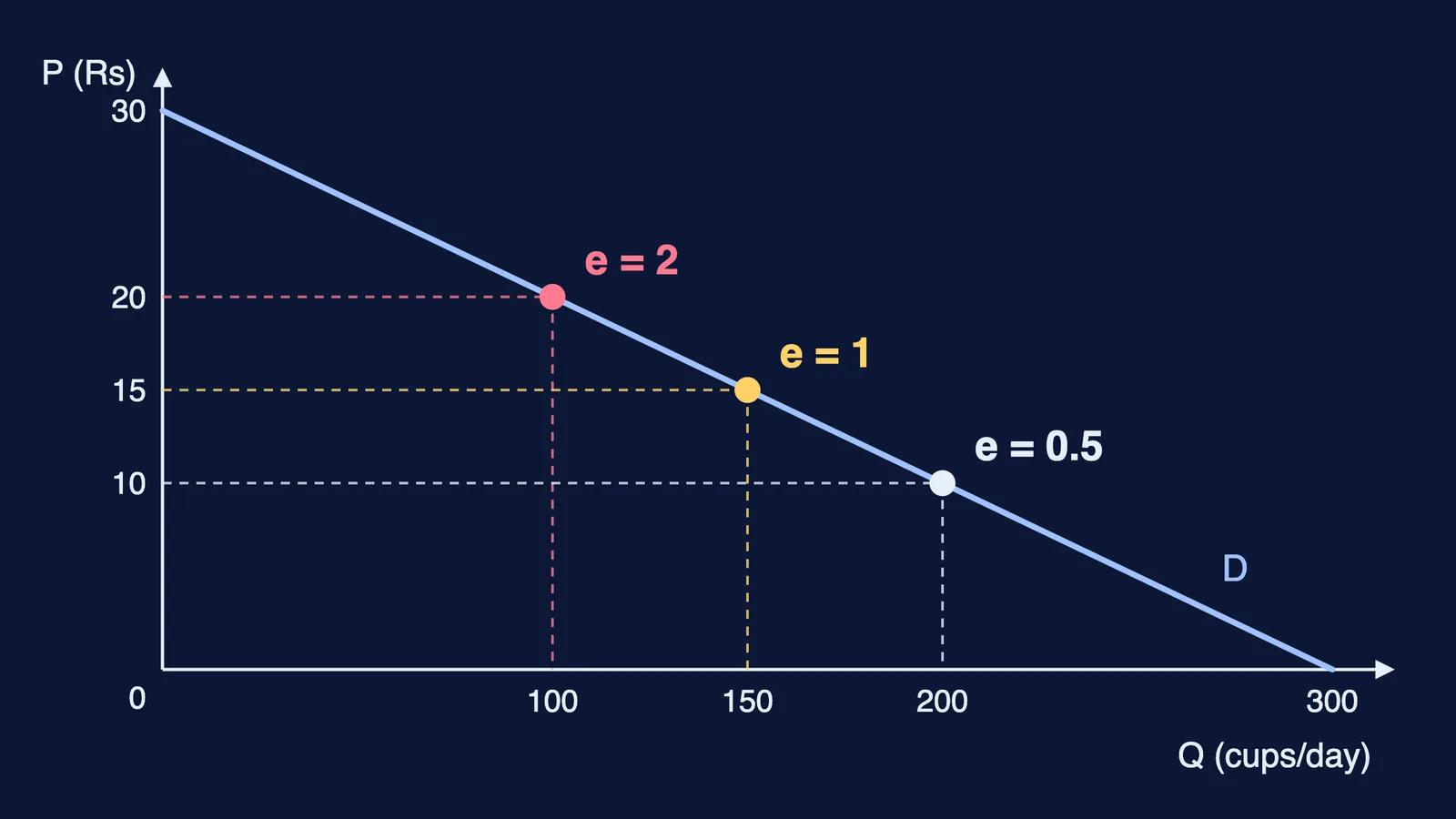
An original example: a school canteen's daily demand for cold coffee is Q = 300 - 10P, with P in rupees and Q in cups (a made-up schedule).
Case A: price cut from Rs 20 to Rs 15
Quantities: at Rs 20, Q = 300 - 200 = 100 cups; at Rs 15, Q = 300 - 150 = 150 cups.
Percentage change in quantity = (150 - 100) / 100 × 100 = 50%.
Percentage change in price = (15 - 20) / 20 × 100 = -25%.
e = 50 / 25 = 2 (absolute value). Demand is elastic at Rs 20.
Case B: price rise from Rs 10 to Rs 12
Quantities: at Rs 10, Q = 200 cups; at Rs 12, Q = 180 cups.
Percentage change in quantity = (180 - 200) / 200 × 100 = -10%.
Percentage change in price = (12 - 10) / 10 × 100 = 20%.
e = 10 / 20 = 0.5. Demand is inelastic at Rs 10.
Same straight-line curve, two different elasticities. As NCERT section 2.6.1 shows, elasticity changes along a linear demand curve and equals 1 at its midpoint: here Rs 15 and 150 cups.
How is elasticity linked to total expenditure?
Total expenditure is price times quantity. NCERT's rule (section 2.6.3): if expenditure moves opposite to price, demand is elastic; in the same direction, inelastic; unchanged, unitary elastic.
Check the canteen:
Case A: price falls, spending rises from Rs 2,000 (20 × 100) to Rs 2,250 (15 × 150). Elastic, matching e = 2.
Case B: price rises, spending rises from Rs 2,000 (10 × 200) to Rs 2,160 (12 × 180). Inelastic, matching e = 0.5.
Spending is highest at the midpoint price of Rs 15, where e = 1.
What factors affect price elasticity of demand?
NCERT names two main factors (Chapter 2, section 2.6.2):
Nature of the good. Demand for necessities such as food tends to be inelastic; demand for luxuries tends to be elastic.
Close substitutes. Food as a whole is inelastic, but one variety of pulses can be elastic, because buyers can switch to another variety when its price rises.
What mistakes cost marks in elasticity numericals?
Using the new values as the base. Start from the original price and quantity, as NCERT does.
Dropping the percentage on one side. Divide percentage by percentage, never a change in quantity by a percentage change in price.
Judging elasticity by slope alone. A straight line has one slope, but its elasticity varies from point to point.
Skipping the conclusion. End with "demand is elastic (or inelastic) at this price".
If your method keeps slipping, the Fermi Problem Library has worked problems with a step-by-step solver that explains the reasoning rather than printing an answer.
Elasticity builds on the demand curve, which comes from the consumer choices in consumer equilibrium with utility analysis and indifference curves and the budget line. Next, see the supply side in law of supply and market equilibrium; the syllabus measures price elasticity of supply by the same percentage-change method.