

On this page
Consumer equilibrium is one of the first models you meet in Class 11 economics. The idea is simple: a buyer keeps buying while the next unit is worth at least as much to them as it costs. The CBSE Economics curriculum for 2026-27 gives the Consumer's Equilibrium and Demand unit 14 marks out of 80 in the Class XI theory paper, and names "conditions of consumer's equilibrium using marginal utility analysis" in the unit.
What are total utility and marginal utility?
NCERT's chapter Theory of Consumer Behaviour defines utility as a commodity's want-satisfying capacity, and notes that it is subjective: it differs from person to person and can change with place and time.
Total utility (TU) is the total satisfaction from consuming a given amount of a commodity.
Marginal utility (MU) is the change in total utility from consuming one more unit: MUn = TUn − TUn−1.
TU is the sum of the MUs: TUn = MU1 + MU2 + ... + MUn.
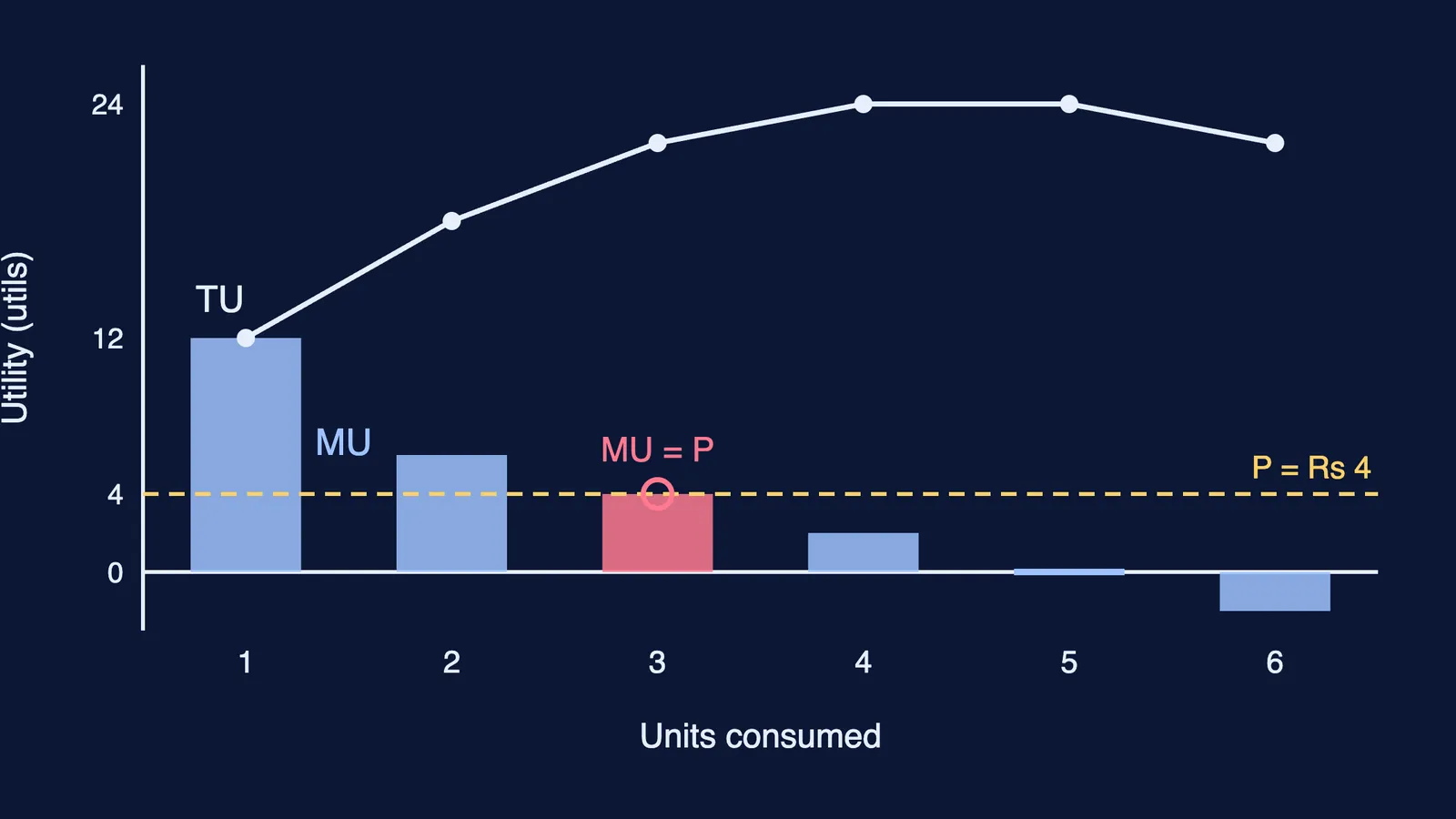
The same NCERT chapter works an example: if 4 bananas give 28 units of utility and 5 give 30, the marginal utility of the 5th banana is 30 − 28 = 2. Its Table 2.1 runs TU as 12, 18, 22, 24, 24, 22 for 1 to 6 units, so MU falls 12, 6, 4, 2, 0, −2. That is the chart at the top of this post.
What does the law of diminishing marginal utility say?
NCERT states the law of diminishing marginal utility as: marginal utility from each additional unit of a commodity declines as its consumption increases, while consumption of other commodities is kept constant (NCERT, Chapter 2). The reason it gives is plain: once you have some of a thing, your desire for more becomes weaker.
Read Table 2.1 again and you can see three facts examiners ask for:
While MU is positive, TU rises, but at a falling rate.
When MU is zero (the 5th unit), TU is at its maximum and stays flat.
When MU turns negative (the 6th unit), TU falls.
How do you find consumer equilibrium with one commodity?
CBSE's archived study material on consumer's equilibrium sets out the one-commodity case. It assumes utility can be measured in numbers and in money, and that income and prices are given. The consumer compares the utility from each unit with the price paid, and buys up to the unit where MU equals price. The condition it writes is MU = Price.
Here is a worked example of our own, in the same method. Riya buys samosas at Rs 15 each. Measured in rupees, the marginal utility of each samosa is:
1st: Rs 30
2nd: Rs 22
3rd: Rs 15
4th: Rs 9
5th: Rs 4
Work it in four steps:
Compare each unit's MU with the price. The 1st and 2nd samosas give more than Rs 15, so she buys them.
The 3rd gives exactly Rs 15. MU = P, so this is her equilibrium: 3 samosas.
Check the next unit. The 4th gives Rs 9 but costs Rs 15, so it would cost her Rs 6 more than it is worth to her. She stops.
If no unit matches the price exactly (say the price were Rs 12), buy every unit whose MU is at least the price and stop before the first unit where MU falls below it. At Rs 12 she still buys 3.
In theory answers, write the condition, show the comparison unit by unit, and say why one more unit lowers satisfaction. The same CBSE material extends the rule to two goods: the consumer gets the same utility from the last rupee spent on each, MUx/Px = MUy/Py.
Why does this give a downward-sloping demand curve?
Lower the price and the rule tells Riya to buy more. At Rs 9, the 4th samosa now passes the test (MU = P), so she buys 4. NCERT makes the same point: because each extra unit gives less marginal utility, a buyer will not pay as much for it, which is why the law of diminishing marginal utility explains the negative slope of the demand curve (NCERT, Chapter 2).
When you move on to shifts of that curve, our guide to checking a demand-supply shift diagram by sketching it first is a useful next read.
What should you revise before the test?
Definitions of utility, TU and MU, close to NCERT's wording.
MUn = TUn − TUn−1, with one table you calculate yourself.
The three TU and MU relationships above, with a sketch.
MU = Price, the reason for stopping, and the no-exact-match case.
Marginal means the change from one more unit, the same idea behind rates of change in maths. If that idea feels shaky, the Fermi Concept Library has every concept in mathematics, each with its own lesson. If economics is pulling you towards a career, read how to become an economist in India and careers after commerce, explained for families.


