On this page
Chapter 1 of NCERT's *An Introduction to Indian Art* Part I is about the oldest pictures made in India: paintings on rock-shelter walls. This guide follows the NCERT chapter (Reprint 2026-27, per the book's prelims) and maps it to the CBSE 2026-27 curriculum. The curriculum does not name a textbook, so treat this as a book-based guide to the unit, not an official one.
How many marks does prehistoric rock painting carry in Class 11?
The CBSE 2026-27 Fine Arts curriculum sets a 30-mark, two-hour theory paper for Painting (049), and Graphics, Sculpture and Applied Art-Commercial Art use the same Class 11 theory syllabus. Unit 1 carries 15 marks, and it is shared: it covers prehistoric rock paintings, the art of the Indus / Sindhu Saraswati Civilization, and Buddhist, Jain and Hindu art. No separate figure is printed for this chapter, so do not expect a fixed mark count for it.
For rock paintings, the curriculum lists an introduction, period and location, and the study and appreciation of the Wizard's Dance at Bhimbetka (the curriculum spells it "Bhimbethaka"; we use the book's spelling). The NCERT chapter does not describe a painting by that title, so check with your teacher which image your school uses for this item.
When and where were the paintings made?
The book calls the time before writing and written documents prehistory, and says the earliest Indian paintings reported come from the Upper Palaeolithic. Archibald Carlleyle made the first discovery of Indian rock paintings in 1867–68 (the book prints his first name as "Archibold"), twelve years before Altamira in Spain was found, according to the NCERT chapter. Cockburn, Anderson, Mitra and Ghosh found many more sites.
Learn the sites as three groups:
Kumaon hills, Uttarakhand: Lakhudiyar, on the banks of the Suyal, about 20 km along the Almora–Barechina road. Its name means "one lakh caves". It shows stick-like humans, a long-snouted animal, a fox, a many-legged lizard, wavy lines, dots and a scene of dancers with linked hands.
Granite rocks of Karnataka and Andhra Pradesh: Kupgallu, Piklihal and Tekkalkota. The book dates these paintings to the Neolithic, early historical and late historical periods. Subjects include bulls, elephants, horses, stylised humans and tridents.
Vindhya hills (Madhya Pradesh) and the Kaimur extensions in Uttar Pradesh: the richest group, including Bhimbetka.
What makes Bhimbetka important?
Bhimbetka lies 45 km south of Bhopal and has about 800 rock shelters, of which 500 bear paintings, according to the NCERT chapter. V.S. Wakankar discovered the caves in 1957–58. The paintings are grouped into seven periods by style, technique and superimposition. The book covers only the first three:
Period I, Upper Palaeolithic: large linear animals (bison, elephants, tigers, rhinos, boars) and stick-like humans in green and dark red. Green figures are dancers and red ones are hunters.
Period II, Mesolithic: the largest number of paintings, smaller in size. Group hunts with barbed spears, bows and traps dominate. Dances, honey gathering, food preparation and children at play also appear. Animals are drawn naturalistically and humans in a stylised way.
Period III, Chalcolithic: named in the book, but not described in detail.
Which pigments and techniques did the artists use?
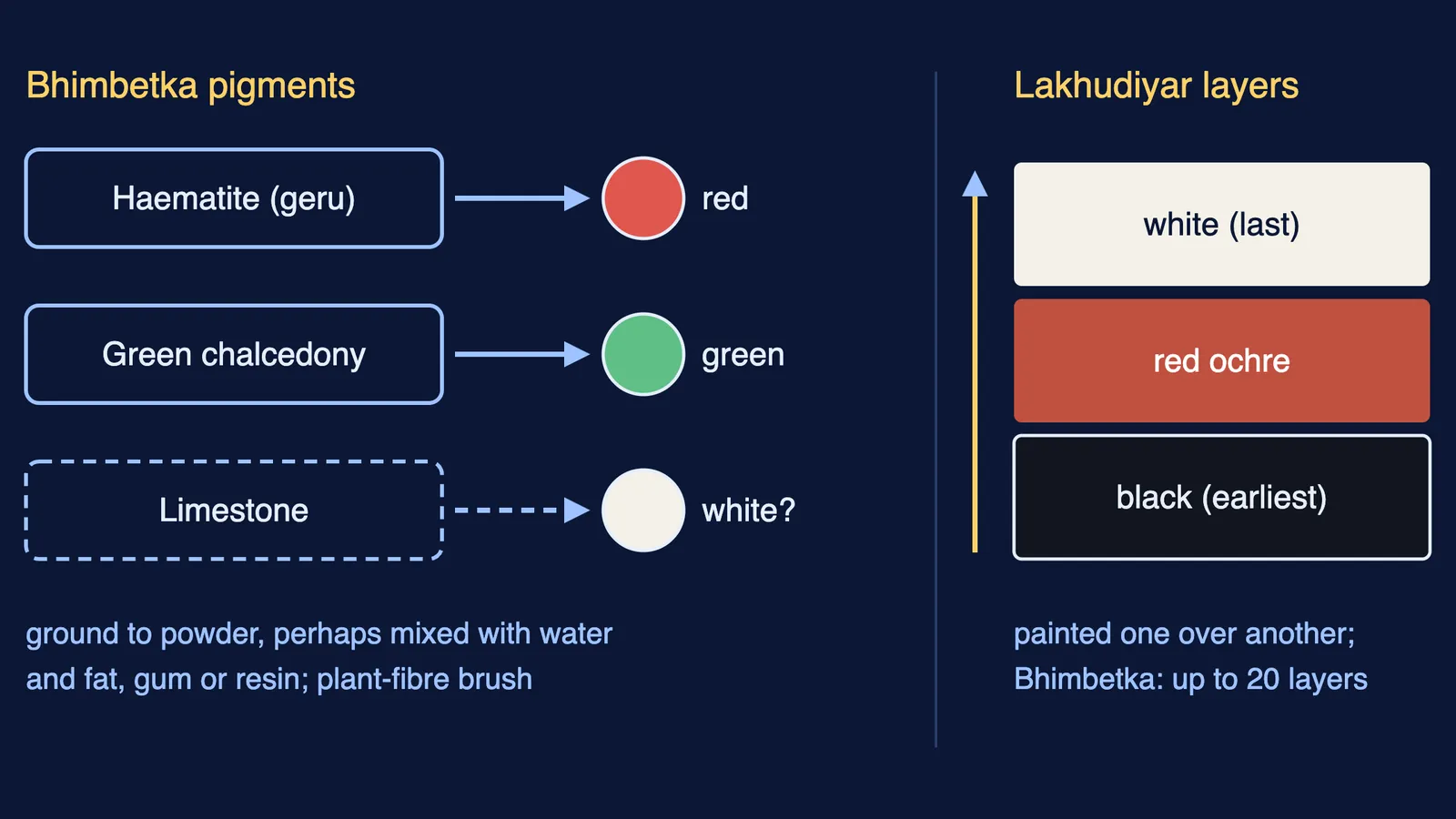
The diagram above sums up the book's account. Red came from haematite (geru), green from a green variety of chalcedony, and white possibly from limestone. White and red were the favourite colours. The ground powder may have been mixed with water and a sticky binder such as animal fat, gum or resin, and brushes were made of plant fibre. The book links the colours' long survival to a chemical reaction with oxide on the rock surface.
Superimposition: at Lakhudiyar, black came first, then red ochre, then white. At Bhimbetka, some spots have as many as 20 layers. Placement: some paintings are high up near the ceilings, perhaps so they could be seen from a distance. The book suggests some non-living spaces may have had religious importance, and it presents these readings as possibilities, not facts.
For background, see our Class 9 guide to the history of arts and mediums and techniques in visual art. Unit 1 continues with Indus art; see how Harappan finds are read.
Practice questions
Mark labels are our suggestion.
Name the mineral that gave Bhimbetka artists their red colour, and its Indian name. (1 mark)
Put the Lakhudiyar paint layers in order from earliest to latest. (1 mark)
Compare Period I and Period II at Bhimbetka in subject, size and colour. (3 marks)
Give two reasons the book suggests for painting the same rock surface again and again. (2 marks)
The book describes a bison hunt with injured men on the ground. Explain how such a scene shows the struggle for survival, using scale, grouping of figures and mood. (6 marks)
Not sure which part of Unit 1 to revise first? Fermi's AI tutor works out what you already know and builds a plan for the session.