On this page
Precision Farming is Chapter 3 of NCERT's Kaushal Vikas, the Grade 9 Skill Education textbook (code 0916, First Edition April 2026). It is a choice chapter in Unit I, Work with Life Forms; schools pick one vocation per unit (NCERT Chapter 3 PDF; book prelims).
What is precision farming in Class 9 Kaushal Vikas?
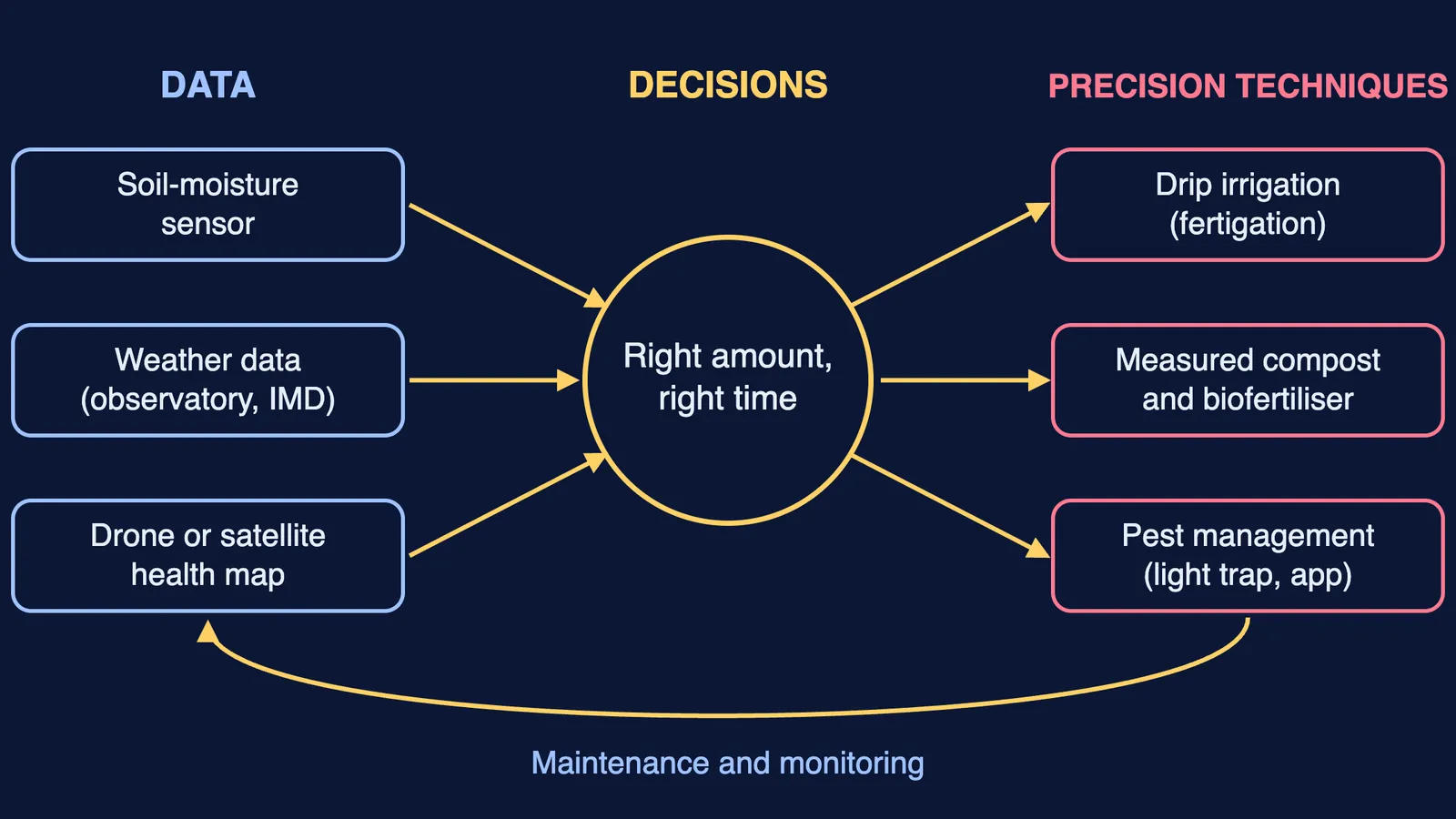
In the book's terms, precision farming uses science and technology to give each plant the water, nutrients and care it needs, when it needs them, while caring for the environment (NCERT Chapter 3).
The chapter opens with a drone or satellite "health map" colouring a field from red (worst) to green (best); in its example, 17 per cent of the crop is in poor health and 1 per cent in good health. Farmers read such maps to plan watering, fertiliser and pest management patch by patch. Introduction to Remote Sensing Class 11 explains such images.
Versus traditional farming:
Irrigation: flooding the field versus sensor-guided drip.
Fertiliser and pests: doses by experience versus need-based doses from soil tests, drones, satellites and apps.
Harvest: handling losses versus sensors and digital labels.
How do you set up a precision farming unit at school?
The workflow (NCERT Chapter 3) starts with scoping, a process chart with dates and owners, and a site visit, such as a Krishi Vigyan Kendra. Pick plants with a 2–3 month life cycle.
Use weather data from the school observatory or the IMD website (Earth as a System Class 9) to choose protection: a greenhouse lowers temperature and keeps off rain and frost; a low-tunnel raises temperature; a humidity chamber raises humidity for seedlings; a shade-net blocks scorching heat.
Sketch a layout and cost tools and materials in a Bill of Materials (see From Ideas to Startups Class 9).
Raise seedlings in a humidity chamber (a clear polythene bag over a pot or tray), then move them to a low-tunnel.
Lay drip pipes with a filter and valves. A soil-moisture sensor lets water flow only when needed; "fertigation" dissolves fertiliser in the irrigation tank.
Make a Lactic Acid Bacteria (LAB) culture from rice rinse water and milk as a biofertiliser, diluted 1 L in 9 L of water.
Identify insects with a light trap and ICAR's National Pest Surveillance System (NPSS) app; the aim is managing pests, not eliminating insects.
Harvest when temperature and humidity are lowest, and add a QR code label with origin, harvest date and techniques.
Book note: Figure 3.12's caption prints "Light Dependent Resistant"; the sensor is a Light Dependent Resistor (LDR).
How much compost does a bed need?
The chapter's rough fizz test (NCERT Chapter 3) adds hydrogen peroxide: no bubbling means very low organic carbon, strong foaming high. The book says soil should hold 1.5 to 2.0 per cent organic carbon and works out the compost in five steps (Figure 3.10). Our own bed, 2 m × 1 m × 0.3 m, aiming for 1.5 per cent:
Deciding size of bed: 2 × 1 × 0.3 = 0.6 m³.
Calculate required soil: about 1,300 kg per m³, so 0.6 × 1,300 = 780 kg.
Decide target OC%: 780 × 0.015 = 11.7 kg of carbon.
Final correction: compost is generally about 30 per cent carbon, so 11.7 ÷ 0.30 = 39 kg.
Mixing soil and compost: only 20 per cent stays stable (microbes use the rest), so 39 ÷ 0.20 = 195 kg of compost.
Check: 195 × 0.30 × 0.20 = 11.7 kg. The method does not subtract carbon already in the soil.
How is Kaushal Vikas Class 9 assessed?
CBSE's 2026-27 guidelines cover Kaushal Vikas as a whole subject, assessed in school. Weightings: paper-pencil test 40%, portfolio 20%, demonstration and oral presentation or viva voce 20%, site visit report or observation notes 10%, teachers' observations 10% (CBSE Kaushal Vikas assessment guidelines). The recommended 40-mark paper has objective (8 marks), short answer (12), scenario- or case-based (16) and reflective or decision-making (4) sections. Marks follow workflow stages, not chapters, so Precision Farming has no separate figure.
The CBSE 2026-27 Vocational Education curriculum names no textbook but lists precision farming under Work with Life Forms. This guide follows the NCERT book and maps it to that form of work. Check formats with your teacher.
Practice questions
Marks are our suggestion.
(1 mark) Which suits seedlings needing very high humidity: shade-net, humidity chamber, greenhouse or open bed?
(2 marks) Order these: add a filter, lay pipes, connect to the tank, fix drippers near roots.
(2 marks) Why does the chapter advise against killing every insect?
(4 marks) The school wants tomatoes through a cold December. Choose a protection mode and give two reasons.
(4 marks) A bed is 1.5 m × 1 m × 0.4 m. Using the book's method, how much compost gives 2 per cent organic carbon? (Answer: 260 kg.)
(4 marks) Nursery seedlings wilt on hot afternoons. Suggest a protection mode and a sensor, and what readings to log.
Not sure where to start revising? Fermi's AI tutor works out what you already know and builds a plan for the session.