On this page
Politics of Planned Development is the third chapter of Politics in India since Independence. This guide turns the current NCERT chapter (Reprint 2026-27) into a timeline, a comparison and practice questions.
How many marks is Politics of Planned Development worth?
The CBSE Political Science curriculum for 2026-27 gives this chapter 2 marks out of the 40 for Part B, the smallest share of any chapter in the book. Its topics run from ideas of development and the Planning Commission to the First Five Year Plan and rapid industrialisation. The curriculum's annexure adds two short notes, on NITI Aayog and the National Development Council, so read those with the textbook.
The 2026-27 sample paper tests the chapter through two 1-mark objective questions: one on which idea was not part of early development policy, and one asking you to put planning milestones in order.
What were the two models of development in front of India?
NCERT says India had two models of modern development on the eve of Independence: a liberal-capitalist model, followed across much of Europe and in the US, and a socialist model, followed by the USSR. Many leaders, including those of the Communist Party, the Socialist Party and Nehru within the Congress, were impressed by the Soviet model; NCERT says supporters of American-style capitalism were few.
NCERT defines the two labels:
Left: favours state control of the economy and prefers regulation over free competition.
Right: believes free competition and the market ensure progress, and that government should not intervene unnecessarily.
The chapter opens with a proposed steel plant in Orissa (now Odisha), where industry, government, tribal residents and environmentalists wanted different things. NCERT's point: development means different things to different people, so choosing a path is a political decision.
Why did India choose planning, and what was the Planning Commission?
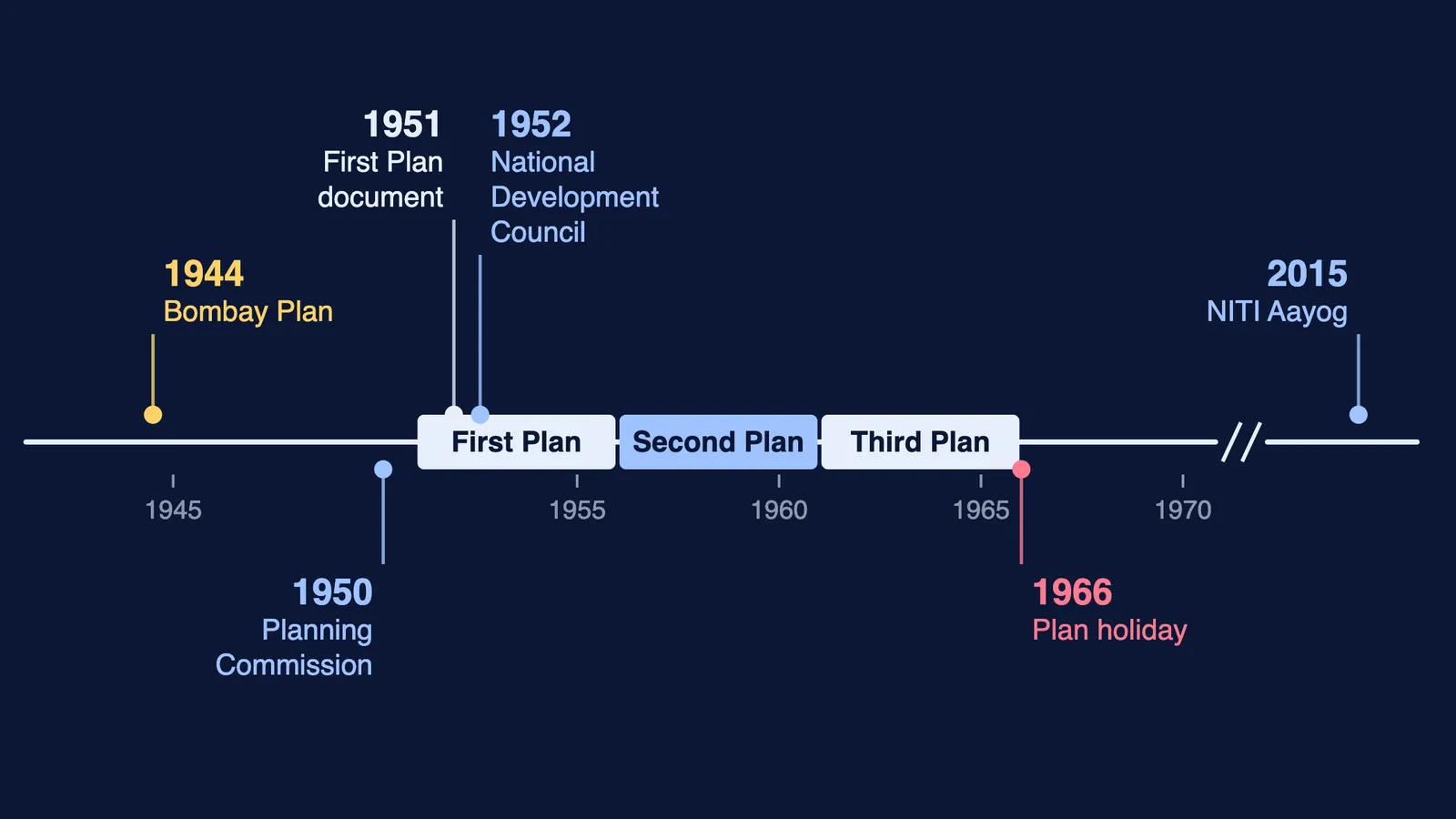
According to NCERT, almost everyone agreed that development should mean both growth and social and economic justice, and that it could not be left to private actors alone. Planning had wide support worldwide in the 1940s and 1950s. Even a group of big industrialists drafted a proposal for a planned economy in 1944, called the Bombay Plan, which asked the state to lead big industrial and economic investment.
In March 1950 a Government of India resolution, not the Constitution, created the Planning Commission, with the Prime Minister as its chairperson (NCERT). Its role was advisory: its recommendations took effect only when the Union Cabinet approved them.
The curriculum annexure dates the National Development Council to 6 August 1952, with the Prime Minister presiding, to bring the states into support of the plans. NCERT notes that NITI Aayog replaced the Planning Commission and came into existence on 1 January 2015.
How did the First and Second Five Year Plans differ?
The core comparison, from NCERT:
First Plan (1951-1956): focused on agriculture, including dams and irrigation, since farming was hit hardest by Partition. It made large allocations to projects such as the Bhakra Nangal Dam and treated land reform as the key to development. Economist K.N. Raj argued that India should "hasten slowly".
Second Plan (from 1956): put heavy industry first. P.C. Mahalanobis headed the team of economists and planners who drafted it, and it aimed at quick structural change. It followed the Congress resolution at Avadi naming a "socialist pattern of society" as the goal. Tariffs protected domestic industry, and sectors such as electricity, railways, steel, machinery and communication grew in the public sector.
NCERT also lists the costs: buying technology used scarce foreign exchange, and with industry drawing more investment, food shortage became a risk. The Third Plan, from 1961, was much like the Second. Critics spoke of an "urban bias" or wanted agriculture first. By 1966, when the Fourth Plan was due, India faced an economic crisis and the government took a "plan holiday".
How do you write board answers on this chapter?
For a 1-mark sequence question, fix this order: Bombay Plan (1944), Planning Commission (1950), First Plan (1951), plan holiday (1966), NITI Aayog (2015). For a 2- or 4-mark answer, use this frame:
Name the idea in one line, in NCERT's words.
Give two or three points, each with a plan, a person or a date.
Close by linking back to the question.
Practice questions written for this guide:
(1 mark) Who led the team that drafted the Second Five Year Plan?
(1 mark) Was the Planning Commission created by the Constitution or by a government resolution?
(2 marks) Give two reasons why the First Plan focused on agriculture.
(4 marks) Compare the priorities of the First and Second Five Year Plans, with one problem each strategy faced.
For the economics side of the same plans, read our Indian economy 1950-90 Class 12 guide. The next chapter is covered in our India's External Relations Class 12 timeline, and later economic change in Recent Developments in Indian Politics Class 12.
If you are unsure where to start, Fermi's AI tutor can work out what you already know and build a plan for the session.