On this page
India's External Relations is the fourth chapter of Politics in India since Independence. This guide turns the current NCERT chapter (Reprint 2026-27) into a timeline and board answers.
How many marks is India's External Relations worth?
The CBSE Political Science curriculum for 2026-27 gives the chapter 6 marks out of the 40 for Part B. Topics run from non-alignment to China, Pakistan, the 1971 war and nuclear policy. Its annexure adds notes on India-EU relations and nuclear updates.
What was non-alignment, and why did India choose it?
NCERT says Nehru was his own foreign minister and shaped foreign policy from 1946 to 1964. It names three objectives: keeping the sovereignty India had won, defending its territory, and speeding up economic development. Non-alignment meant staying out of the military alliances led by the US (NATO) and the Soviet Union (the Warsaw Pact) while getting aid from both blocs.
Some, NCERT notes, wanted closer ties with the US bloc: Dr Ambedkar, the Bharatiya Jan Sangh and later the Swatantra Party. NCERT calls it a hard balance: in 1956 India led protests when Britain attacked Egypt over the Suez Canal, but did not join public condemnation of the Soviet invasion of Hungary.
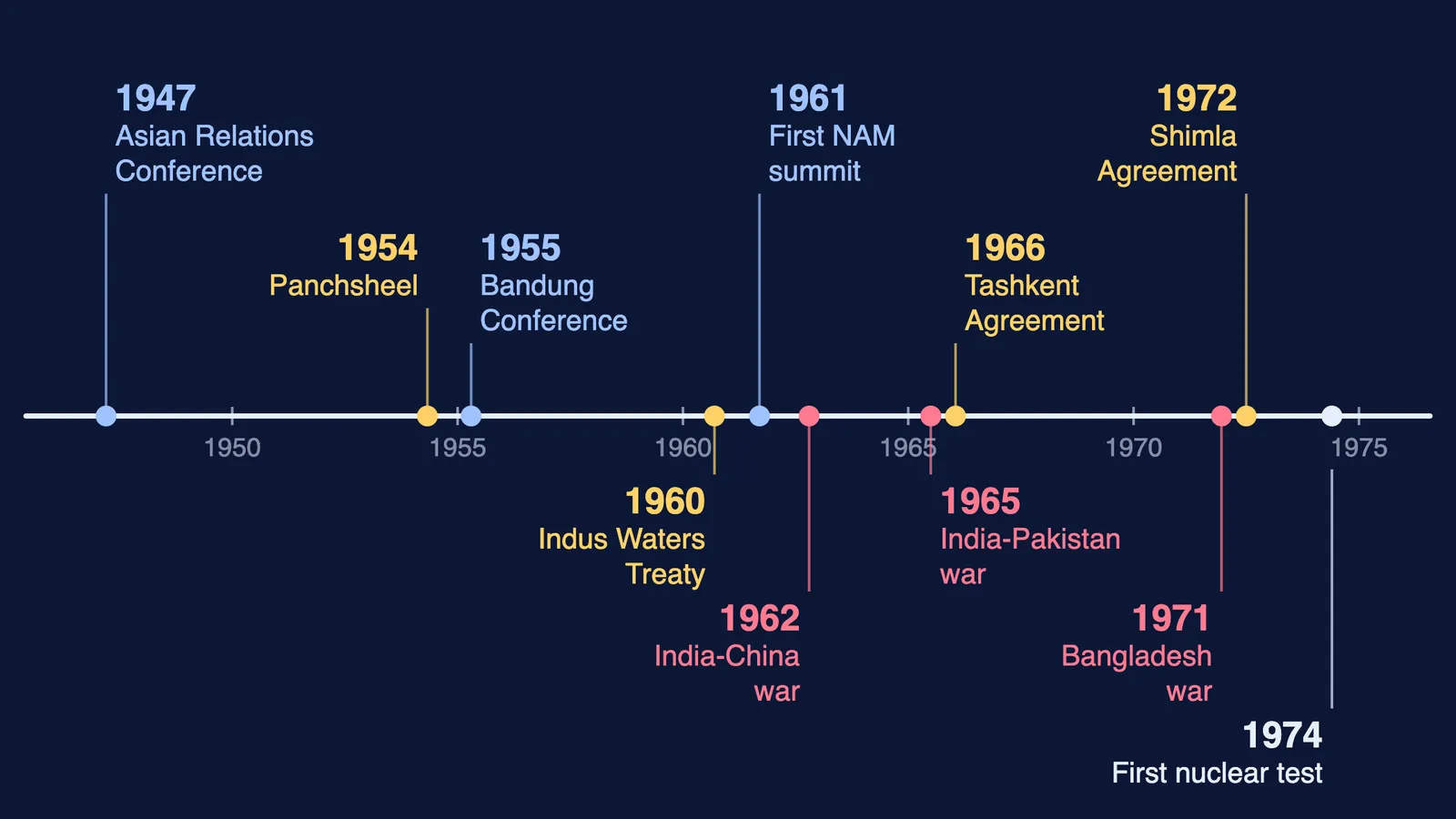
On Afro-Asian unity, NCERT lists the Asian Relations Conference (March 1947), a 1949 conference supporting Indonesia's freedom, the Bandung Conference (1955), and the first NAM summit in Belgrade (September 1961), which Nehru co-founded.
What does NCERT say about China and Panchsheel?
NCERT says relations began on a friendly note: after the 1949 revolution, India was one of the earliest states to recognise China's new communist government. Nehru and Premier Zhou Enlai jointly set out Panchsheel, the Five Principles of Peaceful Coexistence, on 29 April 1954. The 2026-27 marking scheme lists them as mutual respect for territorial integrity and sovereignty, mutual non-aggression, mutual non-interference in internal affairs, equality and mutual benefit, and peaceful coexistence.
NCERT names two strains: China's takeover of Tibet in 1950, with the Dalai Lama granted asylum in India in 1959, and a boundary dispute in which, NCERT says, China claimed Aksai-chin in Ladakh and much of present-day Arunachal Pradesh (then NEFA), areas within Indian territory. NCERT calls what followed in October 1962 a Chinese invasion of both disputed regions; China later declared a unilateral ceasefire and its troops withdrew to earlier positions. At home, Defence Minister V. Krishna Menon left the cabinet, the first no-confidence motion against Nehru's government was debated, and the CPI split in 1964. Full diplomatic relations were restored in 1976.
What happened in the 1965 and 1971 wars?
NCERT traces relations with Pakistan from the 1947 conflict over Jammu and Kashmir, referred to the UN, and also records cooperation: the Indus Waters Treaty of 1960, mediated by the World Bank and signed by Nehru with General Ayub Khan.
1965: NCERT says Pakistan launched armed attacks in the Rann of Kutch in April, followed by a larger offensive in Jammu and Kashmir in August-September. It ended with UN intervention, and Lal Bahadur Shastri and Ayub Khan signed the Soviet-brokered Tashkent Agreement in January 1966.
1971: Pakistan's rulers did not accept the 1970 election verdict in East Pakistan, and the army's crackdown there sent about 80 lakh refugees into India. In August 1971, with the US and China backing Pakistan, India and the Soviet Union signed a 20-year Treaty of Peace and Friendship. War broke out in December; about 90,000 Pakistani soldiers surrendered, Bangladesh became independent, and India declared a unilateral ceasefire.
1972: Indira Gandhi and Zulfikar Ali Bhutto signed the Shimla Agreement on 3 July.
How did India's nuclear policy develop?
NCERT says the programme began in the late 1940s under Homi J. Bhabha, aimed at peaceful uses. India called the 1968 Nuclear Non-proliferation Treaty discriminatory and did not sign it. India's first nuclear test, in May 1974, was described as a peaceful explosion. In a Fast Forward box, NCERT adds the May 1998 tests and a doctrine of credible minimum deterrence with "no first use".
How do you write board answers on this chapter?
The 2026-27 sample paper has a 6-mark question with an internal choice: how domestic and international factors together shape foreign policy, using a 1960s example, or the main objectives of India's foreign policy. Its marking scheme accepts the 1962 conflict as the example and lists six objectives, from sovereignty to an independent nuclear policy. Use this frame:
Define (1 line): state the idea in the question.
Three points: each with one date from the timeline.
Close (1 line): link back to the question.
Practice questions written for this guide:
(1 mark) In which year was Panchsheel set out by Nehru and Zhou Enlai?
(2 marks) Give two reasons why India stayed out of the Cold War military blocs.
(4 marks) Explain how the 1962 war affected politics inside India.
(6 marks) Trace India's nuclear policy from the late 1940s to 1998.
For context, read our Cold War era Class 12 guide and the Challenges of nation building Class 12 guide.
If you are unsure where to start, Fermi's AI tutor can work out what you already know and build a plan for the session.