

On this page
If you searched for the Cold War era in Class 12, check one thing first. In the CBSE Political Science (028) curriculum for 2026-27, there is no separate Cold War chapter. The Cold War still sits inside three chapters, and you need its story to write any of them well.
Is the Cold War era chapter in the Class 12 syllabus?
For CBSE in 2026-27, it is not a chapter of its own. The official curriculum lists seven chapters in Part A, and the Cold War appears in these places:
The End of Bipolarity: the Soviet system, Gorbachev and why the Soviet Union broke up.
International Organizations: a topic called Reform of the UN after Cold War.
India's External Relations (Part B): the policy of non-alignment, Nehru's role, distance from two camps, Afro-Asian unity and India's nuclear policy.
The Delhi Directorate of Education's 2026-27 annual syllabus for Class 12 uses the same list. On another board or an older book? Ask your teacher which version you will be examined on.
What were the two blocs in the Cold War?
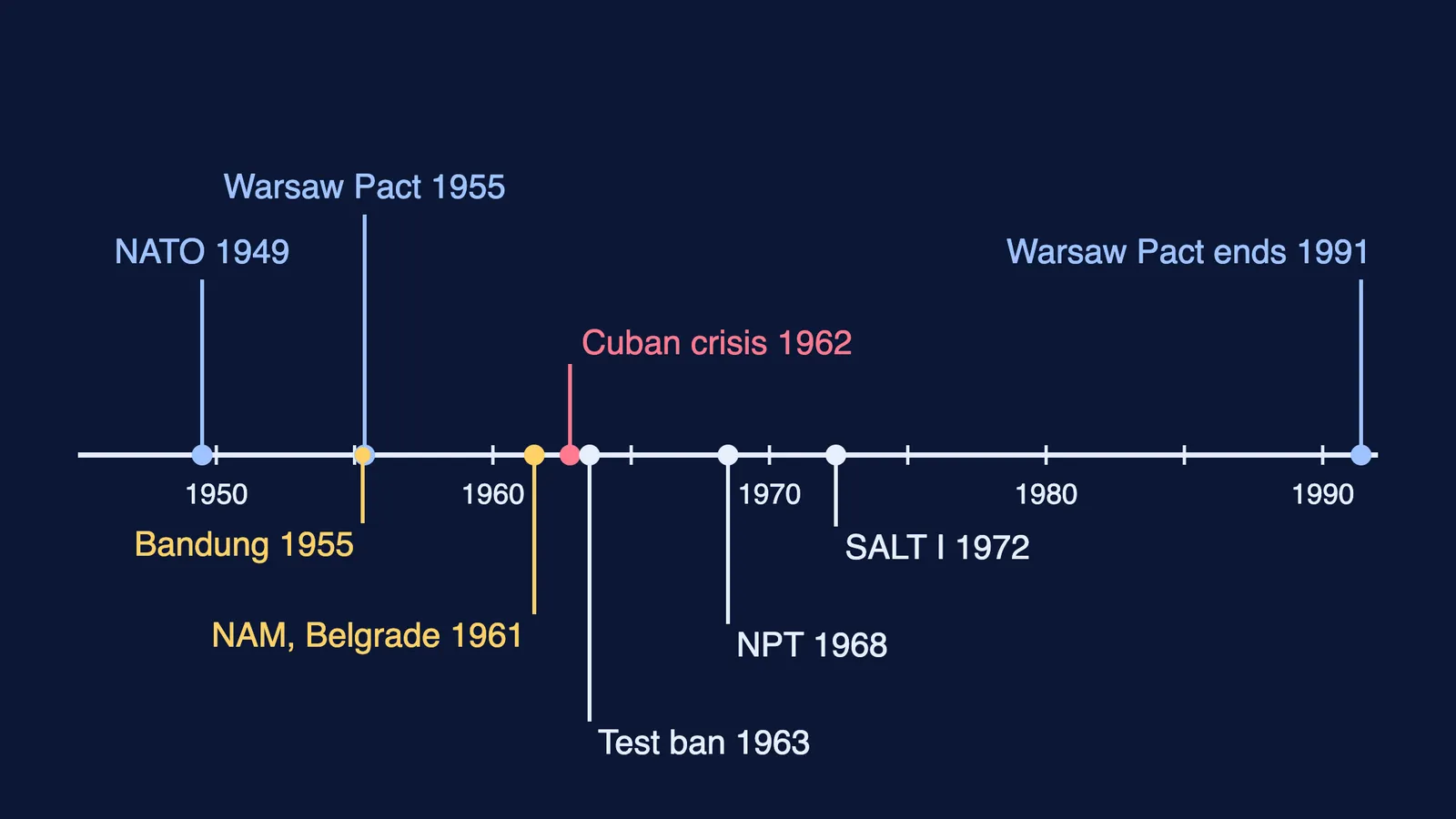
Bipolarity means a world organised around two blocs, each led by a superpower. The Western bloc's alliance was NATO, which the US Office of the Historian says was created in 1949 by the United States, Canada and several Western European nations. The same page names the twelve countries that formed it.
The Eastern bloc's alliance was the Warsaw Pact, established on 14 May 1955 between the Soviet Union and seven Eastern European states, including Poland, Hungary and East Germany. The same source records that the Pact officially disbanded in March and July 1991.
What happened in the Cuban missile crisis?
The Office of the Historian's account gives the sequence you need:
14 October 1962: US U-2 photographs showed sites for medium-range and intermediate-range ballistic nuclear missiles under construction in Cuba.
22 October: President Kennedy ordered a naval quarantine of Cuba, a term that legally set it apart from a blockade.
28 October: Soviet leader Khrushchev said publicly that the missiles would be removed.
The US guaranteed it would not attack Cuba, and it removed its Jupiter missiles from Turkey in April 1963, a step kept out of the public deal.
Afterwards a direct White House-Kremlin telephone link, the Hotline, was set up. Use the crisis to show that nuclear deterrence carried real risk, which is why arms control followed.
How did NAM keep India out of both camps?
Non-alignment meant joining neither military bloc. Its roots go back to Bandung in April 1955, where twenty-nine Asian and African governments met; India was one of five co-sponsors, and the Office of the Historian says the conference laid the foundation for the non-aligned movement.
The movement took shape at the 1961 Belgrade conference, which, according to an essay by Ivana Ancic for Global South Studies, was organised by Josip Broz Tito of Yugoslavia, Gamal Abdel Nasser of Egypt and Jawaharlal Nehru. This is the material behind the syllabus phrases Nehru's role, distance from two camps and Afro-Asian unity.
Which arms control treaties should you know?
Limited Test Ban Treaty, 1963: signed by the US, the Soviet Union and Britain, it banned nuclear tests in the atmosphere, in space and underwater, the first arms control agreement of the Cold War.
Nuclear Non-Proliferation Treaty (NPT): the UN Office for Disarmament Affairs says it was opened for signature in 1968 and entered into force in 1970; a total of 191 states have joined it.
SALT I, 1972: on 26 May 1972 in Moscow, Nixon and Brezhnev signed the ABM Treaty and an interim agreement; the ABM Treaty limited each side to 200 interceptors and two missile defence sites.
Memory line: 49, 55, 62, 63, 68, 72. Blocs form, the crisis peaks, treaties follow. To connect them, build a cause-and-effect chart for a history chapter, and if a chatbot hands you a date, check it against NCERT before you learn it.
How do you write a 6-mark answer on the Cold War?
The CBSE question paper design gives 22 marks out of 80 (27.5%) to applying knowledge to a situation, cartoon, clipping, source or map. It also says competency-based questions will be 50% of the Class 12 paper in 2026-27. Treat events as evidence, not as a list to recite.
Worked plan for: Explain how non-alignment served India during the Cold War.
Define (1 line): not joining either military bloc.
Context (1 line): NATO from 1949, the Warsaw Pact from 1955.
Point 1: India co-sponsored Bandung in 1955, building Asian-African solidarity.
Point 2: Nehru helped organise Belgrade in 1961 with Tito and Nasser.
Point 3: freedom to judge each crisis without following a bloc leader; add one textbook example.
Close (1 line): one criticism from your textbook, then your judgement.
Time yourself with the 20-minute board answer-writing drill.
If a blank page is the hardest part, Fermi's AI tutor can work out what you already know, build a plan for the session and check your understanding as it goes.


