On this page
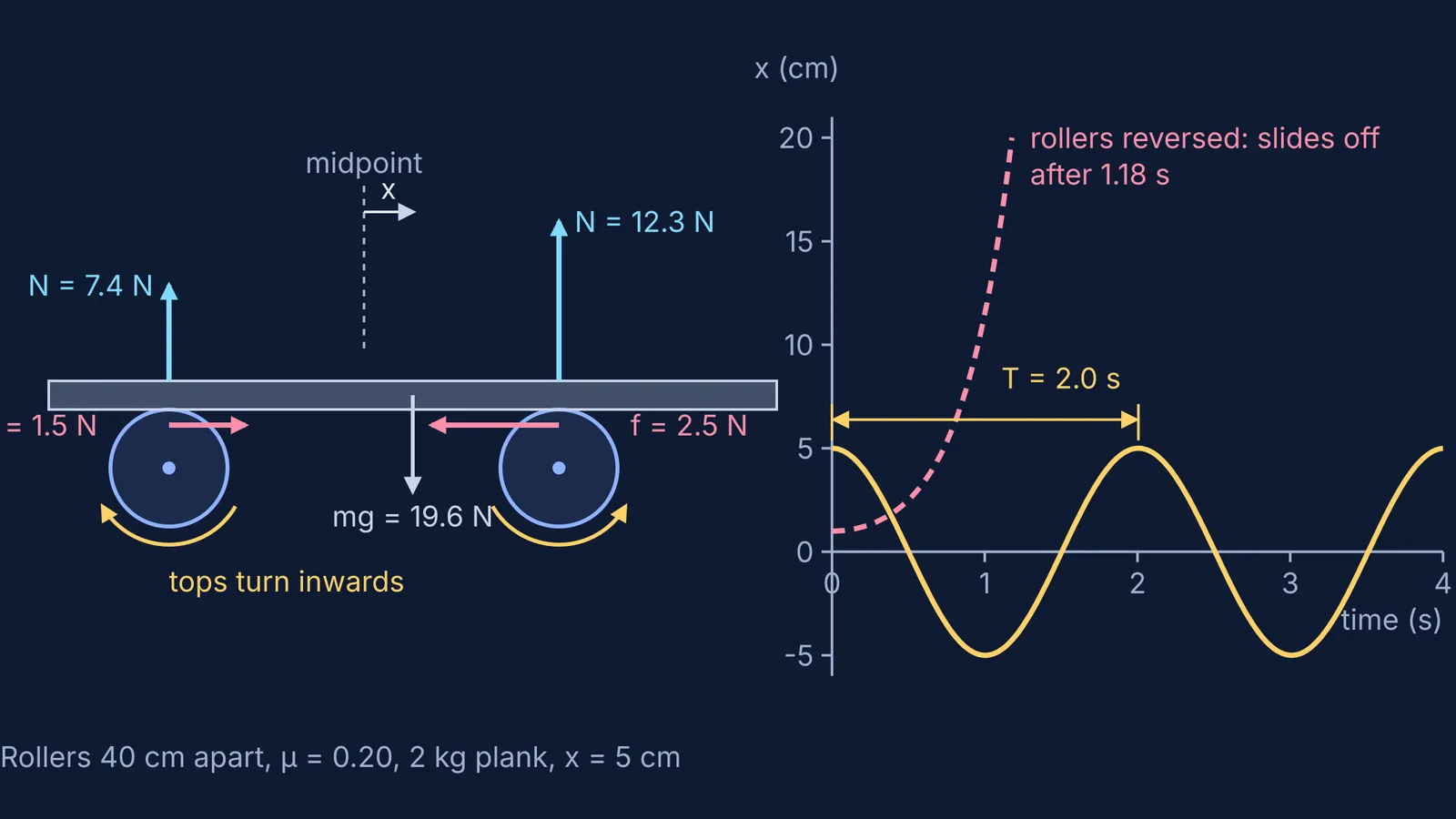
Lay a plank across two rollers that spin towards each other, so their tops move inwards. Push the plank a little off centre and let go. It slides back, overshoots, and swings to and fro on its own with a steady period. The motion is simple harmonic, the plank's mass drops out, and the period gives you the coefficient of kinetic friction. With rollers 40 cm apart and μ = 0.20, the plank swings with a period of 2.0 s.
What is the plank-on-rollers set-up?
Two identical rollers sit with their axes parallel and horizontal, a distance 2a apart. A motor turns both. The left roller turns clockwise and the right one anticlockwise, so both tops move towards the middle. A uniform plank rests across them. Its centre of mass is at its middle.
The rollers turn fast, so their rims always slide under the plank. That means both contacts give kinetic friction, μN, and each friction force on the plank points inwards, the way the roller top moves.
Physicists call this a friction oscillator, or a Timoshenko oscillator. A 2018 paper in the American Journal of Physics by Henaff and colleagues, A study on kinetic friction: the Timoshenko oscillator, built one from a motor and LEGO and used its period to measure μ. Their values agreed with published ones.
Why are the two normal forces unequal?
Let the plank's centre be a distance x to the right of the midpoint between the rollers. The plank has no vertical acceleration and does not rotate, so two conditions hold.
Vertical forces: N_L + N_R = mg.
Torques about the centre of mass: the left contact is a + x to the left of the centre, and the right contact is a − x to its right. So N_L(a + x) = N_R(a − x).
Solving these gives N_L = mg(a − x)/2a and N_R = mg(a + x)/2a. The roller nearer the centre of mass carries more weight, just as the nearer support carries more of a bridge's load. Strictly, friction acts at the plank's underside, a little below its centre of mass, so it adds a small torque. For a thin plank you can ignore it.
Why does the plank move in SHM?
Both friction forces are kinetic and point inwards. The left one pushes right with μN_L. The right one pushes left with μN_R. The net horizontal force is
F = μN_L − μN_R = μmg[(a − x) − (a + x)]/2a = −(μmg/a)x.
The force is proportional to the displacement and opposite to it. That is the test for SHM, the one set out in how to check if motion is SHM from its acceleration equation. Divide by m: the acceleration is −(μg/a)x, so
ω = √(μg/a) and T = 2π√(a/μg).
The mass has cancelled. A heavy plank and a light one swing with the same period, because both the restoring force and the inertia scale with m. The roller radius and spin rate do not appear either, as long as the contacts keep sliding.
Worked example: what is the period, and what does it say about μ?
Take rollers with axes 40 cm apart, so a = 0.20 m. Take μ = 0.20 and g = 9.81 m/s². These are illustrative values.
Angular frequency. ω = √(0.20 × 9.81/0.20) = √9.81 = 3.13 rad/s.
Period. T = 2π/3.13 = 2.01 s.
Check the forces. For a 2 kg plank shifted 5 cm right, N_L = 19.62 × 0.15/0.40 = 7.36 N and N_R = 19.62 × 0.25/0.40 = 12.26 N. Their sum is 19.62 N, the weight.
Net friction. 0.20 × (12.26 − 7.36) = 0.98 N, pointing left. The formula μmgx/a gives 0.20 × 19.62 × 0.05/0.20 = 0.98 N. They agree.
Change μ. Doubling μ to 0.40 gives T = 1.42 s. The period goes as 1/√μ.
Turn it round. If you time the plank and get T = 2.0 s, then μ = 4π²a/(gT²) = 4π² × 0.20/(9.81 × 4.0) = 0.201.
We also simulated the plank step by step with rims moving at 1 m/s and the friction direction set by the relative sliding velocity. Starting 5 cm off centre, the plank's period came out as 2.006 s, matching the formula. Its top speed, ωA = 3.13 × 0.05 = 0.16 m/s, stays well below the rim speed, so both contacts keep sliding throughout.
What happens if the rollers turn the other way?
Reverse both motors so the tops move outwards. Each friction force now points outwards, and the net force becomes +(μmg/a)x. That is not SHM. The solution is x = x₀ cosh ωt, which grows without limit.
With the same rollers, a plank placed only 1 cm off centre is 20 cm off after t = (1/ω) × arccosh 20 = 1.18 s. At that point its centre is over the right roller, the left contact carries no load, and the plank tips off. The inward-spinning case is stable and the outward one is not.
When does the simple result break down?
A contact stops sliding. If the plank ever moves as fast as a roller's rim, that contact grips and gives static friction. The equations change. Keep the rim speed well above ωA.
The plank is not uniform. The torque balance assumed the centre of mass is at the middle. Put x as the distance of the centre of mass from the midpoint and the same result follows.
μ is not constant. Real kinetic friction varies a little with sliding speed, so a measured period gives an average μ.
The plank is thick. As noted above, friction acting below the centre of mass adds a small torque that shifts the normal forces. Thin planks make this negligible.
Friction here creates the oscillation rather than holding something in place, which is the reverse of a block riding an oscillating platform without slipping. It also gives a second way to measure μ, alongside finding the coefficient of friction from stopping distance.
The Fermi Problem Library has SHM and friction problems with a step-by-step solver that explains the reasoning. If you are preparing for JEE Main & Advanced, Fermi Test Prep offers personalised preparation with an AI tutor, live classes, adaptive mocks, mentorship and a study plan that updates based on mastery.
Quick checklist
Normal forces: N_L = mg(a − x)/2a, N_R = mg(a + x)/2a, from a torque balance.
Rollers turning inwards: net friction −(μmg/a)x, so SHM with ω = √(μg/a).
Period T = 2π√(a/μg), independent of the plank's mass.
Measure T and get μ = 4π²a/(gT²).
Rollers turning outwards: x = x₀ cosh ωt, and the plank slides off.
Both contacts must keep sliding for the result to hold.