

On this page
A block on a platform moving back and forth in simple harmonic motion (SHM), and a coin on a plate vibrating up and down, are the same problem. In both, you compare the largest acceleration the motion demands with the largest acceleration the contact can supply.
Why does the block slip at the ends, not in the middle?
In SHM the acceleration is greatest at the extreme positions, and its peak value is a_max = Aω², where A is the amplitude and ω the angular frequency (OpenStax University Physics, section 15.1). The same section gives ω = 2πf, so a platform at f hertz has ω = 2πf radians per second.
At the mean position the acceleration is zero, so friction on the block is zero too. At the ends the platform reverses hardest, and that is where the block gets left behind.
The only horizontal force on the block is static friction from the platform. Static friction adjusts to whatever is needed, up to a limit: f_s ≤ μs N (OpenStax University Physics, section 6.2). On a horizontal platform N = mg, so friction can give the block an acceleration of at most μs g.
In the platform's frame, the same condition appears as a pseudo force mω²x that friction must balance; see solving problems with pseudo forces in an accelerating frame.
What is the maximum amplitude so a block does not slip?
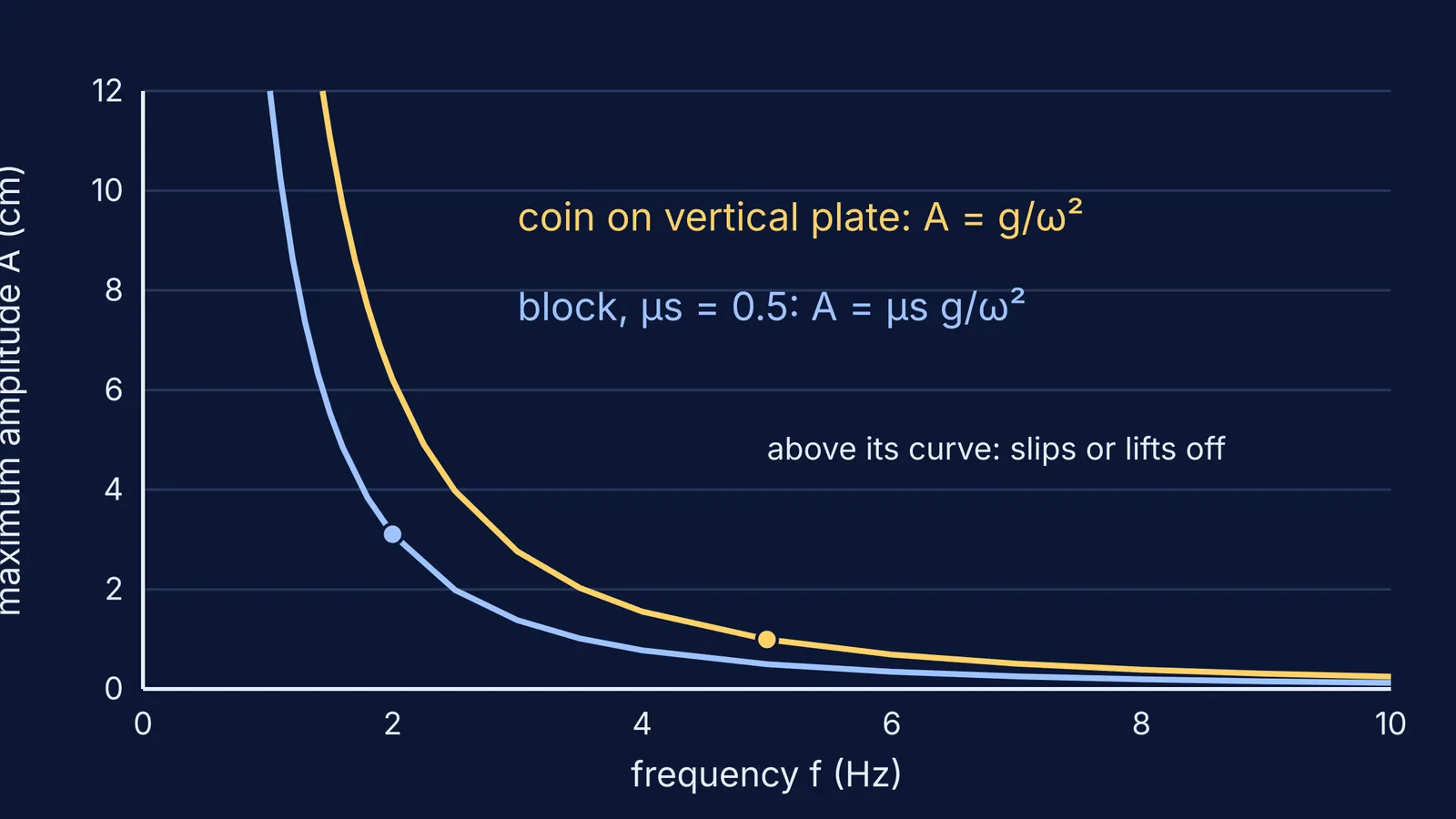
Set demand equal to supply: ω²A = μs g, so A_max = μs g/ω². Take g = 9.8 m/s²; the exact standard value is 9.80665 m/s² (NIST CODATA).
Amplitude at a given frequency. A wooden block sits on a wooden platform, for which OpenStax lists μs = 0.5 (friction table). The platform oscillates at 2 Hz. Then ω = 4π ≈ 12.57 rad/s and ω² ≈ 158 s⁻². A_max = 0.5 × 9.8 / 158 ≈ 0.031 m, about 3.1 cm.
Frequency at a given amplitude. The amplitude is fixed at 2 cm and the surfaces are dry steel, μs = 0.6 (same table). Now solve for ω: ω_max = √(μs g/A) = √(0.6 × 9.8 / 0.02) = √294 ≈ 17.1 rad/s, so f_max ≈ 2.7 Hz.
Block on a spring-driven block. A 1.5 kg block on a smooth floor is attached to a spring, k = 200 N/m, and a 0.5 kg block rides on top with μs = 0.4. Moving together, ω² = k/(total mass) = 200/2.0 = 100 s⁻². A_max = 0.4 × 9.8 / 100 ≈ 0.039 m, about 3.9 cm. Check: the friction needed on the top block at that amplitude is 0.5 × 100 × 0.0392 ≈ 1.96 N, which equals μs mg.
Stacked blocks without oscillation follow the same logic; see static vs kinetic friction and blocks on blocks.
When does a coin leave a vibrating plate?
Now the plate moves up and down. Take y upward from the mean position, so the plate's acceleration is −ω²y (the SHM relation in OpenStax section 15.1). On the coin, the normal force N acts up and gravity mg acts down:
N − mg = −mω²y, so N = m(g − ω²y).
N is smallest at the top, y = +A, where N = m(g − ω²A). The plate can push but never pull, so contact is lost when N reaches zero. The coin stays on while ω²A ≤ g, giving A_max = g/ω².
Worked example: at 5 Hz, ω = 10π ≈ 31.4 rad/s and ω² ≈ 987 s⁻², so A_max = 9.8 / 987 ≈ 0.0099 m, about 1 cm. Above that the coin lifts off near the top of each cycle. At the bottom N = m(g + ω²A), so the coin presses hardest there.
Friction plays no part here, and mass cancels again. Both limits fall as 1/f², so doubling the frequency cuts the safe amplitude to a quarter.
What mistakes cost marks on these problems?
Using the maximum speed ωA instead of the maximum acceleration ω²A.
Squaring f instead of ω, which makes the answer wrong by a factor of 4π².
In spring systems, using k/m of the top block alone instead of k divided by the total mass that moves together.
Using the kinetic coefficient μk. Before slipping, the surfaces are at rest relative to each other, so μs applies.
Saying the coin leaves at the bottom. It leaves at the top, where the plate accelerates downward fastest.
To revise where ω comes from in each system, read how to prove SHM and find the period.
A wrong answer on a variant usually means a wrong method, not wrong arithmetic: the wrong mass in ω, or the wrong point in the cycle. The Fermi Problem Library has worked problems with a step-by-step solver that explains the reasoning rather than printing an answer, so you can see which step went astray. To revisit SHM or static friction on its own, use the Fermi Concept Library.


