On this page
The Philosophy of the Constitution is Chapter 10, the last chapter of NCERT's Class 11 textbook *Indian Constitution at Work*. In the CBSE 2026-27 Political Science curriculum, it shares 4 marks with Chapter 9, Constitution as a Living Document, out of 80 theory marks. It asks what moral vision sits behind the articles you studied earlier. For the basics, see our guide to Constitution: why and how.
What is meant by the philosophy of the Constitution?
NCERT argues that laws are often tied to values: a law against discrimination on grounds of religion or language exists because we value equality (NCERT, Chapter 10). So the chapter takes a political philosophy approach, which has three parts:
Understand the meaning of key terms such as rights, citizenship, minority and democracy.
Work out a coherent vision of society from those terms.
Read the Constitution alongside the Constituent Assembly Debates, which give the reasons behind its values.
A constitution also does two jobs: it restrains state power so the state cannot turn tyrannical, and it offers peaceful, democratic means of social transformation.
Why go back to the Constituent Assembly?
NCERT contrasts India with the USA, whose constitution dates from the late 18th century. In India, it argues, our values have not moved far from the framers', so going back recovers the reasons behind practices we now take for granted, which matters most when they are challenged.
What is the political philosophy of the Indian Constitution?
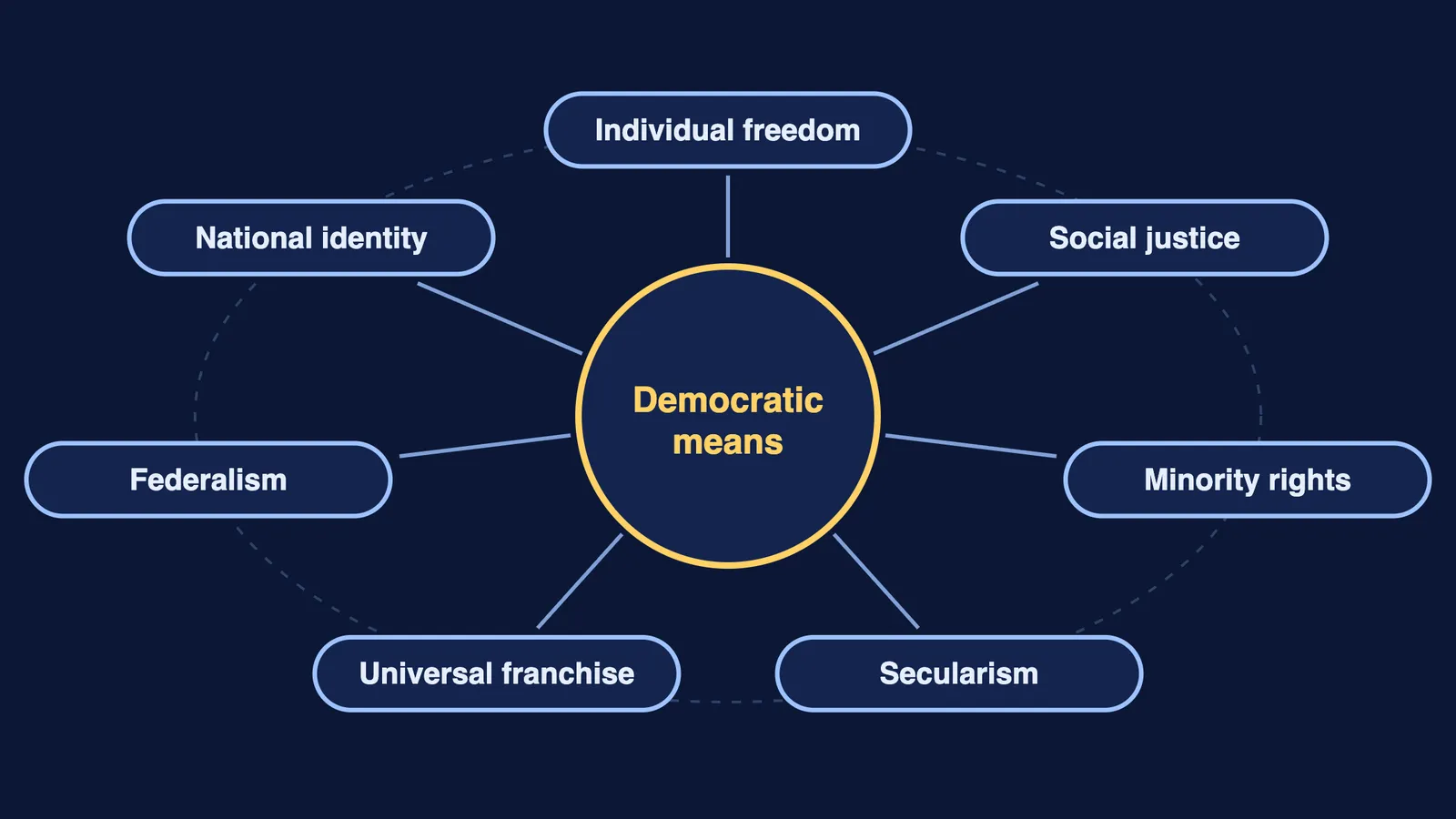
NCERT says no one word captures it: the document combines liberal, democratic, egalitarian, secular and federal ideas, values communities, protects minorities and builds a shared national identity, all pursued through peaceful, democratic means (NCERT, Chapter 10). The curriculum lists seven features:
Individual freedom: built over more than a century of political and intellectual activity, from Rammohan Roy's defence of press freedom to opposition to the Rowlatt Act.
Social justice: Indian liberalism differs from the classical Western kind because it is tied to social justice, for example reserved seats in legislatures for Scheduled Castes and Scheduled Tribes. See our guide to rights in the Indian Constitution.
Respect for diversity and minority rights: the Constitution recognises communities, such as the right of religious communities to run their own educational institutions.
Secularism: not the Western idea of mutual exclusion but principled distance, where the state may intervene in or stay away from religion, whichever better promotes liberty, equality and social justice.
Universal franchise: NCERT traces it to the Constitution of India Bill (1895) and the Motilal Nehru Report (1928), which entitled every person of either sex aged 21 or over to vote. Our guide to election and representation covers how voting works today.
Federalism: asymmetric rather than symmetric like the American model; Article 371A, for example, gives Nagaland special status.
National identity: a common identity that sits alongside religious and linguistic ones; the Constitution rejected separate electorates based on religion.
NCERT notes that many people see the Preamble as the best summary of this vision; it names justice, liberty, equality and fraternity as its ideals (Preamble). NCERT adds that the word "secular" was not in the original text, yet the Constitution was always secular in practice.
What are the criticisms and limitations of the Constitution?
NCERT names three criticisms, each with a reply (NCERT, Chapter 10):
Unwieldy: it is long because it holds matters, such as the Election Commission, that other countries keep outside the main document.
Unrepresentative: members were chosen by a restricted franchise, so the "voice" side of representation was weak, but a wide range of opinion was heard in the debates.
Alien: it borrowed from the West, but NCERT calls this innovative borrowing and selective adaptation, blending Western and Indian values.
It then lists three limitations:
a centralised idea of national unity;
gaps in gender justice, especially within the family;
some basic socio-economic rights placed in the Directive Principles, not the Fundamental Rights.
NCERT says none of these undermines the Constitution's philosophy.
Worked example: answering a "criticism" question
For a 4-mark question on whether the Constitution is borrowed, make four points:
Concede: many provisions came from other constitutions.
Counter: the borrowing was innovative, with an Indian imprint.
Evidence: principled distance and asymmetric federalism depart from the Western models NCERT compares them with.
Conclude: it was selective adaptation, not copying.
Practice questions for Philosophy of the Constitution
The curriculum's question paper design uses 1, 2, 4 and 6-mark questions, plus passage, map and cartoon-based ones (CBSE curriculum).
(1 mark) Which Indian state is given special status by Article 371A? *Nagaland.*
(2 marks) Name two procedural achievements of the Constitution. *Faith in deliberation; compromise and accommodation.*
(4 marks) How does Indian secularism differ from mutual exclusion? *Community rights (2), power to intervene or abstain (2).*
(6 marks) Explain three core features of the Constitution's philosophy and one limitation. *Three features (4), one limitation with an example (2).*
If you are not sure where to start revising, Fermi's AI tutor can work out what you already know and build a plan for the session.