On this page
Classification of Elements and Periodicity in Properties is Unit 3 of the NCERT Class 11 Chemistry textbook, Part I (reprint 2026-27), and the CBSE Chemistry syllabus for 2026-27 lists the same topics, from early tables to periodic trends. For the full chapter walkthrough, see our Classification of Elements Class 11 guide.
How did chemists first arrange the elements?
Law of Triads (Dobereiner): in some sets of three similar elements, the middle one has an atomic weight close to the average of the other two. Example: Li 7, Na 23, K 39 (NCERT Table 3.1).
Law of Octaves (Newlands): listing elements by atomic weight, every eighth element resembles the first; it held only up to calcium.
Mendeleev's Periodic Law: properties repeat regularly when elements are arranged by atomic weight. He broke that order where properties demanded, placing iodine after tellurium.
Eka-aluminium and eka-silicon: names for gaps Mendeleev left for elements later found as gallium and germanium. He predicted a density of 5.9 g/cm3 for eka-aluminium; gallium's is 5.94 (NCERT Table 3.3).
Modern Periodic Law: when elements are ordered by atomic number, their physical and chemical properties recur at regular intervals. Moseley's 1913 X-ray work showed atomic number is the more basic property. Don't confuse with: Mendeleev's law, which used atomic weight.
What do periods, groups and blocks mean?
Period: a horizontal row; its number equals the highest principal quantum number (n) of its elements. There are seven (NCERT section 3.3).
Group (family): a vertical column of elements with similar outer electron arrangements, hence similar chemistry. IUPAC numbers them 1 to 18.
IUPAC temporary name: a name for an element above Z = 100 built from digit roots (nil, un, bi, tri...) plus "ium". Example: element 120 is unbinilium, Ubn.
s-block: groups 1 and 2 (ns1 or ns2); reactive metals forming 1+ or 2+ ions.
p-block: groups 13 to 18 (ns2np1 to ns2np6). With the s-block, these are the representative (main group) elements.
d-block (transition elements): groups 3 to 12, where inner d orbitals fill; most form coloured ions and show variable oxidation states. Don't confuse with: Zn, Cd and Hg, d-block metals that lack most transition properties.
f-block (inner transition elements): the two bottom rows, lanthanoids (Ce to Lu) and actinoids (Th to Lr), where f orbitals fill. Elements after uranium are transuranium elements.
Metalloid (semi-metal): an element on the zig-zag metal/non-metal border with properties of both. Example: silicon, germanium, arsenic.
What decides the size of an atom or ion?
Covalent radius: half the distance between two identical atoms joined by a single bond. Example: Cl–Cl is 198 pm, so chlorine's radius is 99 pm (NCERT section 3.7.1).
Metallic radius: half the distance between neighbouring metal cores in a crystal. Example: copper atoms 256 pm apart give 128 pm.
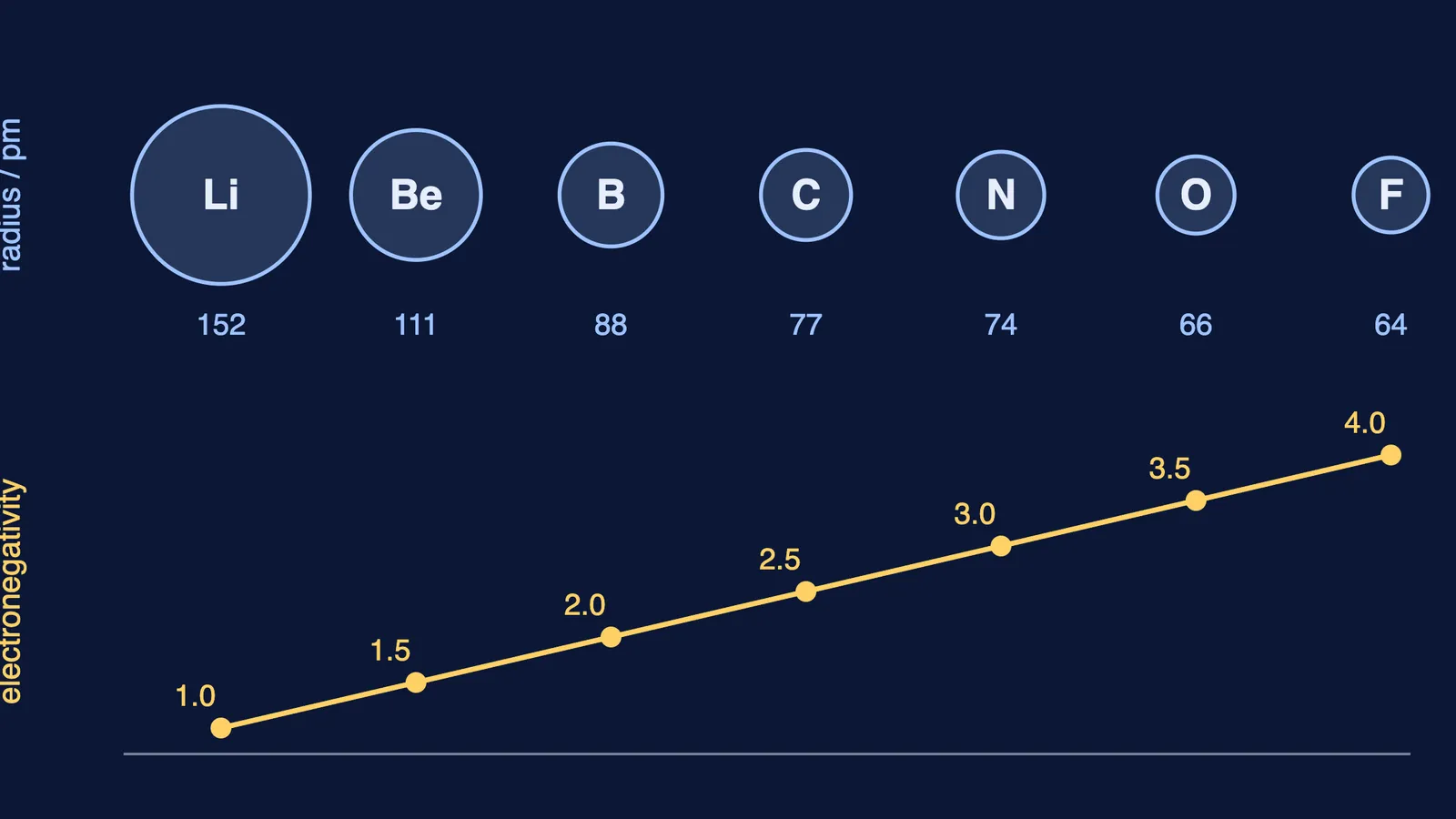
Effective nuclear charge: the net pull an outer electron feels after inner electrons shield (screen) part of the nucleus. It rises across a period, so atoms shrink from Li (152 pm) to F (64 pm).
Ionic radius: the size of an ion in an ionic crystal. A cation is smaller than its atom; an anion is larger. Example: F⁻ is 136 pm, F is 64 pm.
Isoelectronic species: atoms or ions with the same number of electrons. Example: O²⁻, F⁻, Na⁺ and Mg²⁺ each have 10; more protons means a smaller ion.
Which energy terms describe losing and gaining electrons?
Ionization enthalpy (ΔiH): the energy to remove the most loosely held electron from an isolated gaseous ground-state atom, X(g) → X⁺(g) + e⁻. Always positive; each successive one is larger (NCERT section 3.7.1).
Penetration: how close an orbital's electron gets to the nucleus; 2s penetrates more than 2p. That is why boron's first ionization enthalpy is below beryllium's.
Electron gain enthalpy (ΔegH): the enthalpy change when a gaseous atom takes an electron to become an anion. Example: chlorine −349 kJ mol⁻¹, fluorine −328 kJ mol⁻¹ (NCERT Table 3.7). Don't confuse with: electron affinity, the same idea with the opposite sign convention.
Electronegativity: how strongly an atom in a molecule pulls a shared electron pair. It is not directly measurable; the Pauling scale sets fluorine at 4.0. Don't confuse with: electron gain enthalpy, measured for a lone gaseous atom.
Which terms describe chemical trends?
Valence: an element's combining capacity; for main group elements, usually the number of outer electrons or eight minus it. Example: Si (4) and Br (1) give SiBr4 (NCERT section 3.7.2).
Oxidation state: the charge assigned to an atom in a compound by giving shared electrons to the more electronegative partner. Example: O is +2 in OF2 but −2 in Na2O.
Covalency: the number of bonds an atom forms. Don't confuse with: oxidation state; in [AlCl(H2O)5]²⁺, Al is +3 but has covalency 6.
Anomalous behaviour: Li to F, the first members of their groups, differ from the rest because of small size, high charge/radius ratio, high electronegativity and only four valence orbitals. Example: boron stops at BF4⁻; aluminium forms AlF6³⁻.
Diagonal relationship: a second-period element resembling the one down and to the right. Example: Li with Mg, Be with Al.
Basic, acidic, amphoteric and neutral oxides: far-left oxides are basic (Na2O), far-right ones acidic (Cl2O7); central ones are amphoteric, reacting with acids and bases (Al2O3), or neutral (CO, NO).
Metallic character: the tendency to lose electrons; it rises down a group and falls across a period.
How to learn these terms
Learn the trends as one picture (across a period, size falls; ionization enthalpy and electronegativity rise), then attach a reason to each exception (Be/B, N/O, F/Cl).
Study the "don't confuse" pairs side by side: electron gain enthalpy vs electronegativity, oxidation state vs covalency.
Write IUPAC temporary names for Z = 101 to 120, then check them against NCERT Table 3.5.
Shade the blocks and the metalloid line on a blank long-form table from memory.
Apply the terms with our periodicity case study questions for Class 11 and periodicity assertion-reason questions.
If a term still feels abstract, the Fermi Concept Library has every concept in physics, chemistry, biology, mathematics and computing, each with its own lesson and its place in the map.