On this page
These ten original items cover classification of elements and periodicity in properties, Unit 9 of the NEET (UG) 2026 syllabus and Unit 3 of NCERT Class 11 Chemistry Part I. Every statement was checked against the 2026-27 reprint of that chapter. For the chapter plan, see our guide to preparing periodicity for NEET.
How do you answer assertion-reason questions?
Work in three steps:
Is the Assertion true on its own?
Is the Reason true on its own?
Only if both are true: is R the textbook's own cause of A?
Our assertion-reason strategy post has more step-3 examples.
Keys for Q1 to Q6:
(A) Both A and R are true and R is the correct explanation of A.
(B) Both A and R are true but R is NOT the correct explanation of A.
(C) A is true but R is false.
(D) A is false but R is true.
Keys for Q7 to Q10:
(A) Both statements are correct.
(B) Both statements are incorrect.
(C) Statement I is correct, Statement II is incorrect.
(D) Statement I is incorrect, Statement II is correct.
Assertion-reason questions on periodicity
Answer facts come from NCERT Class 11 Chemistry, Unit 3: sections 3.7.1 and 3.7.2.
Q1 (easy). Assertion (A): Atomic radius falls from 152 pm for lithium to 64 pm for fluorine across period 2. Reason (R): Across a period, the outer electrons stay in the same shell while the effective nuclear charge increases.
Answer: (A). Both are true, and R is NCERT's reason: the same shell feels a stronger pull at each step.
Trap: assuming that more electrons must make a bigger atom.
Q2 (easy). Assertion (A): A sodium ion, Na+, is smaller than a sodium atom. Reason (R): Na+ has a greater nuclear charge than the Na atom.
Answer: (C). A is true. R is false: losing an electron leaves the nucleus unchanged, with 11 protons. The cation is smaller because fewer electrons feel the same nuclear charge.
Trap: mixing up "same nuclear charge, fewer electrons" with a change in the nucleus.
Q3 (medium). Assertion (A): Noble gases have large negative electron gain enthalpies. Reason (R): An electron added to a noble gas atom has to enter the next higher principal quantum level.
Answer: (D). A is false: noble gases have large positive values, from +48 kJ/mol for helium to +116 kJ/mol for neon. R is true, and it is exactly why the values are positive.
Trap: reading "stable configuration" as "eager to gain an electron".
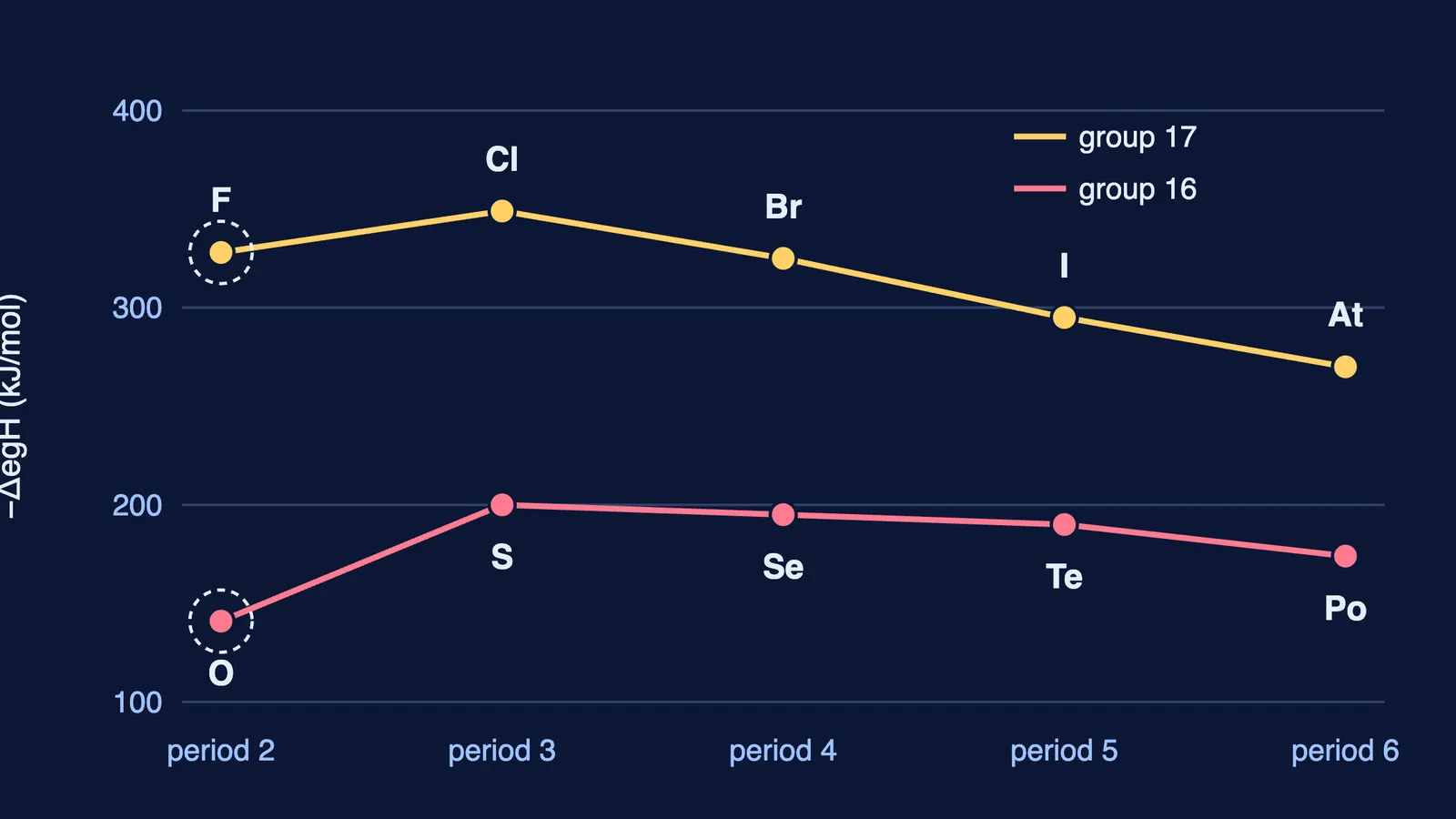
Q4 (medium). Assertion (A): The electron gain enthalpy of fluorine (−328 kJ/mol) is less negative than that of chlorine (−349 kJ/mol). Reason (R): Fluorine is the most electronegative element.
Answer: (B). Both are true, but R does not explain A. The cause is repulsion: the added electron enters fluorine's small, crowded n = 2 shell.
Trap: treating electronegativity and electron gain enthalpy as one property.
Q5 (hard). Assertion (A): The first ionization enthalpy of oxygen is lower than that of nitrogen. Reason (R): Oxygen has a larger nuclear charge than nitrogen.
Answer: (B). Both are true, but a larger nuclear charge would raise ionization enthalpy, not lower it. The dip comes from oxygen's fourth 2p electron, which is paired in one orbital; the extra repulsion makes it easier to remove.
Trap: picking (A) because both statements compare O with N.
Q6 (hard). Assertion (A): Gaseous boron needs less energy than gaseous beryllium to lose its first electron, although boron has one more proton. Reason (R): Boron loses a 2p electron, which penetrates less towards the nucleus than a 2s electron and is therefore more shielded by the inner core.
Answer: (A). Both are true, and R is NCERT's own explanation: boron's 2p electron is held less firmly than beryllium's 2s electron.
Trap: rejecting A because ionization enthalpy generally rises across a period.
Statement I and Statement II questions on periodicity
Judge each statement on its own against NCERT Unit 3; there is no "because" step.
Q7 (easy). Statement I: All Group 1 elements have an ns1 valence shell configuration. Statement II: The modern periodic law states that the properties of elements are periodic functions of their atomic masses.
Answer: (C). Statement I is correct. Statement II is incorrect: after Moseley showed that atomic number is the more fundamental property, the law was restated in terms of atomic numbers.
Trap: confusing Mendeleev's law (atomic masses) with the modern law.
Q8 (medium). Statement I: Like ionization enthalpy, electronegativity is a directly measurable quantity. Statement II: On the Pauling scale, fluorine was assigned an electronegativity of 4.0.
Answer: (D). Statement I is incorrect: NCERT says electronegativity is not measurable; numerical scales stand in for it. Statement II is correct.
Trap: assuming that a property with a table of numbers must be measured directly.
Q9 (medium). Statement I: Among the isoelectronic species O2−, F−, Na+ and Mg2+, Mg2+ has the smallest radius. Statement II: The ionic radius of F− (136 pm) is larger than the atomic radius of fluorine (64 pm).
Answer: (A). Both are correct. All four have 10 electrons, so Mg2+, with the most protons (12), holds them tightest. F− is larger than F because the added electron increases repulsion.
Trap: ranking isoelectronic ions by parent-atom size instead of nuclear charge.
Q10 (hard). Statement I: Boron can show a maximum covalency of 6, as in [BF6]3−. Statement II: Lithium and beryllium, like the heavier members of their groups, form mainly ionic compounds.
Answer: (B). Both are incorrect. Boron has only four valence orbitals (2s and 2p), so its maximum covalency is 4, as in [BF4]−; aluminium can form [AlF6]3−. Lithium and beryllium form compounds with pronounced covalent character.
Trap: carrying the group pattern up to the first member, which is anomalous because of its small size and high charge/radius ratio.
How should you use this set?
Cover the answers and write your key for all ten, with one line on why.
Wrong on whether a statement is true? That is a fact gap: reread the NCERT section. Wrong only between (A) and (B)? That is an explanation gap: find the textbook's own reason.
Then try our periodicity NEET practice set.
If a trap exposes a concept gap, such as shielding, the Fermi Concept Library has a lesson for every concept in chemistry, each with its place in the map.