On this page
Most NEET periodicity questions test one rule applied carefully. These 8 original questions run easy to hard; every wrong option is a real slip.
All of them sit inside Unit 9, Classification of Elements and Periodicity in Properties, of the NMC NEET (UG)-2026 syllabus, and inside NCERT Class 11 Chemistry Part I, Unit 3 (Reprint 2026-27). As in NEET-UG 2026, each has four options and one answer, with +4 for correct and -1 for wrong, according to the NTA information bulletin.
How should you use this periodicity practice set?
Cover the solutions and give each question about a minute.
Write the rule you will use before reading the options.
Read the trap line even when you get the answer right.
Log each miss with the rule you broke; redo it in three days.
For the full chapter plan and worked examples, start with how to prepare periodicity for NEET.
Easy: can you name, place and size an element?
Q1 (easy). Using the IUPAC rules for temporary names, what are the name and symbol of the element with atomic number 126?
(A) Unbisexium, Ubs (B) Unhexbiium, Uhb (C) Unbihexium, Ubh (D) Ununhexium, Uuh
Answer: (C). NCERT's Table 3.4 roots are un for 1, bi for 2 and hex for 6. Join them in digit order, add "ium", and take each root's first letter for the symbol: Unbihexium, Ubh. Trap: (A) borrows the Latin "sex" for 6; (D) is the old temporary name of element 116.
Q2 (easy). Silver (Z = 47) has the configuration [Kr] 4d¹⁰ 5s¹. Where does it sit in the periodic table?
(A) Period 5, group 1, s-block (B) Period 5, group 11, d-block (C) Period 4, group 11, d-block (D) Period 5, group 11, p-block
Answer: (B). The highest n is 5, so period 5. The 4d subshell is being filled, so d-block, and the group is (n-1)d + ns electrons: 10 + 1 = 11. Trap: (A) counts only the 5s electron, as if silver were an alkali metal.
Q3 (easy). Arrange Se²⁻, Br⁻, Rb⁺ and Sr²⁺ in decreasing order of ionic radius.
(A) Sr²⁺ > Rb⁺ > Br⁻ > Se²⁻ (B) Br⁻ > Se²⁻ > Sr²⁺ > Rb⁺ (C) All four are the same size (D) Se²⁻ > Br⁻ > Rb⁺ > Sr²⁺
Answer: (D). All four have 36 electrons. NCERT Unit 3 states that among isoelectronic species, the one with the larger nuclear charge has the smaller radius. The nuclear charges are 34, 35, 37 and 38, so Se²⁻ is largest and Sr²⁺ smallest. Trap: (A) assumes the heaviest ion is biggest.
Medium: can you read enthalpy data, valence and trends?
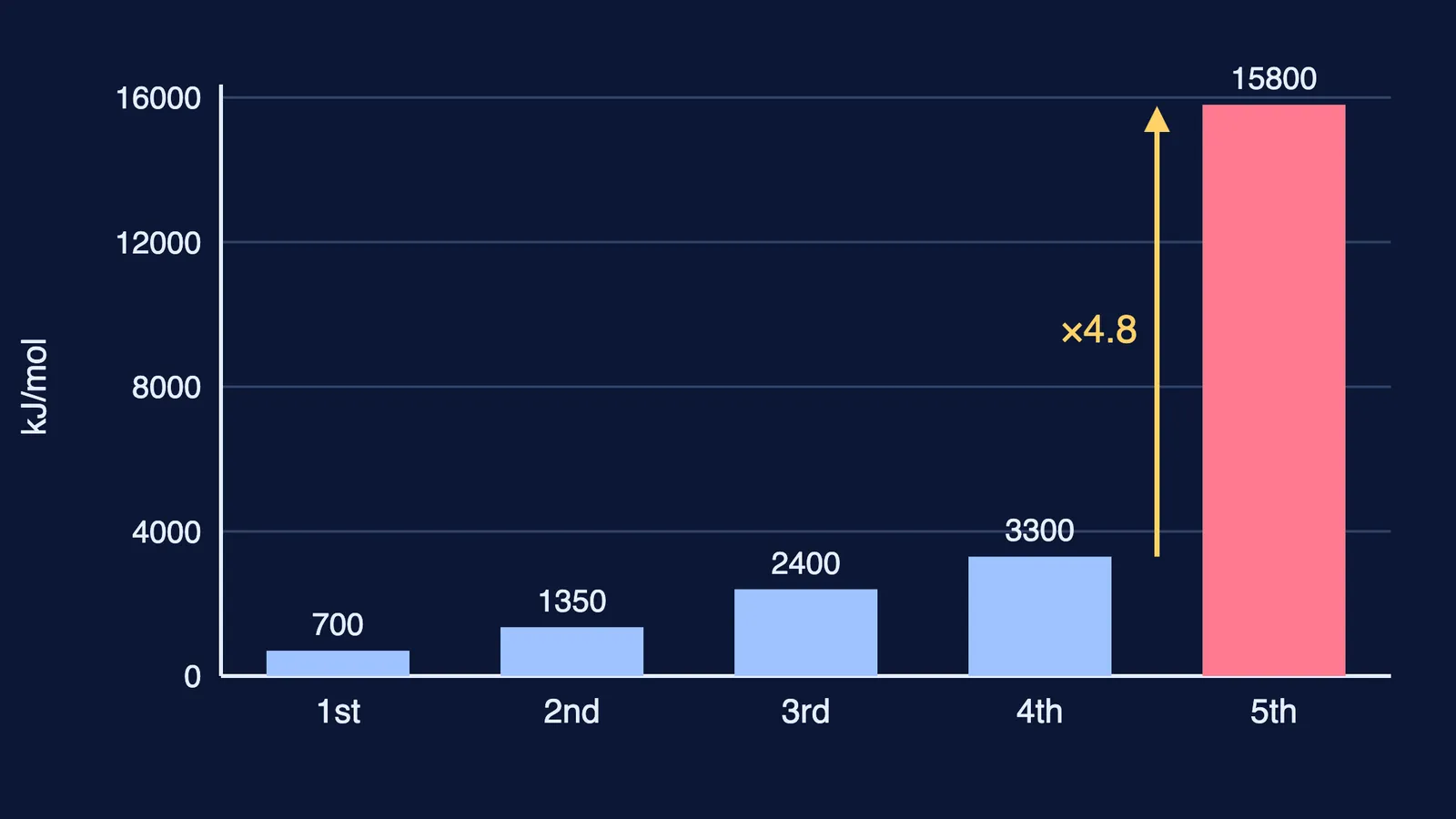
Q4 (medium). A made-up element M has successive ionization enthalpies of 700, 1350, 2400, 3300 and 15800 kJ/mol. What is the formula of its chloride?
(A) MCl₂ (B) MCl₃ (C) MCl₄ (D) MCl₅
Answer: (C). The ratios of successive values are 1.93, 1.78, 1.38 and 4.79. The jump comes after the fourth electron, so M has four valence electrons and forms MCl₄. Trap: (A) mistakes the first near-doubling for the jump. The diagram at the top draws these five values to scale.
Q5 (medium). Element X has Z = 20 and element Y has Z = 15. What is the formula of the binary compound they form?
(A) X₃Y₂ (B) X₂Y₃ (C) XY (D) XY₂
Answer: (A). X is [Ar] 4s², group 2, valence 2. Y is [Ne] 3s² 3p³, group 15, valence 8 - 5 = 3 (NCERT). Balancing 2 × 3 = 3 × 2 gives X₃Y₂ (calcium phosphide). Trap: (B) gets both valences right but swaps the subscripts.
Q6 (medium). Which statement about chemical reactivity matches the periodic trends?
(A) Across period 3, reactivity rises steadily from Na to Cl (B) Within a period, reactivity is highest at groups 1 and 17 and lowest in the middle (C) Down group 17, reactivity increases, as down group 1 (D) Sodium reacts mainly by gaining an electron
Answer: (B). NCERT explains it: the extreme left element loses an electron most easily, the extreme right one gains one most easily. Trap: (C) carries the alkali-metal trend to the halogens; NCERT says halogen reactivity decreases down the group.
Hard: can you combine configuration and enthalpy reasoning?
Q7 (hard). An element is in period 6, its last electron enters a p orbital, and its atom has three unpaired electrons. Which atomic number and group fit?
(A) Z = 51, group 15 (B) Z = 73, group 5 (C) Z = 69, group 15 (D) Z = 83, group 15
Answer: (D). Only p³ has three unpaired p electrons. In period 6 that is [Xe] 4f¹⁴ 5d¹⁰ 6s² 6p³: 54 + 14 + 10 + 2 + 3 = 83 (bismuth), group 10 + 2 + 3 = 15. Trap: (C) forgets the 4f¹⁴ electrons; (B) tantalum's three unpaired electrons are 5d.
Q8 (hard). Read the two statements.
Statement I: The second ionization enthalpy of magnesium is lower than the second ionization enthalpy of aluminium.
Statement II: The third ionization enthalpy of aluminium is higher than the third ionization enthalpy of magnesium.
(A) Both statements are correct (B) Both statements are incorrect (C) Statement I is correct, Statement II is incorrect (D) Statement I is incorrect, Statement II is correct
Answer: (C). Statement I: Mg⁺ (3s¹) and Al⁺ (3s²) both lose a 3s electron, but Al has one more proton, so its value is higher. Statement II: Al²⁺ still loses a 3s electron; Mg²⁺ must break its neon core. NIST data, converted to kJ/mol, give 1451 and 7733 for Mg, and 1817 and 2745 for Al (NIST Atomic Spectra Database). Trap: (A) applies "one more proton wins" to both steps and misses the core in the second.
What should you do after checking your answers?
7 or 8 correct: try timed mixed sets, such as our structure of atom NEET practice questions.
4 to 6 correct: redo each miss tomorrow, writing the configuration first.
3 or fewer: reread sections 3.5 to 3.7 of NCERT Unit 3, then our Class 11 notes on periodic trends and exceptions, and try the set again in a week.
If a step still does not click, the Fermi Problem Library has worked problems with a step-by-step solver that explains the reasoning rather than printing an answer.