On this page
Three original case studies, easiest first. Class 11 exams are set by schools, so treat these as practice, not a forecast. Every fact follows the NCERT Chemistry Part I chapter (Reprint 2026-27), which is Unit 3 of the CBSE 2026-27 Class XI Chemistry curriculum. For the theory, read our Classification of Elements Class 11 guide on trends and exceptions.
Case 1: Tiles for a periodic table wall
A science club in Bhopal is painting a periodic table on a wall: 18 columns, 7 rows and two rows of 14 for the lanthanoids (Ce to Lu) and actinoids (Th to Lr). Each of the 118 tiles shows an official name on the front and the temporary IUPAC name on the back, built from the digit roots nil (0), un (1), bi (2), tri (3), quad (4), pent (5), hex (6), sept (7), oct (8) and enn (9) plus "ium". Tile 113 is nihonium, whose configuration ends in 7p¹; tile 116 is livermorium. One student adds a tile for element 119, beyond the 118 NCERT lists as discovered.
(i) What is the temporary IUPAC symbol on the back of tile 116? (a) Unh (b) Uuh (c) Ubh (d) Uhx
(ii) In which period, group and block does nihonium belong?
(iii) Write the temporary name and symbol for element 119, and the group and period it would start.
(iv) Predict the formulas of the oxide and chloride of element 119, and whether the oxide is acidic or basic, with a reason.
Answers.
(i) (b) Uuh, ununhexium. Unh is element 106.
(ii) Period 7, group 13, p-block: the last electron enters a 7p orbital.
(iii) Ununennium, Uue. Period 7 ends at 118, so 119 would open period 8 in group 1, as [Og]8s¹.
(iv) M₂O and MCl, since group 1 has a valence of 1. The oxide would be basic, like Na₂O: elements on the extreme left lose their ns electron easily.
Case 2: Which kitchen and bathroom ions are isoelectronic?
A student in Kolkata lists the ions in four things at home: table salt (Na⁺, Cl⁻), low-sodium salt with KCl (K⁺, Cl⁻), toothpaste with sodium fluoride (Na⁺, F⁻) and an antacid with magnesium hydroxide (Mg²⁺). Her textbook gives four radii: fluorine atom 64 pm and fluoride ion 136 pm; magnesium atom 160 pm and Mg²⁺ ion 72 pm. She expects all 10-electron ions to be the same size.
(i) Which ion in her list has the same number of electrons as K⁺? (a) Na⁺ (b) F⁻ (c) Cl⁻ (d) Mg²⁺
(ii) Name the three ions in her list that are isoelectronic with neon, and the largest of them.
(iii) By what percentage does the radius change when F becomes F⁻, and when Mg becomes Mg²⁺?
(iv) Correct her using F⁻ and Mg²⁺. Is Na⁺ or K⁺ larger, and why?
Answers.
(i) (c) Cl⁻: 17 + 1 = 18 electrons, the same as K⁺ (19 − 1 = 18).
(ii) F⁻, Na⁺ and Mg²⁺ (10 electrons each); F⁻ is largest.
(iii) F to F⁻: (136 − 64)/64 × 100 = 112.5% larger. Mg to Mg²⁺: (160 − 72)/160 × 100 = 55% smaller.
(iv) The same 10 electrons are pulled by 9 protons in F⁻ but 12 in Mg²⁺, so Mg²⁺ is far smaller (72 pm against 136 pm). K⁺ is larger than Na⁺: its electrons fill the n = 3 shell, while Na⁺ stops at n = 2.
Case 3: Which metal is in the scrap?
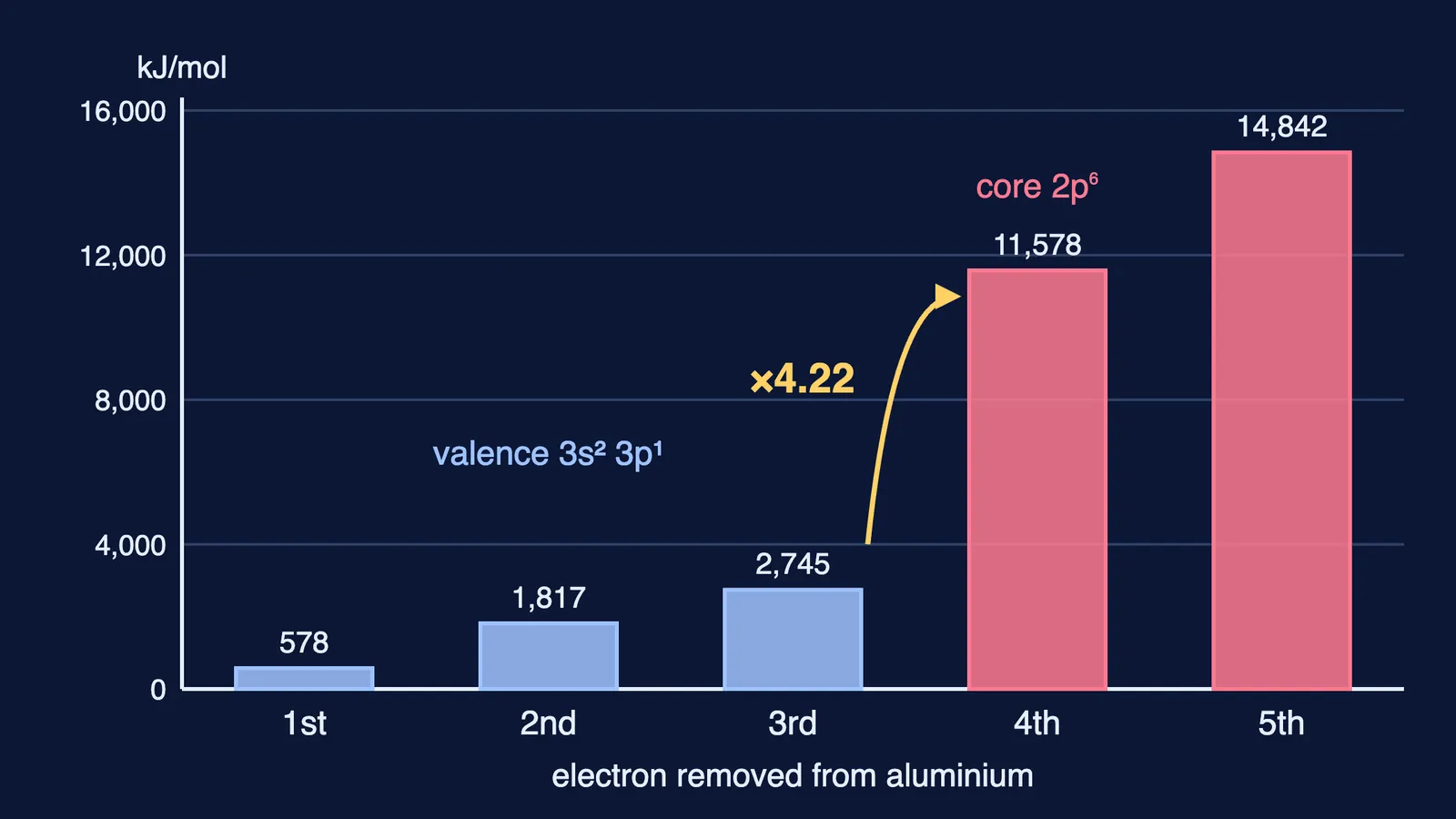
A recycling unit in Pune sorts offcuts of a light, silvery metal M from old window frames. A college lab reports its first five successive ionisation enthalpies as 578, 1,817, 2,745, 11,578 and 14,842 kJ/mol (NIST Atomic Spectra Database values, converted from eV and rounded). The oxide of M dissolves both in dilute hydrochloric acid and in sodium hydroxide solution. The lab also lists first ionisation enthalpies for phosphorus (1,012 kJ/mol) and sulphur (1,000 kJ/mol) from the same database.
(i) Between which two successive ionisations is the largest jump? (a) 1st and 2nd (b) 2nd and 3rd (c) 3rd and 4th (d) 4th and 5th
(ii) Which group does M belong to? Write the formulas of its oxide and chloride.
(iii) What kind of oxide does M form, and what does that say about where M sits in its period?
(iv) Find the energy to turn one mole of gaseous M atoms into M³⁺ ions, and explain why the fourth electron costs so much more. Then explain why sulphur's first ionisation enthalpy is below phosphorus's.
Answers.
(i) (c). The ratios are 1,817/578 = 3.14, 2,745/1,817 = 1.51, 11,578/2,745 = 4.22 and 14,842/11,578 = 1.28; the rise of 8,833 kJ/mol dwarfs the others.
(ii) Three electrons come off before the jump, so M is in group 13 (it is aluminium): oxide M₂O₃, chloride MCl₃.
(iii) Amphoteric: basic with acids, acidic with bases. Such oxides come from the centre of a period, between basic Na₂O and acidic Cl₂O₇.
(iv) 578 + 1,817 + 2,745 = 5,140 kJ per mole. M³⁺ has the neon configuration, so the fourth electron comes from the n = 2 shell, closer to the nucleus and less shielded. In sulphur (3s² 3p⁴) two 3p electrons share an orbital, and the extra repulsion makes one easier to remove than phosphorus's unpaired 3p electrons, just as oxygen sits below nitrogen.
How do you attack periodicity case study questions?
Mark the units first: radii in pm, enthalpies in kJ/mol.
With successive ionisation enthalpies, find the biggest ratio, not the biggest number. Electrons before the jump are the valence electrons.
For names above 100, swap each digit for its root, add "ium"; the first letters give the symbol.
Learn each exception with a one-line reason: Be above B and Mg above Al (p electron is easier to remove), N above O and P above S (paired p electron), and O and F less negative in electron gain enthalpy than S and Cl (crowded n = 2 shell).
For oxides, place the element first: left basic, right acidic, centre amphoteric or neutral.
For long passages under time pressure, see our guide to case-based questions in board exams, and for harder numericals, try the periodic trends practice questions with solutions. If shielding still feels shaky, the Fermi Concept Library has a lesson for every chemistry concept, each with its place in the map.