On this page
Patterns in Life: Diversity and Classification is Chapter 12 of Exploration, the new NCERT Class 9 science textbook (first edition April 2026, per its imprint page). The CBSE Class IX Science curriculum for 2026-27 lists its key concepts: classification, the five kingdoms, major divisions of plants and animals, binomial nomenclature and viruses. Below are the chapter's key terms in six groups. For a study plan, read our Patterns in Life Class 9 chapter guide.
What do biodiversity and classification mean?
Biodiversity: the whole variety of living things on Earth, from microbes to giant trees, in every habitat.
Endemic species: a species found naturally in only one region of the world. Example: the Nilgiri tahr and Neelakurinji, found wild only in India.
Biodiversity hotspot: a region rich in endemic species that has already lost much of its natural habitat. Example: the Western Ghats. Don't confuse with: endemic species; one describes a species, the other a place.
Biological classification: grouping living things by similarities and differences (cells, nutrition, body features, DNA) into one shared system.
Fossils: traces of plants and animals from long ago, kept in rock, sand or mud layers. Deeper, older layers usually show simpler life; newer layers show more complex forms.
Which features sort life into five kingdoms?
Prokaryote: a cell with no true, membrane-bound nucleus. Example: bacteria.
Eukaryote: a cell with a membrane-bound nucleus. Example: *Amoeba*. Don't confuse with: prokaryote; bacteria and *Amoeba* are both single-celled, but only *Amoeba* has a true nucleus.
Autotrophic nutrition: making your own food, as plants do by photosynthesis. Don't confuse with: heterotrophic nutrition, depending on other organisms for food, as animals and fungi do.
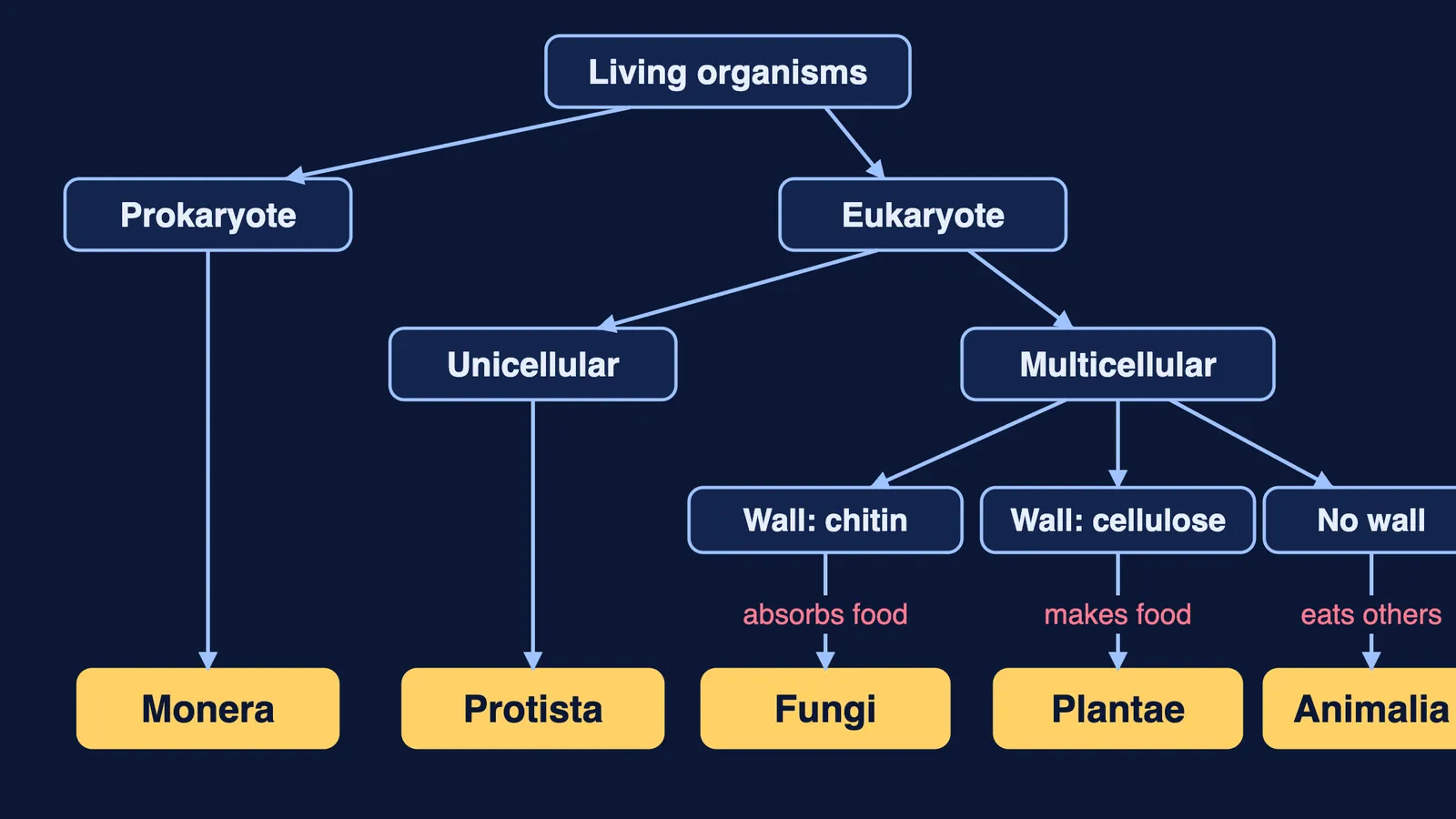
Five kingdom classification: Robert Whittaker's 1969 system of Monera, Protista, Fungi, Plantae and Animalia, sorted by cell type, cell wall, number of cells and nutrition (diagram above).
Three domain system: Carl Woese's 1977 grouping into Bacteria, Archaea and Eukarya, based on comparing DNA.
What are Monera, Protista and Fungi?
Monera: unicellular prokaryotes. Example: bacteria such as *Lactobacillus* and *Rhizobium*, and cyanobacteria.
Protista: single-celled eukaryotes with no cell wall or a cellulose wall, living in water or moist places. Example: *Amoeba*, *Paramecium*, *Euglena*.
Fungi: eukaryotes, mostly multicellular, with chitin cell walls, that absorb food instead of making it. Example: mushrooms, *Aspergillus*. Single-celled yeast sits here because its wall is chitin.
Saprophyte: an organism that feeds on dead, decaying matter, as most fungi do through a thread network called mycelium. Don't confuse with: a parasite, which feeds on a living host.
Lichen: a partnership of an alga, which makes food, and a fungus, which gives protection. Their colour changes with air pollutants, making them bioindicators.
Virus: an acellular entity with genetic material but no cell, so it fits none of the five kingdoms.
How are plants divided into five groups?
Plantae: multicellular eukaryotes that photosynthesise and have cellulose cell walls, split into five classes.
Thallophyta: the simplest plants, with an undivided body (thallus) that exchanges water, gases and nutrients directly. Example: *Spirogyra*.
Bryophyta: land plants that still need water to reproduce, with root-like rhizoids and no vascular tissue; the "amphibians" of the plant kingdom. Example: moss, *Marchantia*.
Pteridophyta: plants with true roots, stems and leaves and vascular tissue (xylem carries water, phloem carries food), but no seeds. Example: ferns. Don't confuse with: bryophytes, which lack both.
Gymnosperms: plants with naked seeds, not enclosed in a fruit, often on cones. Example: pine, cycads.
Angiosperms: flowering plants whose seeds form inside fruits. Example: gulmohar. Don't confuse with: gymnosperms, which make seeds but no fruits.
How are animals classified?
Notochord: a flexible rod-shaped support. Having one or not splits Animalia (multicellular, no cell wall, feeding on others) into chordata and non-chordata.
Invertebrates (non-chordata): animals without a notochord, in eight phyla, from sponges (Porifera, no true tissues) and Cnidaria (tentacles, one opening) to Platyhelminthes, Nematoda, Annelida, Arthropoda, Mollusca and Echinodermata.
Bilateral symmetry: a body that one plane divides into two matching halves, with head and tail ends. Example: flatworms.
Segmentation: a body divided into repeated segments. Example: earthworm (Annelida). Don't confuse with: arthropods, also segmented but with jointed appendages and a hard outer skeleton.
Exoskeleton: a hard outer covering that protects and cuts water loss. Example: crabs, insects. Don't confuse with: endoskeleton, an internal skeleton, made of calcium carbonate in starfish, which still lack a notochord.
Protochordates: primitive chordates in which a notochord appears at some stage of life, even if not throughout. Example: *Amphioxus*.
Vertebrates: animals with a backbone (vertebral column) protecting the brain and spinal cord, in five groups: fish, amphibians, reptiles, birds and mammals. The chapter gives no full feature list for each.
How do you write a scientific name?
Hierarchy of classification: ranks from broadest to narrowest: kingdom, phylum, class, order, family, genus, species. Lower ranks share more features. Example: tiger: Animalia, Chordata (sub-phylum Vertebrata), Mammalia, Carnivora, Felidae, *Panthera*, *Panthera tigris*.
Genus: a group of closely related species. Example: *Panthera* holds the tiger (*Panthera tigris*) and the lion (*Panthera leo*).
Species: the narrowest rank, a group of individuals alike enough to breed with one another and have young.
Binomial nomenclature: Carolus Linnaeus's 18th-century two-part naming system in Latin or Latinised words: capitalised genus, then species in lower case, italic in print or underlined by hand. Example: *Mangifera indica* (mango). Don't confuse with: common names such as bagh or puli, which change with language.
How to learn these terms
Learn the five kingdoms as four questions in order: true nucleus? one cell or many? cell wall of what? makes its own food? Redraw the tree from memory.
Learn in pairs: prokaryote and eukaryote, endemic species and hotspot, gymnosperm and angiosperm, exoskeleton and endoskeleton, genus and species.
Tell plants as a move onto land: thallus, rhizoids, vascular tissue, seeds, then flowers and fruits.
Write every scientific name in the chapter by hand, checking all three rules.
Going on to Class 11? See our Class 11 Biological Classification guide (five kingdoms, viruses and lichens) and our Class 11 The Living World guide (taxonomic hierarchy and naming rules). If a term still feels hazy, the Fermi Concept Library has every concept in biology, each with its own lesson and its place in the map.