On this page
Our Apparel is Chapter 9 of NCERT's Human Ecology and Family Sciences Part II for Class 11. It asks why people wear clothes, and what a child needs from clothing at each age up to adolescence. Here is the 2026-27 syllabus, the core ideas and practice questions.
What does Our Apparel cover in CBSE Class 11 for 2026-27?
The CBSE Home Science (064) curriculum for 2026-27 places Our Apparel in Unit IV, Childhood, alongside Nutrition, Health and Well-being. Unit IV carries 15 of the 70 theory marks, shared by both chapters; CBSE prints no separate figure for this one.
The curriculum lists five parts: clothing functions and selection, factors affecting selection in India, children's basic needs, needs at each childhood stage, and special-needs clothing. The current NCERT chapter (Reprint 2026-27) covers all five.
One mismatch: the curriculum gives the school years as 5-11 and adolescence as 11-19, while the textbook says 6-11 and 11-18. Check with your teacher which ranges to use.
Why do we wear clothes?
NCERT names four reasons. Give an example for each.
Modesty: covering the body is learnt, not inborn, and what counts as modest differs between communities.
Protection: from weather, dirt and pollution, and from physical harm, as with a firefighter's suit or a cricketer's pads.
Status and prestige: clothes once marked social class clearly; affordable, common styles such as jeans now act partly as levellers.
Adornment: every society has some wish to look attractive.
Five factors shape what a family picks for a child: age, climate and season, occasion, fashion and income. A fad is a fashion that exaggerates one feature or reaches only part of society, and it fades fast. One reason schools set uniforms is to play down income differences.
What do all children need from their clothes?
Some needs apply to every child. Ask six questions of any garment.
Comfort: can the child run and climb in it? Tight bands fail.
Safety: any loose trims, long sashes or swallowable buttons? Bright colours help drivers see a child.
Self-help: can the child dress alone? Large front openings and big buttons pass; tiny hooks and bows at the neck fail.
Appearance: does the child have a say, and are prints in scale with a small body?
Growth: can it be let out? Raglan sleeves, let-down trouser cuffs and adjustable straps help; buying far too big does not.
Easy care: does it wash easily, with flat seams and reinforced knees?
Cotton is the fabric the book says is most widely used, since it washes easily and is comfortable. Wool should not touch a child's skin, and a cotton-polyester blend absorbs better than pure polyester.
How do clothing needs change from infancy to adolescence?
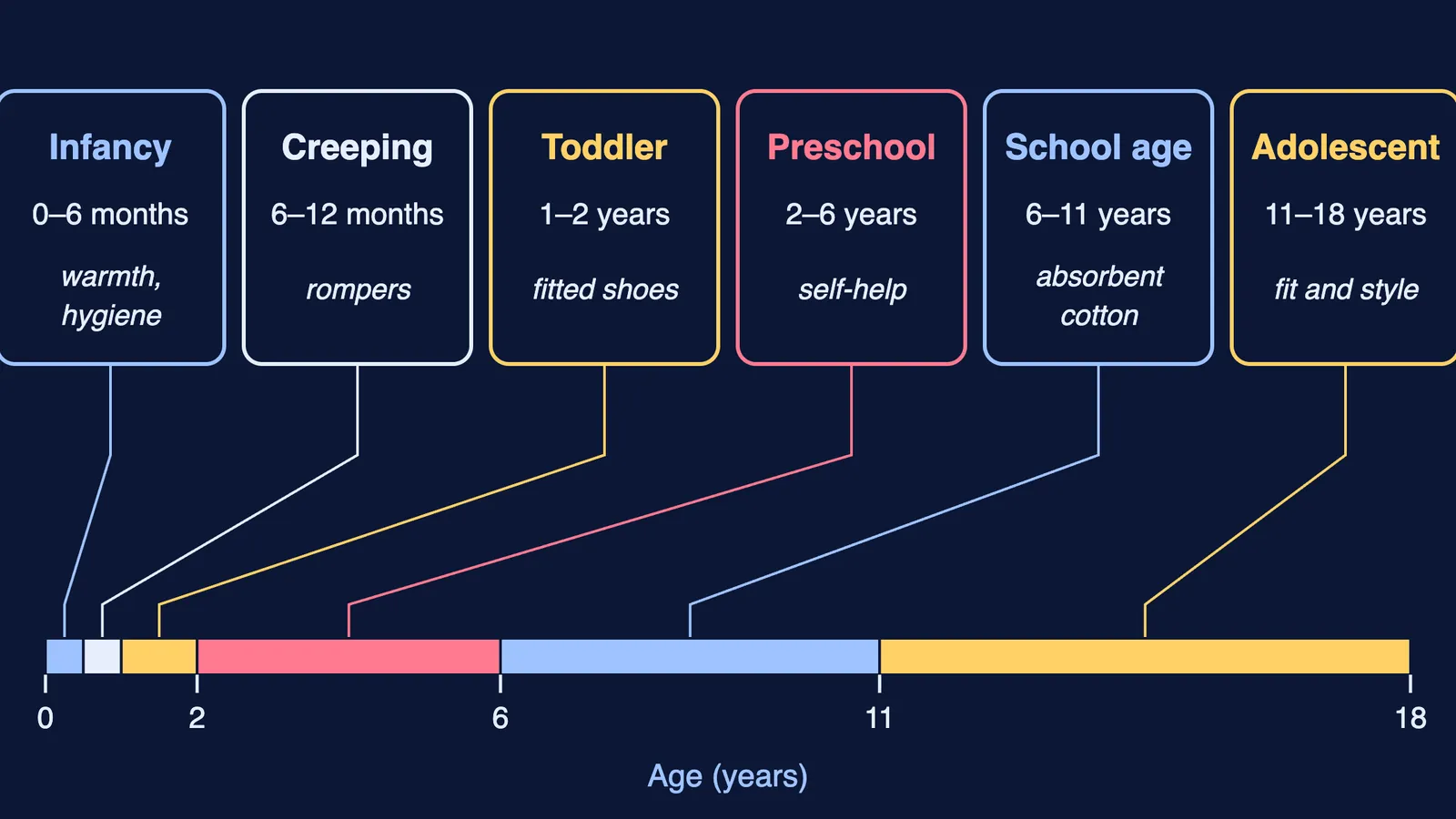
The textbook splits childhood into six stages, shown in the diagram above.
Infancy (birth to 6 months): warmth, comfort and hygiene. Front openings, no neck drawstrings, soft unsized fabric, plenty of shirts and diapers.
Creeping age (6 months to 1 year): loose, light clothes for crawling. Rompers and sun-suits suit this stage.
Toddlerhood (1-2 years): shoes become the main concern, fitted on the child for length, width, toe room and heel. Overalls with room for a diaper work well.
Preschool (2-6 years): hard-wearing pre-shrunk cotton, self-help features and a say in style. Twins need not dress alike.
Elementary school (6-11 years): peer acceptance and fit matter; absorbent fabrics handle sweat from sport.
Adolescence (11-18 years): fast, uneven growth, so keep the wardrobe small in the early years. Fit and style lead, and fads matter.
What should clothes for children with special needs look like?
Dressing alone builds a child's sense of competence. Garments are chosen for the type of disability: strong fabric that resists rubbing from wheelchairs or orthotic devices, reinforcement where calipers and braces press, Velcro or key-chain zippers, wide necklines, elastic waists and front plackets. They should still look like any child's clothes. The best garment meets the needs of both wearer and carer.
Heading to Class 12? See Design for Fabric and Apparel Class 12 and Fashion Design and Merchandising Class 12. For child development, read Early Childhood Care and Education Class 12.
Practice questions for Our Apparel
The mark labels below are our suggestion, not CBSE's.
(1 mark) Name the stage at which the selection of shoes becomes the main clothing concern.
(2 marks) Define a fad and give one reason it does not last.
(3 marks) Ravi, aged 7, has a jacket with small hooks at the back. Explain two self-help problems and suggest two changes.
(4 marks) A family in a cold hill town has a 3-month-old baby. Suggest four clothing choices with reasons.
(5 marks) Design an outfit for a 9-year-old who uses a wheelchair. Justify the fabric, openings and fasteners.
Not sure where to start your revision tonight? Fermi's AI tutor works out what you already know and builds a plan for the session.