On this page
Food, Nutrition, Health and Fitness is Chapter 3 of the NCERT Human Ecology and Family Sciences Part I textbook for Class 11 (reprint 2026-27). Here are the key ideas, two worked meal-planning answers and practice questions we wrote ourselves.
How many marks is Food, Nutrition, Health and Fitness worth?
The CBSE Home Science (064) curriculum for 2026-27 gives Unit II, Understanding oneself: Adolescence, 23 of the 70 theory marks. Five chapters share those 23 marks: Understanding the Self, this chapter, Management of Resources, Fabric Around Us, and Media and Communication Technology. There is no separate figure for this chapter.
The curriculum's topic list matches NCERT sections 3.1 to 3.9. In the practical exam, preparing healthy snacks for an adolescent carries 7 of the 30 marks.
What are food, nutrition, nutrients and a balanced diet?
Food: anything solid or liquid that, once swallowed, digested and assimilated, gives the body nutrients.
Nutrition: the science of foods and nutrients and what they do in the body, from ingestion to excretion.
Nutrients: proteins, carbohydrates, fats, vitamins, minerals, fibre and water. Macronutrients are needed in large amounts, micronutrients (such as iron, iodine and vitamins) in small amounts.
Balanced diet: many kinds of food, in the right quantities and ratios, so that every nutrient the day needs is covered, plus a safety margin.
The formula to learn by heart is RDA = requirement + margin of safety (NCERT Chapter 3).
Health and fitness are not the same thing. The chapter uses the WHO definition of health: full physical, mental and social well-being, which is more than simply being free of disease. Physical fitness is narrower. NCERT's current definition is the body's capacity to perform well at work and leisure, stay healthy, resist disease and handle emergencies. It lists five categories: flexibility, aerobic fitness, body composition, muscular strength and muscular endurance.
How do the food groups and the pyramid help plan meals?
NCERT uses the five food groups suggested by ICMR: cereals and grains; pulses and legumes; milk and meat; fruits and vegetables; fats and sugars. Key rules: include every group, pair cereals with pulses in vegetarian meals, include milk, and keep cereals to at most 75 per cent of total energy (NCERT Chapter 3).
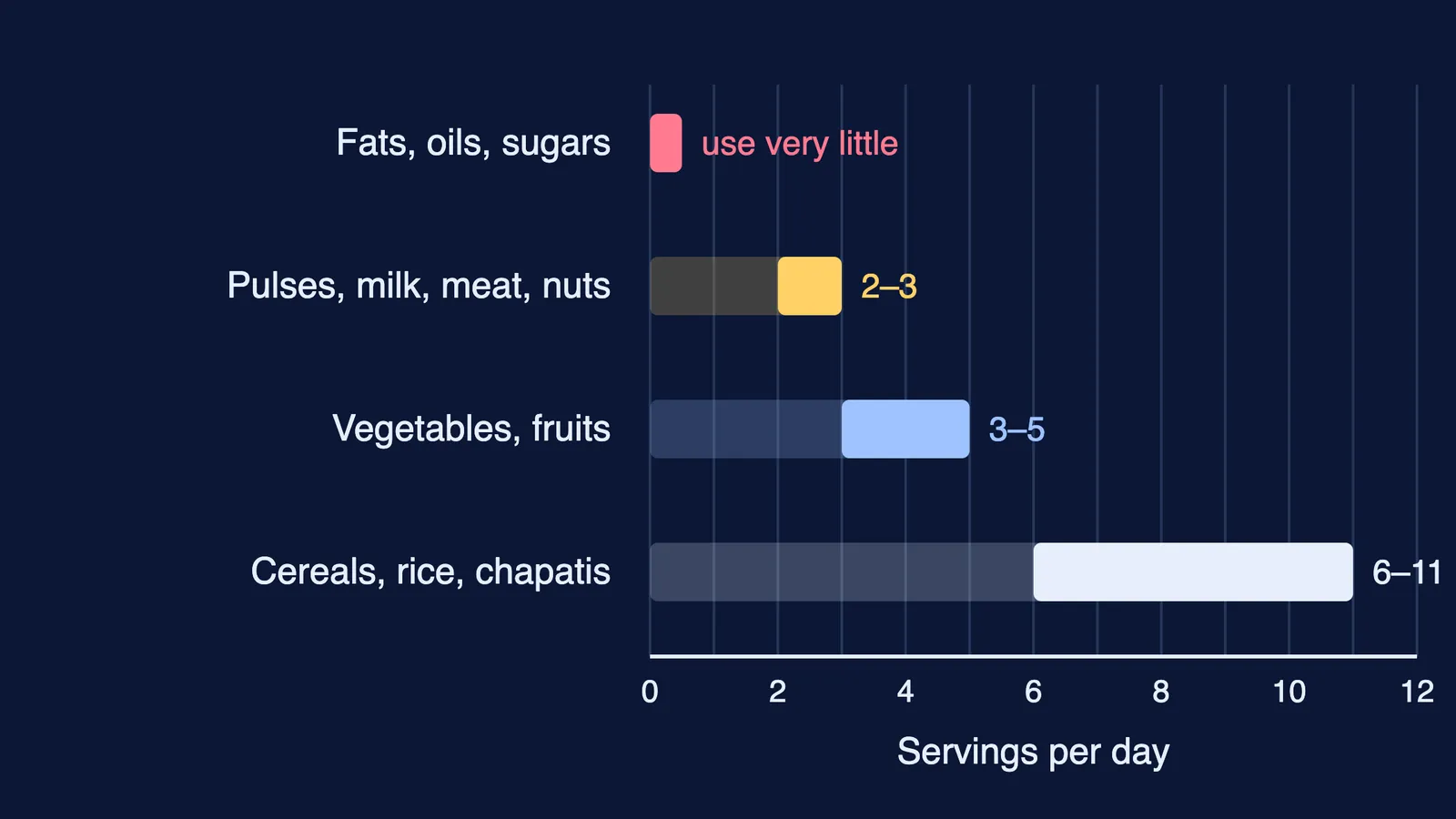
The food guide pyramid in the chapter turns this into daily servings: 6 to 11 of cereals, 3 to 5 of vegetables and fruits, 2 to 3 of body-building foods, and very little fat, oil and sugar.
What shapes teen eating, and what are eating disorders?
NCERT names common teen habits: skipping meals, eating fast food routinely, avoiding fruits and vegetables, frequent snacking and dieting. Influences are external (family, peers, media, food fads) or internal (body image, values, food preferences).
The chapter describes two eating disorders. Anorexia nervosa is tied to a distorted body image: the person eats very little and believes they are fat even when underweight. Bulimia involves bingeing followed by purging.
Helpline source: the Tele MANAS launch release.
Worked meal-planning answers
These are practice numbers, not intake targets. Energy values are NCERT's: 1 g carbohydrate gives 4 kcal, 1 g protein 4 kcal and 1 g fat 9 kcal (NCERT Chapter 3).
Example 1. A snack portion has 40 g carbohydrate, 10 g protein and 6 g fat. Find its energy and the share from fat.
Carbohydrate: 40 × 4 = 160 kcal.
Protein: 10 × 4 = 40 kcal.
Fat: 6 × 9 = 54 kcal.
Total: 160 + 40 + 54 = 254 kcal. Fat share: 54 ÷ 254 = 21.3 per cent.
Example 2. A one-day plan gives 2,200 kcal, with cereals supplying 1,540 kcal. Does it follow the 75 per cent rule?
Cereal share: 1,540 ÷ 2,200 = 70 per cent, so yes.
If cereals supplied 1,760 kcal, the share would be 80 per cent. The limit is 0.75 × 2,200 = 1,650 kcal, so the plan is 110 kcal over the limit.
Practice questions (our suggestion)
The mark labels are our suggestion.
(1 mark) Which nutrient gives 9 kcal per gram?
(2 marks) Why does a diet that meets the RDA still leave a reserve for a day of fasting?
(3 marks) A lunch has rice, dal and curd. Which of the five food groups are missing, and which two items would you add?
(4 marks) A 16-year-old skips breakfast to lose weight. Using the chapter, explain why this can backfire and name two healthier habits.
(5 marks) A snack has 30 g carbohydrate, 8 g protein and 10 g fat. Find its total energy and the percentage from each nutrient.
Answers: Q1, fat. Q5, 242 kcal: about 49.6 per cent from carbohydrate, 13.2 per cent from protein and 37.2 per cent from fat.
Next, see our Class 12 guides to Public Nutrition and Health and Clinical Nutrition and Dietetics, and our Class 11 PE fitness guide.
Short on revision time this week? Fermi's AI tutor works out what you already know and builds a plan for the session.