On this page
Clinical Nutrition and Dietetics is Chapter 2 of the NCERT Human Ecology and Family Sciences Part I textbook for Class 12 (reprint 2026-27). It covers diet during illness, the dietitian's role and careers. Here are the key ideas, a frame for diet questions and our own practice questions.
How many marks is Clinical Nutrition and Dietetics worth?
The CBSE Home Science (064) curriculum for 2026-27 gives Unit II, Nutrition, Food Science and Technology, 23 of the 70 theory marks. Four chapters share those 23 marks: this one, Public Nutrition and Health, Food Processing and Technology, and Food Quality and Food Safety. There is no chapter figure.
Its topic list runs from diet therapy and diet types to careers and scope. Its first Class 12 practical asks you to turn a normal diet into a soft diet for an elderly person.
What is clinical nutrition?
NCERT defines clinical nutrition as the branch of nutrition that deals with nutrition during illness, now also called medical nutrition therapy (NCERT Chapter 2). Illness can make it hard to eat, swallow, digest or absorb food.
The chapter gives five objectives of diet therapy:
Help recovery with a diet that fits the patient's food habits.
Modify the usual diet to keep the disease under control.
Correct any nutritional deficiency.
Prevent short- and long-term complications of chronic disease.
Counsel the patient to stick to the prescribed diet.
What does a dietitian do?
Nutritional care during illness runs in four steps: assess nutritional status, diagnose the nutritional problem, plan and prioritise the intervention, then monitor, evaluate and adjust. Assessment uses health, diet and medication histories, body measurements (anthropometry), and lab and physical findings read with the doctor's diagnosis.
The physician stays responsible for the patient's medical needs. Working from that diagnosis and the assessment, the dietitian prescribes the diet, checks that hospital food follows it and counsels the patient. NCERT describes the dietitian as an integral part of the medical team.
To work as one, the chapter's route is 10+2, then a BSc in Home Science or in Nutrition or Food Technology, then at least a Postgraduate Diploma in Dietetics plus an internship to qualify as a registered dietitian. College teaching needs the UGC's National or State Eligibility Test. Our guide to BSc Nutrition and Dietetics careers covers degrees and roles in more depth.
What are regular and modified diets?
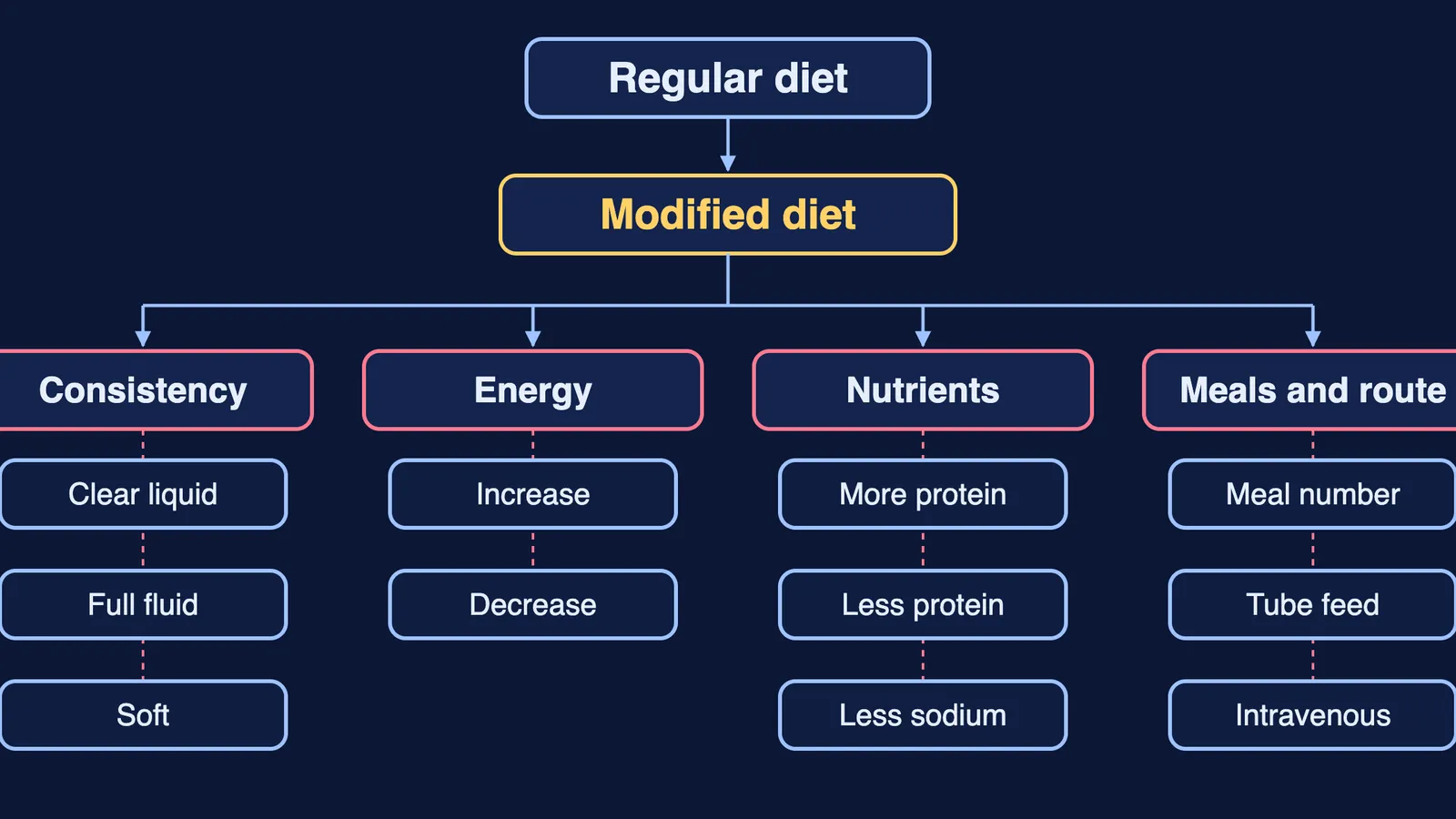
A regular diet includes all food groups and meets a healthy person's needs; in hospitals it is kept low in fried foods, sweets and spices. A modified diet is adjusted to a patient's medical needs in one or more of four ways:
Consistency: a clear liquid diet (clear soup, pulp-free juice) comes just after surgery; a full fluid diet suits people who cannot chew or swallow normally; a soft diet such as khichdi or sago kheer is easy to chew and digest.
Energy: more or fewer calories.
Nutrients: more protein after surgery, less protein in kidney failure, less sodium, or less spinach because it is rich in oxalates.
Meals and route: more or fewer meals, new intervals, or a new feeding route. Eating by mouth comes first. If that fails but the gut still works, tube feeding is preferred to intravenous feeding.
Keep the two soft diets apart. A mechanical soft diet (soft, mashed or pureed food) helps older people who struggle to chew. A therapeutic soft diet rests the digestive system, with no harsh fibre, high fat or spice.
How does diet help prevent chronic diseases?
NCERT notes that urban Indian diets now carry more fat and refined sugar and less fibre, vitamins and minerals. It links these shifts to obesity, diabetes, heart disease, hypertension and colon cancer, with low activity adding to obesity and diabetes risk. Clinical nutritionists can counsel individuals and groups such as schools.
Practice questions for Clinical Nutrition and Dietetics
The CBSE 2026-27 sample paper uses 1-mark MCQs and 2-, 3-, 4- and 5-mark answers. These questions are ours.
(1 mark, MCQ) Straight after an operation, which diet is usually given first? (a) soft (b) mechanical soft (c) clear liquid (d) regular.
(2 marks) Give one difference between a mechanical soft diet and a therapeutic soft diet.
(3 marks) A patient is unconscious, but the digestive tract still works. Which feeding route is preferred, and why? Name the other option.
(4 marks) List four nutrient-level diet changes from the chapter. For two of them, name the situation the chapter links them to.
(5 marks) A school hires a clinical nutritionist. Explain two urban diet trends, the diseases linked with them, and two ways the nutritionist could help students.
Answer to Q1: (c) clear liquid.
Then revise the rest of Unit II: Public Nutrition and Health and Food Quality and Food Safety.
Got a free evening this week? Fermi's AI tutor works out what you already know and builds a plan for the session.