On this page
Chapter 3(A), Law of Contract, opens Unit 3 of the CBSE Legal Studies Class XII textbook, revised in 2023. Its question: when does a promise become something a court will enforce?
What does the Law of Contract chapter cover in 2026-27?
The CBSE Legal Studies curriculum for 2026-27 places it in Unit 3, Business Laws (titled Topics in Law I), and lists nine topics, from introduction and formation to discharge and remedies. Unit 3 carries 20 marks shared by four chapters (Contract, Torts, Property and Intellectual Property Law), so contract law has no separate figure.
The 2026-27 sample paper uses 1-mark multiple choice (including assertion-reason) and 2-, 3- and 5-mark answers capped at 40, 100 and 140 words.
When does an agreement become a contract?
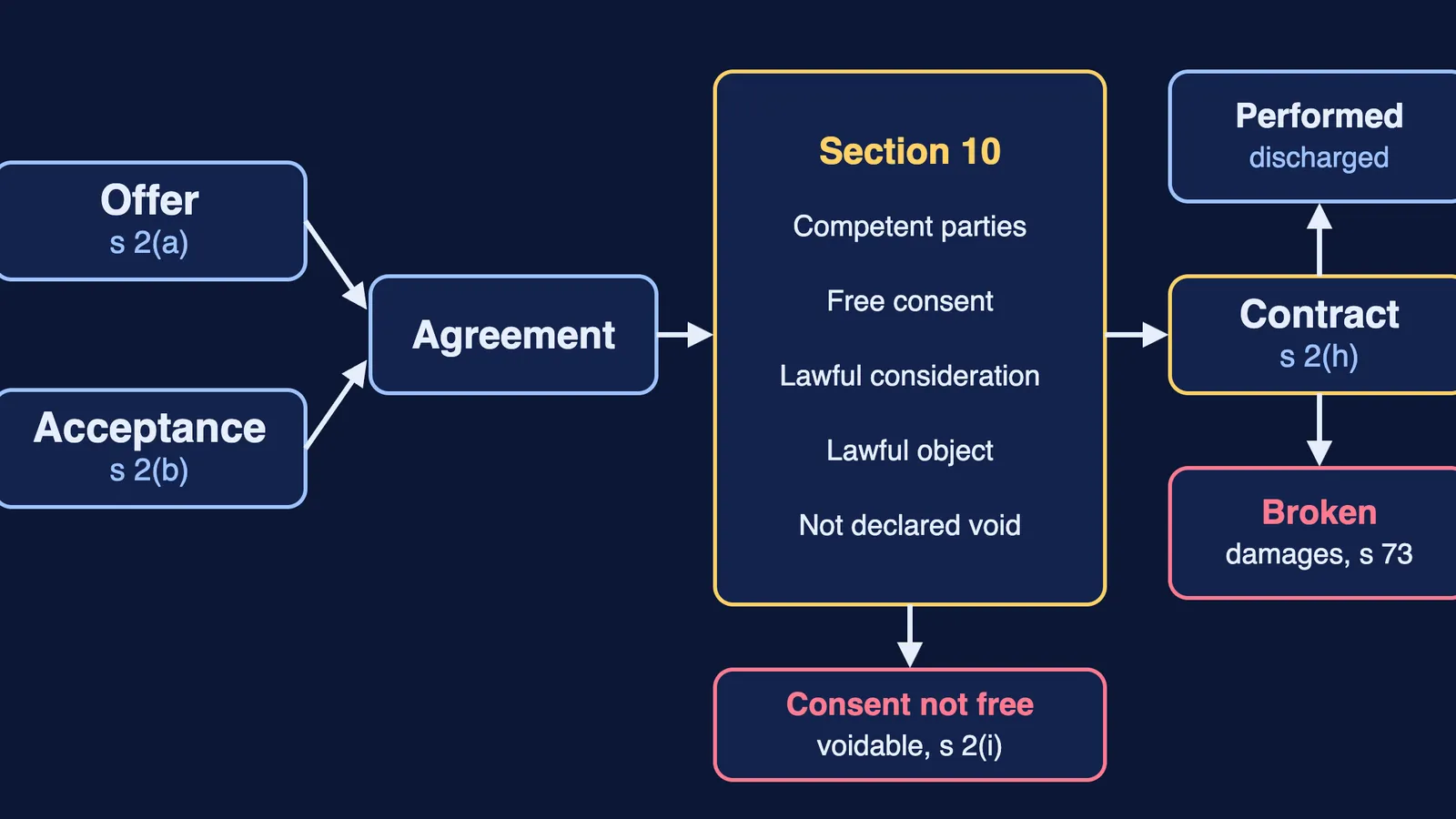
The book gives the core definition from the Indian Contract Act, 1872: a contract is an agreement enforceable by law, under Section 2(h). An agreement starts with an offer, Section 2(a), and the other side's acceptance, Section 2(b).
Section 10 then sets the test:
the parties are competent to contract
consent is free
consideration and object are lawful
the law has not declared that kind of agreement void
Key ideas and cases:
Intention. In Balfour v. Balfour, a husband's promised monthly sum to his wife was only a moral obligation, not a contract, because the parties never meant to create legal relations.
General offer. In Carlill v. Carbolic Smoke Ball Co., an advertised reward was an offer to the whole world; meeting its conditions counted as acceptance.
Consideration. Something in return, an act or a forbearance; it must be real, not necessarily adequate. In Durga Prasad v. Baldeo, the plaintiff built shops at the District Collector's desire, not the defendant's, so the defendant's promise of a commission had no consideration.
Capacity and consent. A minor (under 18), a person of unsound mind and a person disqualified by law cannot contract; in Mohori Bibee v. Dharmodas Ghose, a minor's agreement was held void from the start. Consent, Section 13, means agreeing on the same thing in the same sense; coercion, undue influence, fraud, misrepresentation or mistake make it not free.
Void, voidable, contingent or wagering: how do you tell them apart?
Void, Section 2(j): stops being enforceable and cannot become valid again.
Voidable, Section 2(i): the party whose consent was not free may affirm or reject it.
Contingent, Section 31: performance depends on whether an uncertain future event happens; enforceable.
Wagering: the parties take opposite views on an uncertain event, each able to win or lose; Section 30 declares it void.
Illegal object or consideration, Section 24: void.
How does a contract end, and what if it is broken?
The book lists six routes to discharge: performance, agreement or consent (for example novation, rescission, remission or merger), impossibility, lapse of time, operation of law, and breach. Impossibility arising later, such as destroyed subject matter, is Section 56. On breach, the injured party can claim damages under Section 73, or ask for specific performance.
How do you write a case-style answer?
Use four steps: Issue, Rule, Apply, Conclude.
Worked example. A housing society asks Neel to repaint its entrance gate. A pleased neighbouring shop owner later promises Neel Rs 1,500, then never pays. Can Neel enforce the promise?
Issue: is there consideration for the shop owner's promise?
Rule: in Durga Prasad v. Baldeo, an act done at someone else's desire, not the promisor's, was no consideration for the promisor's promise.
Apply: Neel painted at the society's desire; the shop owner never asked for the work.
Conclude: no consideration, so the promise is not an enforceable contract.
Practice questions (written by us)
(1 mark) A water board announces Rs 1,000 for anyone who reports a pipe leak with a photo. Ishaan does so; the board says he never wrote to accept. This is: (A) no contract, as acceptance was not communicated (B) a general offer accepted by performance (C) void for want of consideration (D) a wagering agreement.
(1 mark, assertion-reason) A: Kabir, who signed a supply deal after being threatened with confinement, may later avoid it. R: Consent caused by coercion is not free consent.
(3 marks) Farhan agrees to deliver 30 specific hand-painted lamps a boutique selected. A fire destroys them before delivery. Is he liable?
(5 marks) Two classmates bet Rs 800 on an inter-house final. Separately, a shop owner pays an insurer a premium, and the insurer promises Rs 60,000 if flood damages the shop's stock. Classify each, with sections, and state enforceability.
Answer key: 1 (B). 2 Both true; R explains A. 3 Discharged by supervening impossibility, Section 56. 4 First is wagering, void under Section 30; second is contingent, Section 31, and enforceable: the flood is uncertain and the premium is consideration.
Related reading: Legal Studies in Class 11, how to answer case study questions and Consumer Education and Protection.
This is a study summary, not legal advice.
Not sure where to start tonight? Fermi's AI tutor works out what you already know and builds a plan for the session.