On this page
Management of Resources is Chapter 4 of NCERT's Human Ecology and Family Sciences Part I for Class XI (Reprint 2026-27).
What does Management of Resources cover in Class 11?
The CBSE Home Science (064) curriculum for 2026-27 places the chapter in Unit II, Understanding oneself: Adolescence, with five topics: introduction, classification of resources, characteristics of resources, managing resources and the management process.
Theory marks: Unit II carries 23 of the 70 theory marks, shared by five chapters, so this chapter has no separate figure.
Practical marks: the Class XI practical scheme gives 3 of its 30 marks to "Prepare a time plan for yourself".
The chapter's closing practical is titled Time, Money, Energy and Space, but in the main text and its resource chart, space appears only as a non-human (material) resource.
How are resources classified?
NCERT defines a resource as anything you use while doing an activity. Something lying unused is not a resource for you, though it may be for someone else. The book sorts resources three ways.
Human and non-human. Human resources are knowledge, motivation or interest, skills and aptitude, time and energy, and they can grow with training. Non-human resources are money and material goods such as space, furniture, clothes and stationery.
Individual and shared. Individual resources are yours alone, like your skills or school bag. Shared resources are open to many people in a community.
Natural and community. Shared resources split into natural ones (air, water, mountains) and community ones, usually provided by government, such as roads, parks, post offices and government hospitals.
NCERT calls time the most valuable resource, since everyone gets the same amount and none of it comes back. It divides time into three dimensions: work time, non-work time, and rest and leisure time.
What are the characteristics of resources?
The chapter names four.
Utility: how useful a resource is for a goal, which depends on the situation. NCERT's example is cow dung, usually waste, which can become fuel or manure.
Accessibility: some resources are easier to get than others, easier for some people, and easier at some times.
Interchangeability: most resources have substitutes. If the school bus is late, another vehicle does the same job.
Manageable: every resource is limited, so it should be managed to get the most output for the least input.
How does the management process work, with a timetable example?
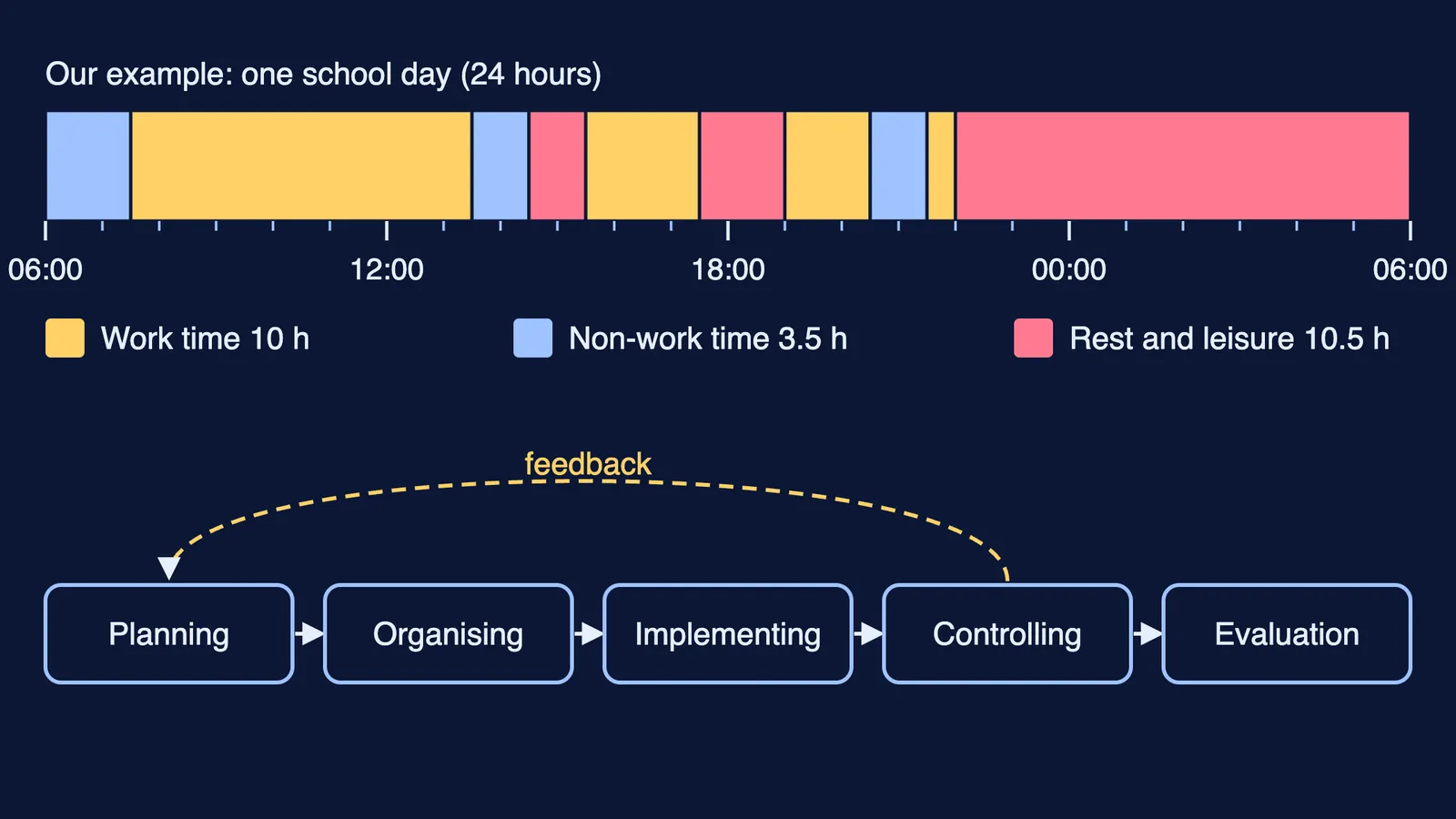
Planning, the first of NCERT's five steps, starts with four questions: where are you now, where do you want to be, what is the gap, and how will you close it?
Here is a worked example of our own. Riya, a Class 11 student, has a unit test in 10 days and has revised 3 of her 5 Unit II chapters.
Planning. Gap: 2 chapters. She estimates 4 hours each, so 8 hours. Plan: two 40-minute sessions on 6 of the 10 days, which is 6 × 2 × 40 = 480 minutes, or 8 hours, leaving 4 days for full revision.
Organising. She gathers her book, notes, a lit desk and a quiet evening slot.
Implementing. She follows a school-day timetable: school 07:30 to 13:30, self-study 15:30 to 17:30 and 19:00 to 20:30, quick revision at 21:30, sleep 22:00 to 06:00.
Controlling. Her plan has 3.5 hours of self-study a day, or 17.5 hours over five school days. Her tick-log shows 13 hours, 4.5 hours short. That feedback tells her to cut a distraction, so her phone leaves the room during study blocks.
Evaluation. After the test she compares her marks with her goal and notes what worked, for next time.
Her day adds up to 24 hours: 10 hours of work time (school and study), 3.5 hours of non-work time (getting ready, travel, meals) and 10.5 hours of rest and leisure (rest, play, sleep). NCERT names the three dimensions but does not sort activities into them; this split is ours. Sorting your own day this way is good practice for the time plan practical.
Practice questions for Class 11
CBSE does not publish a Class 11 sample paper for Home Science, so these mark labels are our suggestion.
Your cousin's unused cricket bat sits in your cupboard. Is it a resource for you? Explain. (our suggestion: 2 marks)
Classify a public library, your handwriting skill and river water, giving a reason for each. (our suggestion: 3 marks)
Forty students want the library's only copy of a reference book before a test. Name the characteristic of resources this shows, and suggest how another characteristic could help. (our suggestion: 3 marks)
Your family is moving to a smaller flat next month. Treating space as the resource, describe one action at each step of the management process. (our suggestion: 5 marks)
Distinguish between controlling and evaluation with one example each. (our suggestion: 3 marks)
In Class 12, Unit V (Resource Management) covers Hospitality Management and Consumer Education and Protection. If your timetables fall apart after a week, try planning smaller.
Not sure where to start tonight? Fermi's AI tutor works out what you already know and builds a plan for the session.