On this page
Understanding the Self is Chapter 2 of the NCERT Human Ecology and Family Sciences Part I textbook for Class 11 (reprint 2026-27). It asks what makes you "I", and why that answer shifts in your teens.
How many marks is Understanding the Self worth?
The CBSE Home Science (064) curriculum for 2026-27 gives Unit II, Understanding oneself: Adolescence, 23 of the 70 theory marks. Five chapters share those marks, so there is no separate figure for this one. (The NCERT book prints this unit as Unit I.)
The curriculum lists all three sections: What makes me 'I', Development and Characteristics of the Self, and Influences on Identity. Its first practical has you record your own physical growth; listing areas of agreement and disagreement with parents, siblings or friends and a teacher is one option in a 5-mark practical exam question.
What is the self, and how is it different from identity?
NCERT treats the self as the whole of your experiences, ideas, thoughts and feelings about yourself: the way you define who you are (NCERT Chapter 2). It has two broad dimensions, and two related terms describe how you see it.
Personal self: what concerns only you.
Social self: what involves others, such as sharing, cooperation and support.
Self-concept: your description of yourself, the answer to "Who am I?"
Self-esteem: how you judge yourself against standards that society largely shapes.
Identity is the steady sense of being the same person over the years, even as you change. Personal identity marks what sets you apart from others; social identity links you to a group, such as a state, a religion or a profession.
How does the self change from infancy to adolescence?
NCERT says we are not born with a self; we build it as we grow.
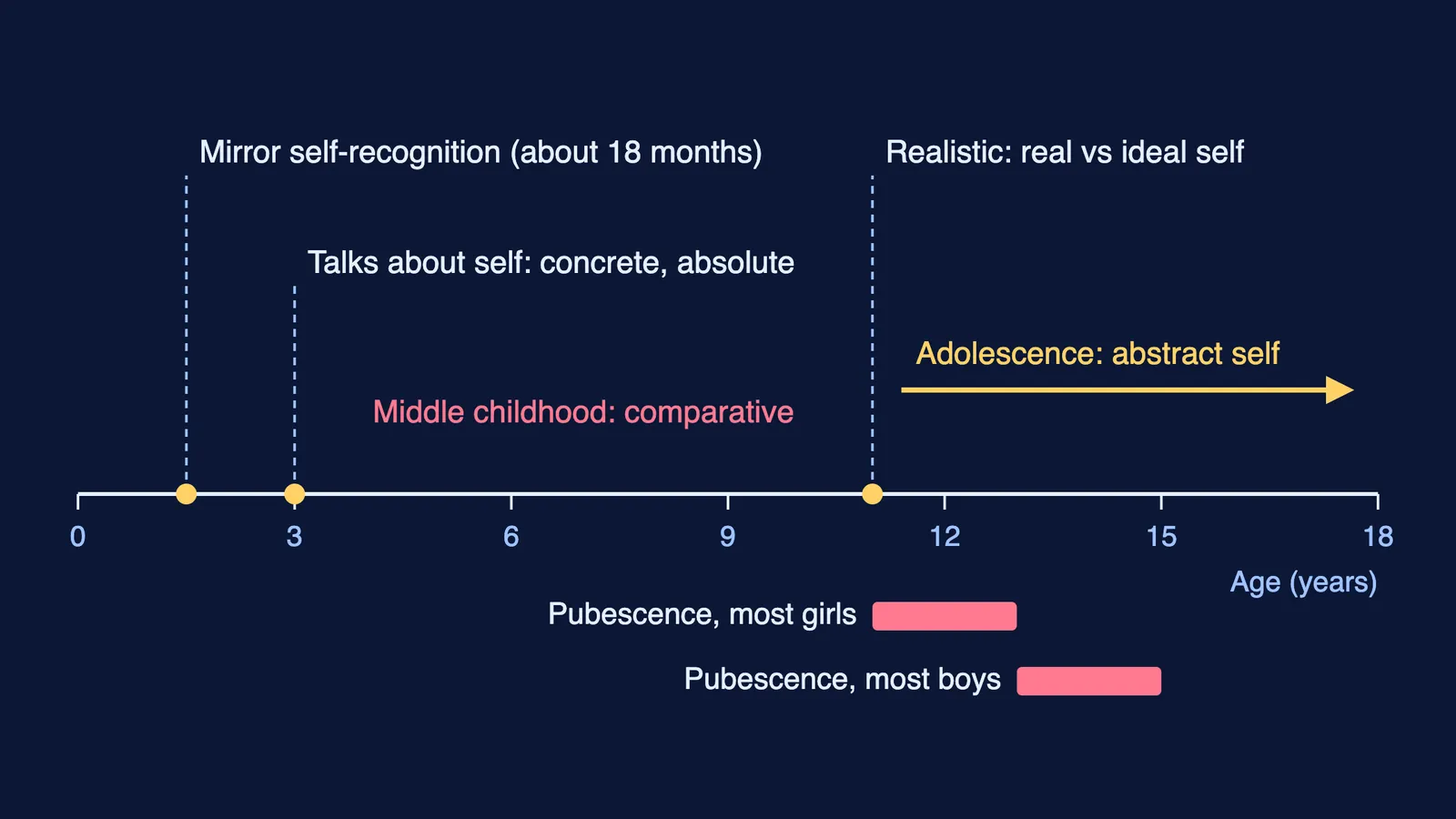
Infancy: a newborn has no self-awareness. In the mirror test, a toddler who touches the red dot on their own cheek recognises themselves, around 18 months. Late in the second year come "I", "me" and "mine".
Early childhood: by about 3, children talk about themselves in concrete, absolute terms ("I am big"), list what they can do and overrate themselves.
Middle childhood: descriptions turn inward and comparative ("I swim better than my cousin"), include groups, separate the real self from the ideal self, and grow more realistic, which NCERT says they are by about 11.
Adolescence: the self becomes abstract ("I am patient"), contradictory, and changes across situations. The ideal self looms larger, and many teens feel constantly watched, as if on stage.
Why does adolescence matter so much for identity?
Psychologist Erik H. Erikson held that each life stage carries a task. For adolescence, the task is a satisfying definition of who you are. NCERT gives three reasons it peaks now: you are more absorbed in knowing yourself than ever, you leave with a fairly lasting identity, and fast bodily change meets shifting social demands.
Mixed messages add to it. This can bring role or identity confusion, seen as trouble concentrating or keeping schedules. NCERT stresses that this is a normal part of growing up.
What influences identity in adolescence?
NCERT groups the influences under four heads.
Biological and physical changes: puberty is when sexual maturity is reached; pubescence is the run-up. For most girls it spans 11 to 13 years, for most boys 13 to 15, with changes in a set order.
Socio-cultural contexts: NCERT contrasts Indian interdependence with Western independence. Firm but affectionate parenting, and a home that values both individuality and connectedness, support healthy identity. Peers can pull either way.
Emotional changes: body image, mood swings and sudden anger as you make sense of change.
Cognitive changes: abstract, hypothetical thinking lets you picture a future self, such as a career.
If these feelings ever feel too heavy, talk to a parent, teacher, school counsellor or doctor.
Practice questions for Understanding the Self
CBSE publishes no Class 11 sample paper, so the mark labels below are our suggestion. The questions are ours.
(1 mark) A 10-year-old says, "I read faster than most of my class." Which stage of self-description does this show?
(1 mark) Name the period of physical change that leads up to puberty.
(2 marks) Give one example each of personal identity and social identity for a student in Shillong.
(3 marks) Distinguish self-concept from self-esteem, with an example of each.
(4 marks) Arjun, 15, says he is "chatty with friends yet shy at home" and checks his hair before every class in case people notice. Name and explain two features of the adolescent self he shows.
(5 marks) Explain how family and culture shape identity in adolescence, using two ideas from the chapter.
Answers: Q1 middle childhood (comparative). Q2 pubescence.
Read Human development Class 11 psychology for Erikson's stages, Self and personality Class 12 psychology, and our Class 12 Home Science guide to early childhood care.
Got a free hour after school? Fermi's AI tutor works out what you already know and builds a plan for the session.