On this page
Human Development is Chapter 3 of the current NCERT Class 11 Psychology textbook (Reprint 2026-27). In the CBSE 2026-27 Psychology curriculum it is Unit III, worth 11 of the 70 theory marks. If you are new to the subject, start with our guide to what psychology is in Class 11.
What does the 2026-27 syllabus include?
The curriculum covers the meaning of development and the life-span perspective, factors influencing development, the context of development, and an overview of the stages (prenatal, infancy, childhood, challenges of adolescence, adulthood and old age). The current NCERT chapter matches it, adding boxes on growth versus maturation and on gender roles.
What is development in psychology?
NCERT defines development as a pattern of progressive, orderly and predictable change that starts at conception and runs through life, including decline as well as growth (NCERT). Three kinds of process drive it together: biological (genes, body, brain), cognitive (thinking, attention, problem solving) and socio-emotional (relationships, emotions, personality).
Know the difference between four words from Box 3.1:
Growth: an increase in size that you can measure, such as height.
Development: directed change across the life cycle; growth is one part of it.
Maturation: changes that unfold in order from a genetic timetable, such as sitting, standing and walking.
Evolution: slow change within a species across generations.
The life-span perspective adds that development is lifelong, multi-directional (some abilities rise while others fall), plastic (open to change), shaped by history, studied by many disciplines and responsive to context.
How do heredity and environment shape development?
Your genotype is the genetic material you inherit; your phenotype is how it shows in traits you can observe, from height to personality (NCERT). Genes set the limits, and the environment decides where within those limits you end up. NCERT also cites Sandra Scarr (1992): parents' genes partly shape the home they build, and children pick settings that suit their own genotype.
For context of development, learn two models:
Bronfenbrenner's contextual view: microsystem (family, school, peers), mesosystem (links between them), exosystem (settings you are not in that still affect you, like a parent's workplace), macrosystem (culture) and chronosystem (life events and historical time).
Durganand Sinha's (1977) ecological model for Indian children: a visible upper layer (home, school, peer group) and a surrounding layer (geography and crowding, caste and class, amenities such as water and electricity).
Worked example: a parent is transferred to another city and stress at home rises. The transfer sits in the exosystem; the tense dinner table is the microsystem.
What happens at each developmental stage?
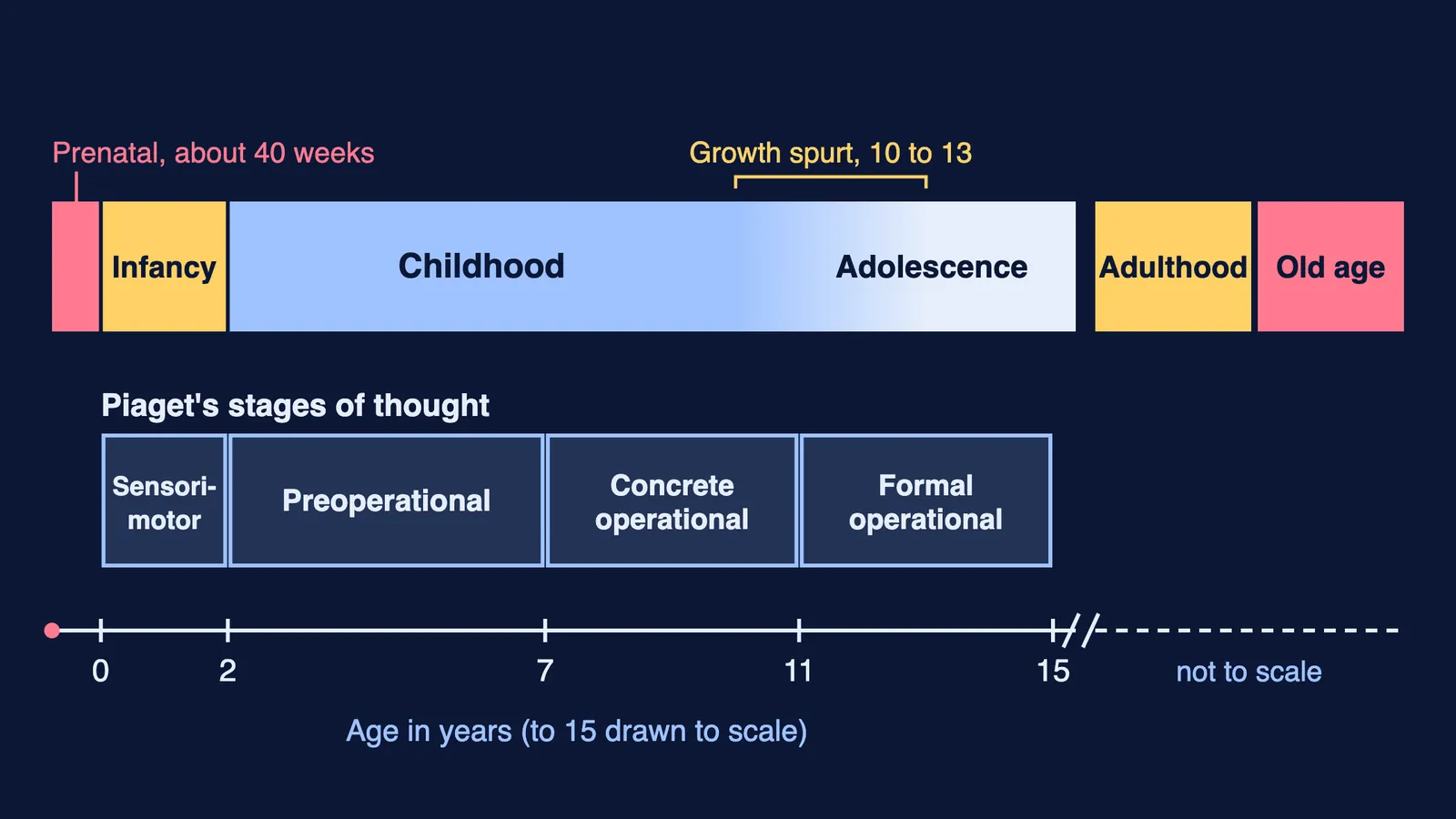
The diagram above lays out the stages and Piaget's ages from Table 3.2 of the NCERT chapter.
Prenatal (about 40 weeks): shaped by the mother's age, nutrition, emotional state and illness, and by teratogens such as drugs, radiation and pollutants.
Infancy (first two years): reflexes like rooting and grasp fade as voluntary control grows. In Piaget's sensorimotor stage the infant lacks object permanence at first. Harlow's monkey study showed contact comfort, not feeding, builds attachment, and Erikson places trust versus mistrust in the first year.
Childhood: growth runs head to toe (cephalocaudal) and centre outwards (proximodistal). Preoperational thought (2 to 7) shows egocentrism, animism and centration; concrete operational thought (7 to 11) brings reversible logic. Erikson's initiative versus guilt and Kohlberg's stages of moral reasoning belong here.
Adolescence: begins with puberty; the growth spurt starts around 10 or 11 for girls and 12 or 13 for boys. Formal operational thought arrives, along with Elkind's imaginary audience and personal fable, Erikson's identity versus confusion, and challenges such as delinquency, substance abuse and eating disorders.
Adulthood and old age: work, marriage and parenthood, then retirement, new family roles and loss.
Some of these adolescent challenges may feel close to home. If you or a friend are finding things hard, talk to a trusted adult or school counsellor, or call Tele MANAS, the Health Ministry's free 24x7 mental health helpline, on 14416 (PIB).
Piaget's stages tie in with how you learn new behaviour, covered in our guide to learning and conditioning in Class 11 psychology.
How should you revise this chapter?
Make one sheet: stages down the side, columns for physical, cognitive and socio-emotional change, one term and your own example per cell. Then test yourself with these questions, written for practice:
A toddler grows 3 cm taller and starts walking without help. Which change is growth and which is maturation? (2 marks)
Ria, 4, says the chair hurt her when she bumped into it. Name the feature of thought and the Piagetian stage. (2 marks)
Give an example from your own family of development being multi-directional, plastic and shaped by history. (3 marks)
Using Bronfenbrenner's model, place these: a school-parent meeting, new shift timings at a parent's office, festival customs. (3 marks)
Describe two forms of adolescent egocentrism and suggest how a parent might respond to each. (4 marks)
Not sure where to start? Fermi's AI tutor can work out what you already know and build a plan for the session.