

On this page
Psychology is the Class 11 subject that studies you: how you think, what you feel and what you do. Chapter 1 of the NCERT book asks “What is psychology?”, and answering it well sets up the rest of the year.
What is psychology, according to NCERT?
NCERT’s Class 11 textbook defines psychology as “a science which studies mental processes, experiences and behaviour in different contexts” (NCERT, Introduction to Psychology, Chapter 1).
The word comes from two Greek words, psyche (soul) and logos (science or study of a subject), so psychology was once called a study of the soul or mind.
The definition rests on three terms:
Mental processes: remembering, learning, knowing, perceiving, feeling. NCERT stresses that mind and brain activity are interdependent, not the same.
Experiences: subjective and internal; only the person having them is aware of them (a crowded bus on a hot day feels different on the way to a picnic with close friends).
Behaviours: responses, reactions or activities, like blinking when something is hurled at you or feeling your heart pound in an exam. Some are overt (seen by others); some are covert, like feeling your hand muscles twitch while planning a chess move.
How do you apply the definition? A worked example
Sort an exam morning with the definition:
You recall a point you revised last night: a mental process (remembering).
You feel nervousness nobody else can see: an experience, private and subjective.
Your heart pounds and you tap your pen: behaviours, one covert (felt inside) and one overt (seen by others).
The nerves ease when a friend jokes beside you: context, the definition’s last word.
NCERT’s Activity 1.1 asks you to name three psychological processes in each of ten situations, from playing chess to expecting an important visitor.
Is psychology a natural science or a social science?
NCERT’s answer is both. The chapter describes psychology today as having two parallel streams, one using the methods of the physical and biological sciences and one using the methods of the social and cultural sciences (NCERT Chapter 1).
As a natural science, psychology follows the hypothetico-deductive model: start from a theory, propose a hypothesis, test it against data, and revise the theory if the data disagree. It looks for cause and effect, so behaviour can be predicted and, if needed, controlled. NCERT calls psychology a young science if you date it from 1879, when Wilhelm Wundt set up the first experimental psychology laboratory in Leipzig, Germany.
As a social science, psychology studies people in their socio-cultural context and assumes each behaviour has multiple causes. NCERT’s example is two classmates, Ranjita and Shabnam, whose families became close after a flood in their village; the chapter notes that in similar crises some communities turn to looting instead.
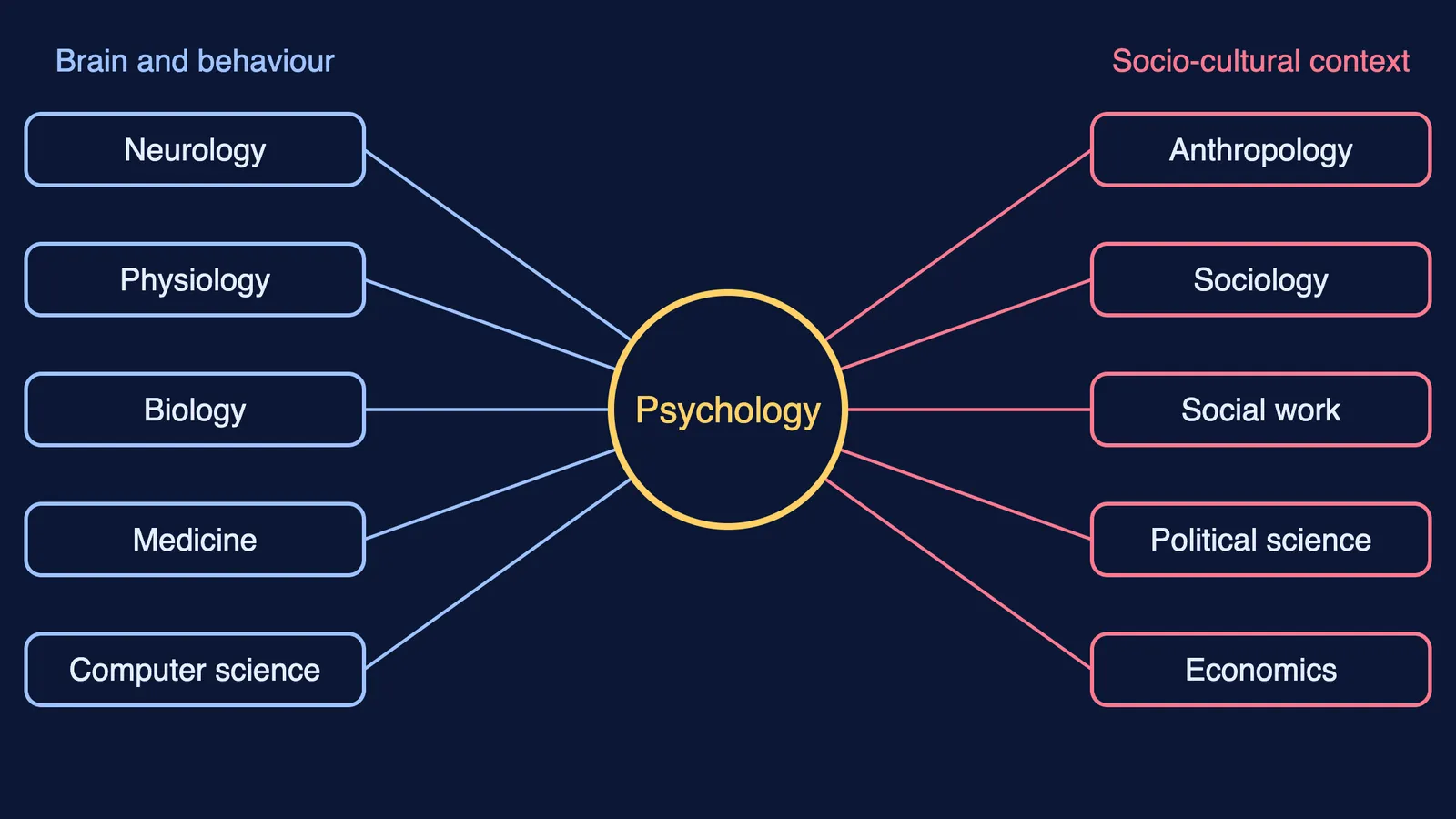
NCERT’s list of neighbouring disciplines mirrors the split: neurology, physiology, biology, medicine and computer science for brain and behaviour; anthropology, sociology, social work, political science and economics for socio-cultural context.
A strong exam answer uses this frame:
Define psychology in one sentence.
Natural science: the method (hypothesis, data, cause and effect) and one example, such as theories of memory.
Social science: context and multiple causes, and one example, such as the flood story.
Conclude that the two streams sometimes meet and sometimes separate: psychology is generally grouped with the social sciences, yet India also offers it in the science faculty.
What are the branches of psychology in Class 11?
NCERT’s Activity 1.3 lists 11 branches and asks you to rank them from 1 (most interesting) to 11 (NCERT Chapter 1):
Cognitive: attention, perception, memory, reasoning, problem solving, decision-making and language.
Biological: behaviour and the brain, nervous system, immune system and genes.
Developmental: change across the life-span, from conception to old age.
Social: attitudes, conformity, helping, prejudice and aggression.
Cross-cultural and cultural: how culture shapes behaviour, thought and emotion.
Environmental: temperature, humidity, pollution, natural disasters and behaviour.
Health: psychological factors such as stress in illness, and coping.
Clinical and counselling: causes, treatment and prevention of psychological disorders.
Industrial/organisational: the workplace, training and selecting employees.
Educational: how people of all ages learn; school psychology sits close by.
Sports: performance and motivation.
A clinical psychologist has a degree in psychology, while a psychiatrist has a medical degree and can prescribe medication, NCERT notes. The chapter also names emerging areas such as aviation, space, forensic, community and political psychology.
Where does biology meet psychology?
Biological psychology and neuropsychology lean on biology: the brain, the nervous system and neurotransmitters. If those ideas are shaky, the Fermi Concept Library has its own lesson for each concept in biology, so you can fill the gap first.
Studying psychology is not the same as getting help. If you or a friend is struggling, talk to a trusted adult, a school counsellor or a professional, or call Tele MANAS, the Ministry of Health and Family Welfare’s national mental health helpline, on 14416 or 1-800-891-4416 (Tele MANAS).
Your next step: pick five moments from tomorrow and sort each into mental process, experience and behaviour.


