On this page
Early Childhood Care and Education is Chapter 6 of the NCERT Human Ecology and Family Sciences Part I textbook for Class 12 (reprint 2026-27). It asks who cares for and teaches children before formal school, and how you train for that work.
How many marks is Early Childhood Care and Education worth?
The CBSE Home Science (064) curriculum for 2026-27 gives Unit III, Human Development and Family Studies, 10 of the 70 theory marks. Two chapters share those 10 marks: this one and the next chapter, on support services and programmes for children, youth and the elderly.
The curriculum keeps every section: significance, basic concepts (objectives, guiding principles, day care and crèche), preparing for a career, and scope. Its Unit III practical is one teaching aid with a socially relevant message, or one age-appropriate toy made from local material.
What is early childhood care and education?
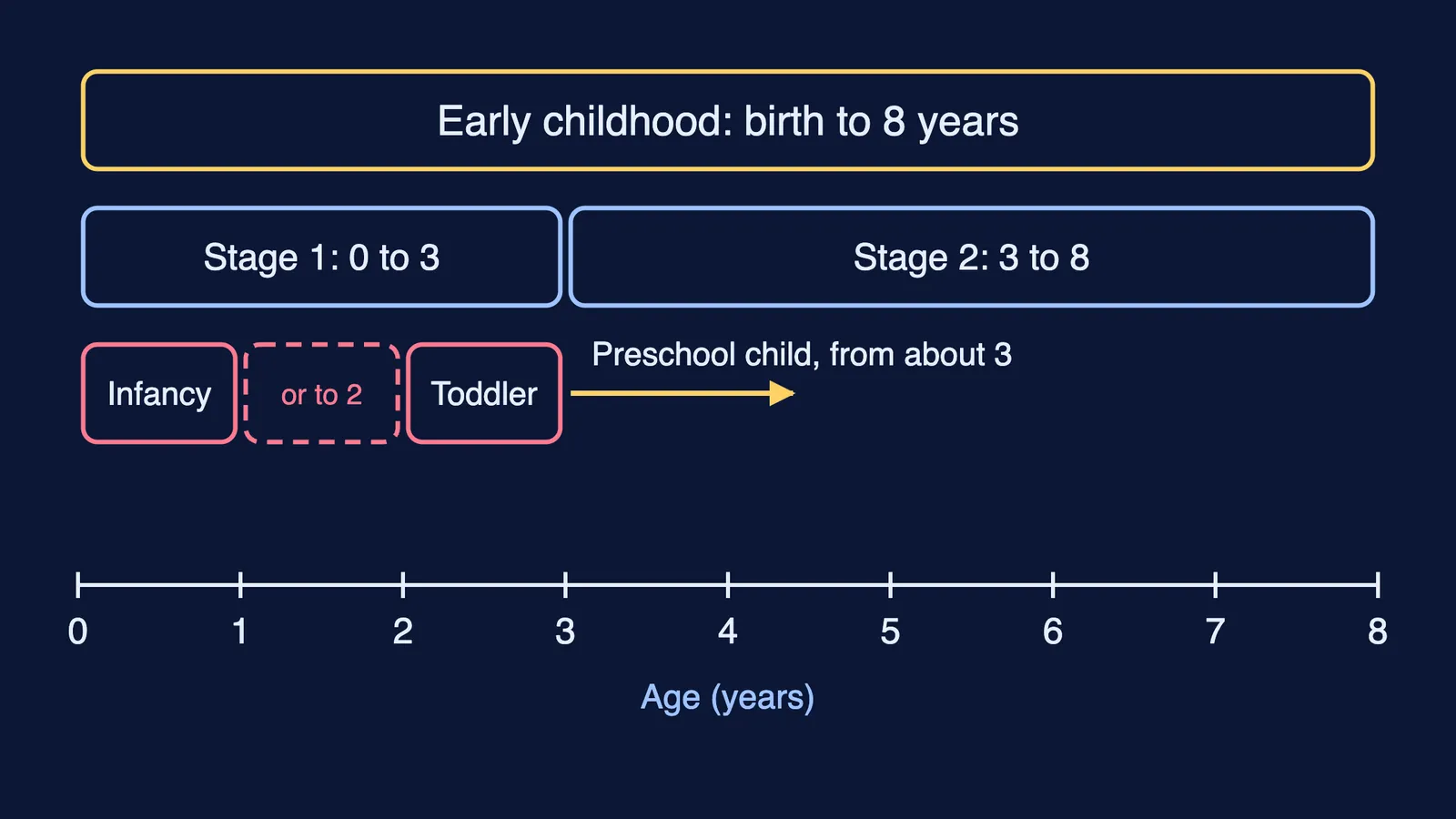
NCERT defines early childhood as birth to 8 years, split into two stages: birth to 3 and 3 to 8 (NCERT Chapter 6).
Infancy: birth to one year (some experts say two), when the child depends on adults for nearly everything.
Toddler: a child of about two to three, named after the jumpy walk of this age.
Crèche: an institution designed to care for infants and young children when home care is not available.
Day care: care through the preschool years, which can include infants, while the main caregiver is away. Both usually run all day.
Preschool child: ready for experiences outside the family. Montessori schools follow Maria Montessori's principles.
Anganwadi: a centre through which the Government of India offers preschool education under ICDS, in urban and rural areas.
Why does ECCE matter?
From about age three, a child walks, talks, handles objects and learns by interacting with people and things. NCERT warns that making a young child sit and learn like an older pupil breeds anxiety and dulls curiosity. NCERT's ideal setting at this age is safe and loving, with different people, toys or natural materials, and a caring adult who need not be a teacher. A good preschool uses a child-centred, play-way approach.
ECCE helps families too. In some remote or poorer communities, older children mind the little ones while parents work, and miss school; a centre frees them. Centres can also add nutrition and health support.
Citing the NCF (2005) position paper, NCERT gives three objectives: all-round development so the child reaches their potential, readiness for school, and support services for women and children. Its ten guiding principles, grouped:
Play and art as the base of learning.
Respect for the way young children think.
First-hand experience over expert instruction.
Routines mixing the familiar with small challenges.
Formal and informal interaction; books and culture together.
Local materials, arts and knowledge.
Developmentally appropriate, flexible, plural practice.
Health, well-being and good habits.
The chapter draws on Jean Piaget, who explained that young children understand the world in their own ways, and Lev Vygotsky, who stressed the need for a caring, knowledgeable adult. Tasks should be neither too easy nor too hard.
What skills and training does an ECCE career need?
NCERT's skills list, in our words:
interest in children and knowledge of their needs and abilities
willingness to answer children's questions and an understanding of individual differences
activity ideas: stories, nature, music, dance, voice modulation
stamina, and flexibility when short attention spans derail a plan
record keeping, accounts, reports and good contact with parents
Routes in: a degree including child or human development or child psychology; a one-year diploma or Open University course; or Nursery Teacher Training. Postgraduate and doctoral study lead to research.
Where you can work: crèches, day care centres, nursery schools, NGOs, ICDS and training institutes, as a teacher, caregiver, programme team member, campaign planner, coordinator, teacher trainer, or entrepreneur running camps, activity clubs or a preschool.
Practice questions for Early Childhood Care and Education
The CBSE 2026-27 sample paper tests this chapter with a 1-mark assertion-reason item and a 4-mark question. The questions below are ours.
(1 mark, MCQ) NCERT's early childhood runs from birth to (a) 3 years (b) 6 years (c) 8 years (d) 10 years.
(1 mark, assertion-reason) Assertion: Preschools should avoid long desk-bound lessons. Reason: Young children have short attention spans.
(2 marks) Give two ways a village child care centre helps families, not just the young children.
(3 marks) Differentiate between a crèche and a preschool on age group, focus and staff training.
(4 marks) Meera plans a home-based preschool after her diploma. Suggest four skills or arrangements she needs beyond teaching.
(5 marks) Explain the three objectives of ECCE and two guiding principles, with an example of each principle.
Answers: Q1 (c). Q2: both true; the reason explains the assertion.
See our Class 12 Home Science study plan, Piaget's stages in Human development Class 11 psychology, and BSc Home Science career options.
Not sure where to start revising? Fermi's AI tutor works out what you already know and builds a plan for the session.