On this page
Chapter 5 of NCERT's Human Ecology and Family Sciences Part I (reprint 2026-27) covers what makes food unsafe, who sets standards and how hazards are kept out.
What does the 2026-27 syllabus include?
The CBSE Home Science (064) curriculum for 2026-27 places this chapter in Unit II, Nutrition, Food Science and Technology. Unit II carries 23 of the 70 theory marks across its four chapters; CBSE prints no per-chapter split. See also our Public Nutrition and Health guide.
It keeps the basic concepts (safety, toxicity, hazards, infection, intoxication, quality), the FSS Act 2006, Codex, ISO and WTO, GMP, GHP, HACCP and scope. Its list does not name contamination, adulteration, the 1954 adulteration law or the food control system; treat those as background.
Adulteration returns in the practical: a chemical test for an adulterant in ghee, tea, pepper, turmeric, milk or asafoetida is worth 2 of the 30 practical marks.
What are food safety, hazard and toxicity?
Food safety is the assurance that food is fit to eat for its intended use. Toxicity is a substance's ability to cause harm in any conditions. A hazard is the likelihood of harm when something is used in the wrong way or amount.
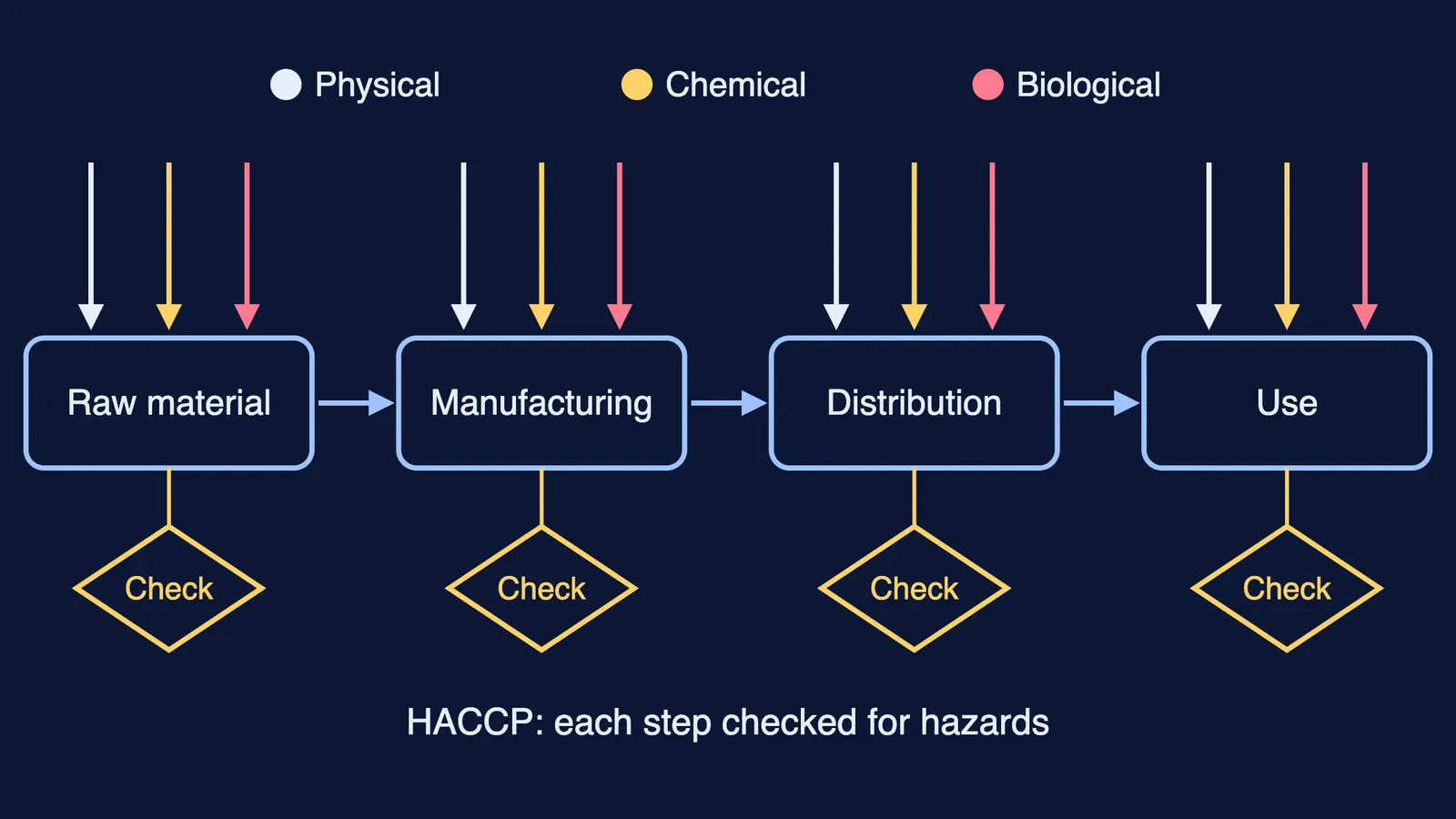
Hazards come in three kinds:
Physical: foreign objects such as stones, hair, wood or bits of pests.
Chemical: pesticide residues, toxic metals, cleaning chemicals, or additives that are banned or overused.
Biological: living things, from pests and worms to bacteria, viruses and moulds.
Microbes cause two types of illness. In food infection (food poisoning), live organisms multiply inside the body; NCERT's example is Salmonella, spread by undercooking or cross-contamination (one board for raw chicken and salad). NCERT says it can double every 20 minutes. At that rate (our arithmetic, unchecked growth), one cell becomes 64 in two hours (6 doublings) and 4,096 in four (12). In food intoxication, a toxin made by bacteria such as Staphylococcus aureus causes harm even after the bacteria die, and the food can look and smell normal.
Food quality is wider: everything that raises or lowers a food's value, from taste and texture to nutrition and spoilage. Safety comes first; quality builds on it.
What does FSSAI do under the FSS Act 2006?
The Food Safety and Standards Act, 2006 brought India's scattered food laws, including the 1954 adulteration law, under one Act (NCERT, Chapter 5). It set up the Food Safety and Standards Authority of India to frame science-based standards and regulate how food is made, stored, distributed, sold and imported.
NCERT lists eight functions; group them as: setting standards (and shaping international ones); accrediting certifiers and labs; advising governments, collecting risk data and sharing alerts; and training businesses and raising awareness.
NCERT names four levels of standards (company, national, regional, international). The Codex Alimentarius Commission publishes the "food code" that countries use for national rules. ISO's standards, such as the ISO 9000 quality family, are voluntary. The WTO (1995) administers trade agreements and settles disputes. The 2026-27 sample paper tests the chapter in Q7 (1 mark, the term hazard), Q14 (assertion-reason on HACCP) and Q27 (4 marks, ISO vs FSSAI), so practise contrasting voluntary and legally binding standards.
How does HACCP keep food safe?
Good Manufacturing Practices help producers cut contamination and false labelling. Good Handling Practices cover hygiene for everyone handling food from farm to shop. HACCP (Hazard Analysis Critical Control Points) examines each raw material and stage, asks what could go wrong, and sets a control there.
End-product testing is slow, costly and catches problems only afterwards; HACCP acts at the stage where they start.
Worked example: the tea stalk test
NCERT's practical boils 5 g of tea, filters it, then picks out, dries and weighs the stalks; they should be under 25 per cent. This weighing test is not one of the board practical's chemical tests.
Sample A: stalks weigh 1.4 g. 1.4 ÷ 5 × 100 = 28 per cent, so it fails.
Sample B: stalks weigh 0.9 g. 0.9 ÷ 5 × 100 = 18 per cent, so it passes.
See our guide to testing food adulteration at home.
Practice questions in the 2026-27 format
(1 mark) A small stone in a bag of rice is which kind of hazard? (a) Biological (b) Physical (c) Chemical (d) Nutritional
(1 mark) Assertion: Reheated food that looks and smells fine can still make you ill. Reason: Some bacterial toxins cause no change in smell, look or taste.
(2 marks) Give two ways a cook could spread Salmonella to a salad.
(3 marks) Classify these as physical, chemical or biological hazards: weevils in flour, a staple pin in dal, excess food colour in sweets.
(4 marks) A spice exporter asks whether it needs Codex, ISO or FSSAI rules. Explain the role of each and which one is legally binding in India.
(5 marks, 2 + 3) I. Give two reasons the FSS Act 2006 was needed. II. Explain three reasons a biscuit factory should use HACCP.
Answers: 1 (b). 2 Both true; the reason explains the assertion. 4 Biological, physical, chemical.
Not sure where to begin your revision? Fermi's AI tutor works out what you already know and builds a plan for the session.