On this page
Legal Profession in India is Unit 7 of the CBSE Legal Studies Class 12 textbook. This guide covers the 2026-27 syllabus, the book's key facts and original practice questions. It is a study summary, not legal or career advice.
What does Unit 7 cover in the 2026-27 syllabus?
The CBSE Legal Studies curriculum for 2026-27 gives Unit 7 eight marks in the 80-mark theory paper, and the unit has only this chapter. Its seven topics run from the Advocates Act, 1961 and professional ethics to advertising, liberalisation, women in the profession, legal education in three countries, and careers.
The prescribed book is the CBSE Legal Studies Class XII textbook, second edition 2023, pages 181 to 194. Facts below are as the book states them; some may have changed since.
How did the legal profession in India develop?
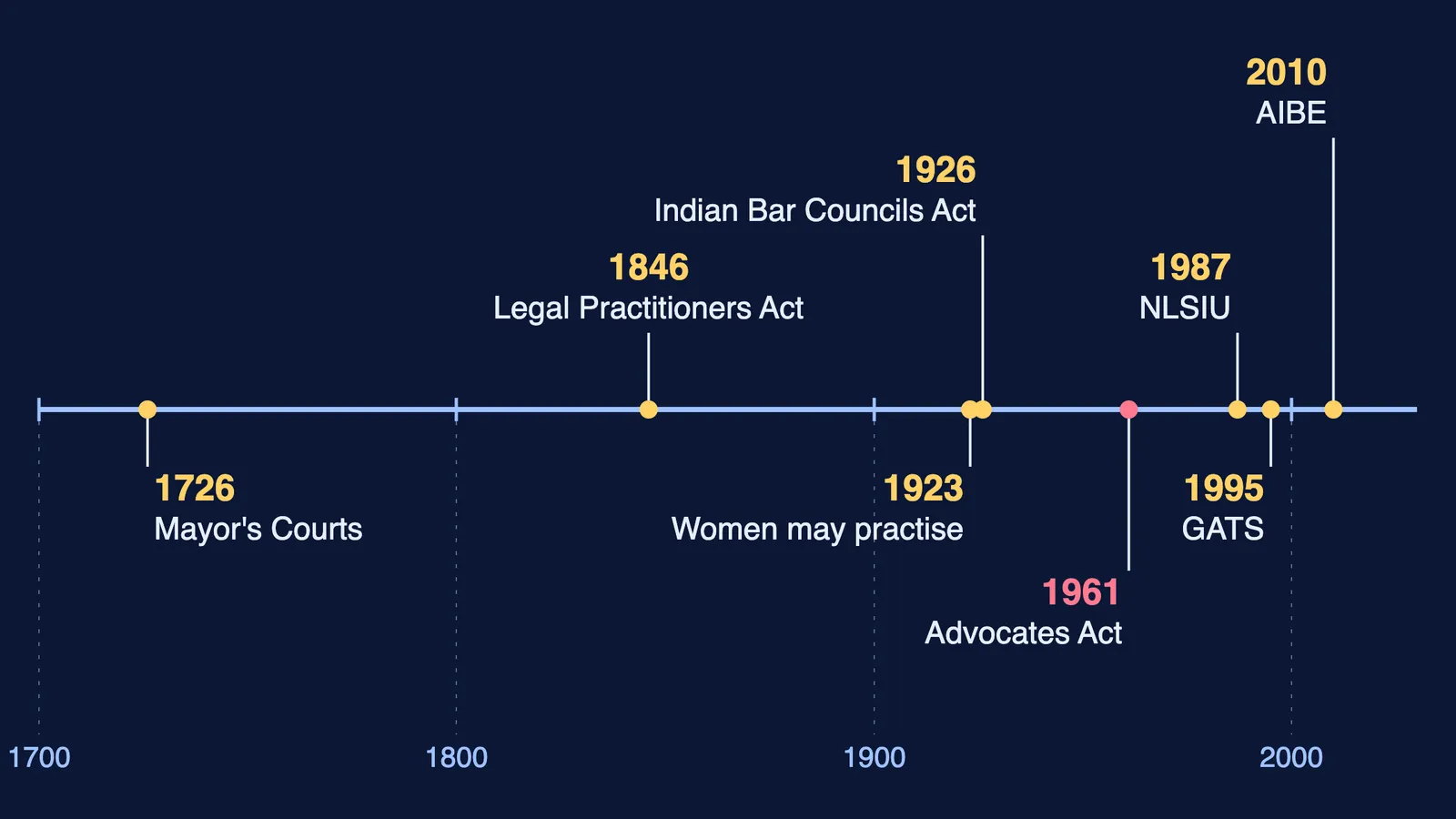
The book traces modern practice to the Mayor's Courts in Madras and Calcutta under the Charter of 1726. The Legal Practitioners Act, 1846 opened practice to qualified people of any nationality or religion, but not to women.
The 1923 Chamier Committee proposed a Bar Council for each High Court, leading to the Indian Bar Councils Act, 1926.
The Calcutta (1916) and Patna (1922) High Courts refused to enrol qualified women. The Allahabad High Court enrolled Cornelia Sorabji as a vakil on 24 August 1921, and the Legal Practitioners (Women) Act, 1923 removed the bar. The book cites 2022 Law Ministry data: women made up 15.3 percent of India's lawyers.
What did the Advocates Act, 1961 change?
One class of lawyer: vakils, barristers, pleaders and mukhtars became "advocates", who may practise across India.
Enrolment, per the book: an Indian citizen aged at least 21 with an LLB from an Indian university, who must also pass the All India Bar Examination, required since 2010. Foreign nationals need reciprocity.
Senior Advocates and Advocates-on-Record: courts designate Senior Advocates under Section 16; only Advocates-on-Record, a Supreme Court category, can file matters in that court.
State Bar Councils: the state Advocate General sits ex officio, with 15 to 25 members elected for five years. They keep the roll and hear misconduct cases.
Bar Council of India: the Attorney-General and Solicitor General sit ex officio, with one member elected by each State Bar Council. It sets standards of conduct and of legal education and recognises universities whose law degrees qualify for enrolment.
What ethics and advertising rules does the book describe?
Under Bar Council of India Rules, an advocate must respect the court, avoid private talks with a judge, keep client secrets and not charge a fee tied to winning (a contingency fee). Breaches can mean suspension or debarment.
The book says India limits advertising tightly. After approval from the Bar Council of India, a website may show only five items: name, contact details, enrolment details, qualifications and practice areas. The USA allows advertising within limits, and the UK dropped its ban.
On foreign lawyers, the book notes that the Bombay High Court (2011, Lawyers Collective) barred foreign firms' liaison offices, while the Madras High Court (A.K. Balaji) allowed "fly in and fly out" advice.
How is legal education different in India, the USA and the UK?
India: a 3-year LLB after a first degree, or a 5-year integrated degree straight after school. The book names NLSIU Bangalore (1987) as the first National Law School; 22 of 24 then used CLAT.
USA: a 4-year degree, the LSAT, a 3-year JD, then a state bar exam.
UK: a 3-year LLB, then the practice course and a training contract for solicitors, or the Bar course and pupillage for barristers.
The book's career routes include litigation, law firms, in-house teams, public policy, teaching, NGOs, judicial services and the Army's JAG Department. Each has its own entry rules; these are options, not outcomes.
Practice questions in the 2026-27 sample paper formats
The 2026-27 sample paper uses 1-mark MCQ and assertion-reason items plus 2-, 3- and 5-mark answers. The questions are ours.
(1 mark, MCQ) The Indian Bar Councils Act, 1926 followed the report of: (a) the Law Commission of India (b) the Chamier Committee (c) the Legal Education Committee (d) the American Bar Association
(1 mark, assertion-reason) A: An advocate cannot agree to take a share of the money a client wins. R: Bar Council of India rules forbid contingency fees.
(2 marks) A foreign national with a law degree from abroad wants to enrol as an advocate in India. State two conditions the book sets.
(3 marks) Kabir holds a BSc and wants to become a lawyer. Using the book, describe one route open to him in India and one in the UK.
(5 marks) For a newly enrolled advocate, name the body that keeps her on the roll, hears misconduct complaints against her and sets her conduct rules. Then describe how each body is composed.
Answers: 1 is (b); in 2 both are true and R explains A.
Planning this week? Fermi's AI tutor works out what you already know and builds a plan for the session.
Related: how advocate enrolment works after an LLB, the Alternative Dispute Resolution Class 12 guide and the Law of Torts Class 12 guide.