On this page
Law of Torts is Chapter 3(B) of the CBSE Legal Studies Class 12 textbook. This guide is a study summary, not legal advice.
What does the Law of Torts chapter cover in 2026-27?
The CBSE Legal Studies curriculum for 2026-27 lists seven topics: the concept of torts, sources, intentional torts, defamation, negligence, strict liability and absolute liability. The chapter sits in Unit 3, Topics in Law I (Business Laws), worth 20 marks shared with Contract, Property and Intellectual Property Law, so torts has no separate figure.
The prescribed book is the CBSE Legal Studies Class XII textbook, second edition 2023, pages 62 to 71. The curriculum does not list general defences as a topic; the defences the chapter gives are the five exceptions to strict liability.
What is a tort, and how is it different from a crime?
In the textbook, a tort is a civil wrong, intentional or accidental, that harms another person, who can then seek damages or an injunction.
Tort vs crime: the injured person sues in a civil court, mainly for compensation; in a criminal case the state prosecutes and the aim is punishment.
Tort vs breach of contract: in tort the duty is owed to people generally and damages are unliquidated (not fixed in advance); in contract the duty is owed to specific parties.
Sources: tort law grew mostly from judges' decisions, with no single Indian statute, though the Motor Vehicles Act and Consumer Protection Act now cover some such harms.
What are intentional torts?
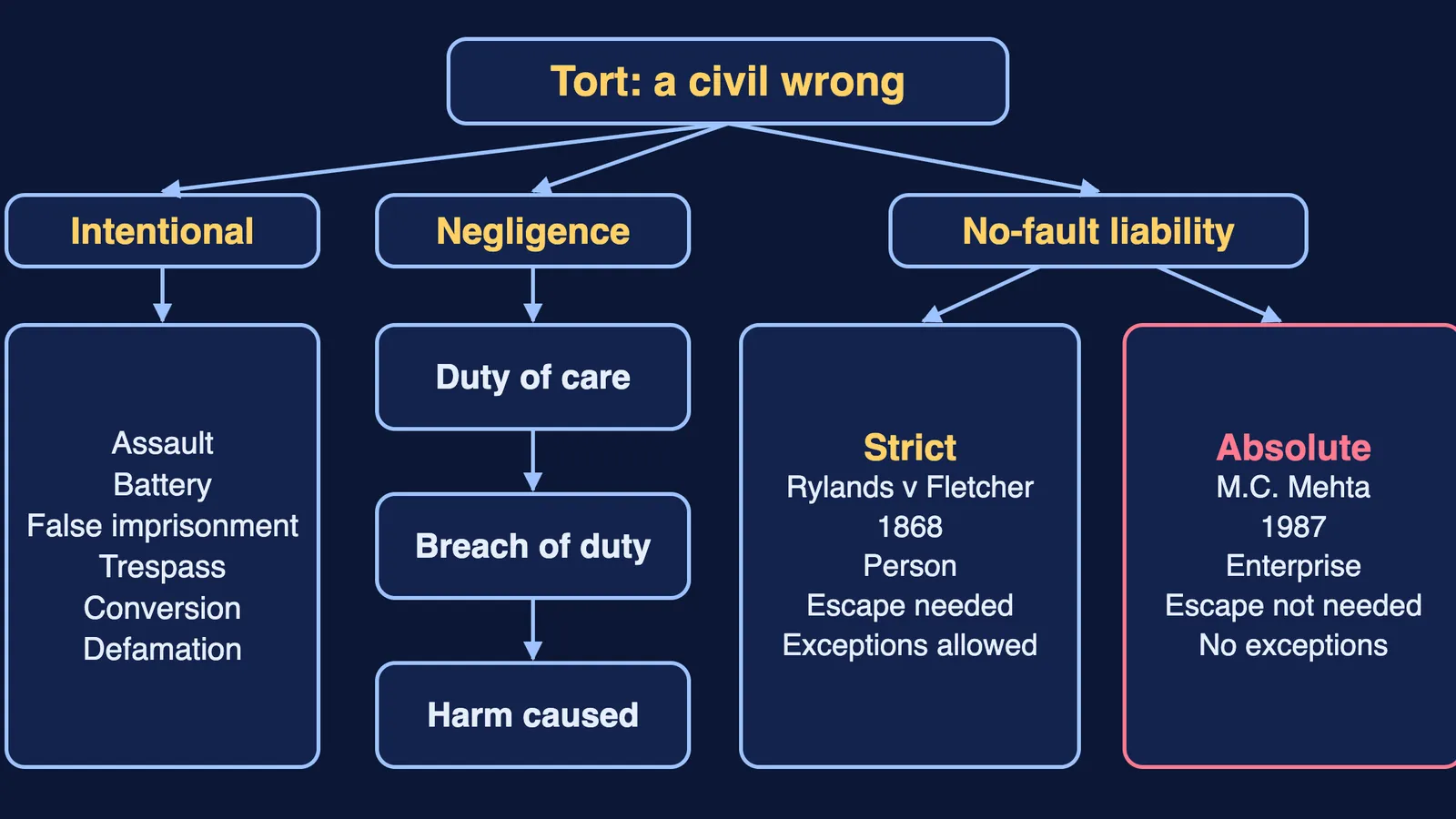
Here the harm is caused on purpose. The book covers assault (a reasonable fear of imminent harmful touching), battery (intentional, direct force), false imprisonment, trespass to land, trespass to chattels (movable goods), conversion (remedied by a forced sale at original value), and unlawful harassment.
Defamation is a false statement that lowers a person's reputation among right-thinking people: libel in permanent form such as writing, slander in spoken words or gestures. The book says criminal defamation falls under the IPC. The IPC, CrPC and Indian Evidence Act were replaced by the Bharatiya Nyaya Sanhita, Bharatiya Nagarik Suraksha Sanhita and Bharatiya Sakshya Adhiniyam from 1 July 2024, as a Press Information Bureau release records.
How does negligence work?
The book defines negligence as a breach of the duty to take care that causes damage. The claimant proves three things in order: a duty of care, a breach of it, and harm caused by the breach. Its cases are Donoghue v Stevenson (a manufacturer owes care to consumers it can reasonably foresee) and MacPherson v Buick Motor Co. (1914), where a car maker was held responsible for not testing a bought-in wheel.
What is the difference between strict and absolute liability?
Both are no-fault liability: the defendant pays even without carelessness. Strict liability comes from Rylands v Fletcher (England, 1868), where water from a mill owner's reservoir flooded a neighbour's mines. Its three principles are a dangerous thing (non-natural use of land), its escape, and resulting damage. The book's five exceptions are the plaintiff's own fault, act of God, mutual benefit (where the plaintiff consented to the source of danger), act of a stranger, and statutory act.
Absolute liability was laid down by the Supreme Court in 1987, after an oleum gas leak from a Delhi factory in 1985. The book names the case M.C. Mehta v. Shri Ram Foods and Fertilizer Industries; the 2026-27 marking scheme calls it M.C. Mehta v. Union of India. An enterprise in a hazardous industry must compensate for any harm; escape is not needed and no exceptions apply.
Practice questions in the 2026-27 sample paper formats
The 2026-27 sample paper uses 1-mark MCQ and assertion-reason items plus 2-, 3- and 5-mark answers. The questions below are ours.
(1 mark, MCQ) Which is not an exception to strict liability in the book? (a) Act of God (b) Act of a stranger (c) The defendant took all reasonable care (d) Statutory act
(1 mark, assertion-reason) A: A chemical plant cannot avoid liability by proving an earthquake caused a leak. R: Absolute liability allows no exceptions.
(2 marks) Distinguish libel from slander with one example of each.
(3 marks) A gym ignores a frayed cable on a weight machine; it snaps and injures a member. Apply the three elements of negligence.
(5 marks) A fireworks maker stores explosives in a busy town and a blast injures passers-by. Which no-fault rule applies, and why would pleading reasonable care fail?
Answers: 1 is (c); in 2 both are true and R explains A.
Short on time this week? Fermi's AI tutor works out what you already know and builds a plan for the session.
Related: what Legal Studies covers in Class 11, Consumer Education and Protection Class 12 guide and the Judiciary Class 11 guide.