On this page
This guide follows the NCERT chapter (Reprint 2026-27) and the CBSE 2026-27 Home Science curriculum.
What does Concerns and Needs in Diverse Contexts cover in Class 11?
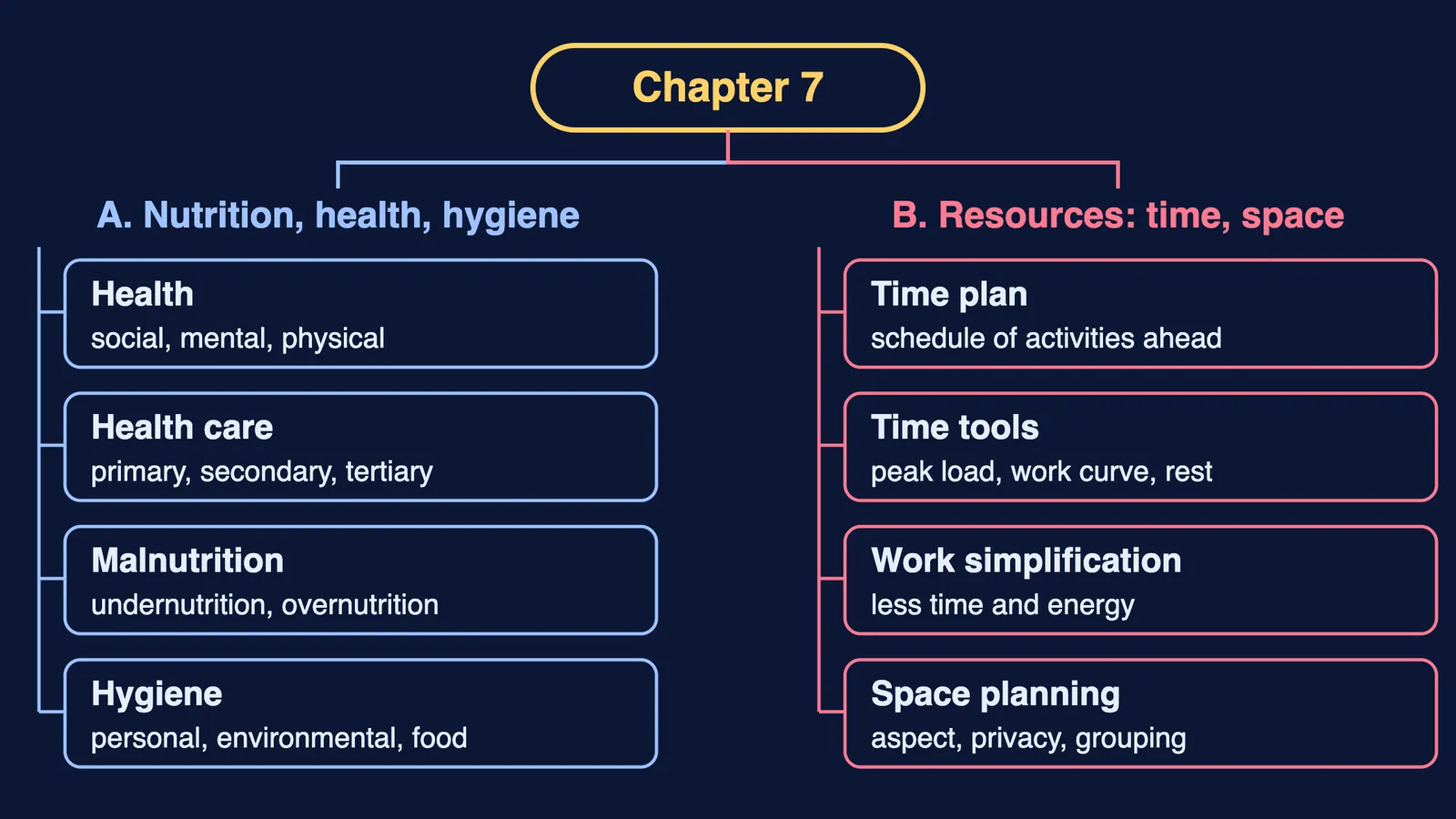
The NCERT chapter has three sections: A. Nutrition, Health and Hygiene; B. Resource Availability and Management; C. Textile Traditions in India, as the book's contents page shows. The 2026-27 curriculum lists only parts A and B under this chapter, so the curriculum does not list Section C.
Marks: the curriculum gives Unit III, Understanding Family, Community and Society, 15 marks out of 70 for theory. This chapter is the only one it lists in Unit III, so those 15 marks cover all of it. (The book prints it under Unit II.)
The curriculum also lists water safety: qualities of potable water and purification by boiling, chlorine, storage and electric filter, and RO. The NCERT chapter stresses safe drinking water but does not describe these methods, so use class notes.
What are the key ideas in nutrition, health and hygiene?
Health in the WHO sense used by NCERT means complete physical, mental and social well-being, not only being free of disease.
Three dimensions: social health (getting along with people and institutions, and equal access in society to what good health needs), mental health (coping with everyday stress, satisfying relationships) and physical health (body fitness and resistance to infection).
Health care levels: primary is your first contact with the system; secondary is referral to a specialised or district hospital; tertiary is referral for intensive, advanced care.
Nutrients: the book counts more than 50, split into macronutrients (fat, protein, carbohydrate, fibre) and micronutrients (minerals such as iron and zinc, plus vitamins).
WHO's four factors for nutritional well-being: food and nutrient security, caring for vulnerable people, good health for all, and a safe environment.
Malnutrition is any departure from normal nutrition. Too little intake causes undernutrition; too much causes overnutrition. India faces both, which the book calls the double burden of malnutrition.
Nutrition and infection feed each other: poor nutrition lowers immunity, and infection drains nutrient reserves while raising needs.
Hygiene has personal and environmental sides, and food hygiene gets its own list. A food-borne illness needs the organism or its toxin in the food, enough of it, and enough food eaten. The NCERT text names 4 to 60°C as the storage range that lets micro-organisms grow.
How do time and space management work?
Time is limited and cannot be got back, so the book treats it as a resource to plan. A time plan is a schedule of activities made in advance for a set period. Its steps include prioritising, saying no to low-priority tasks, splitting big tasks and fixing start and stop times.
Four tools help:
Peak load period: the time with the most work, such as early morning.
Work curve: work traced against time, from warm-up to a plateau, then a fall from fatigue.
Rest periods: breaks that should be neither too long nor too short.
Work simplification: finding the easiest, quickest way to do a job, through changes in body motions, in work space and equipment, or in the end product.
Space management means planning, organising, using and evaluating space. The ten principles are aspect, prospect, privacy (internal and external), grouping, roominess, furniture requirements, sanitation (light, ventilation, cleanliness), circulation, practical considerations and elegance.
Worked example: planning a three-hour morning
You have 9:30 am to 12:30 pm on a Sunday, a science project due on Monday, a chemistry chapter to read and an optional cricket match with friends. Compulsory work goes first, nearest deadline first, with one short break:
9:30 to 11:00 am: science project (90 minutes)
11:00 to 11:15 am: break (15 minutes)
11:15 am to 12:00 noon: chemistry reading (45 minutes)
12:00 to 12:30 pm: cricket (30 minutes)
That adds up to 180 minutes, exactly three hours.
Now try the book's 15-question self-check, where each answer scores 1 to 5, so totals run from 15 to 75. If you score 2 on five items, 3 on six and 4 on four, your total is 10 + 18 + 16 = 44. That falls in the 31 to 45 band, meaning room to improve in places.
Practice questions for 2026-27
CBSE publishes no Class 11 sample paper, so these mark labels are our suggestion.
Name the three dimensions of health and give one sign of each. (our suggestion: 3 marks)
Explain how nutrition and infection affect each other in a child with diarrhoea. (our suggestion: 3 marks)
Distinguish primary, secondary and tertiary health care. (our suggestion: 3 marks)
A bedroom's only window faces the blank wall of the next building, and the room feels stuffy by evening. Name two space-planning principles involved and suggest one change. (our suggestion: 2 marks)
Give two examples of work simplification you could use while cleaning your room. (our suggestion: 2 marks)
For the Class 12 follow-ups, see Public Nutrition and Health Class 12 and Food Quality and Food Safety Class 12.
Not sure where to begin tonight? Fermi's AI tutor works out what you already know and builds a plan for the session.