On this page
Human Rights Violations: Complaint Mechanism is Chapter 5(B) of CBSE Class 12 Legal Studies. This guide covers the 2026-27 syllabus, each commission, the NHRC complaint route and original practice questions. It is a study summary, not legal advice.
What does Chapter 5(B) cover in 2026-27?
The CBSE Legal Studies curriculum for 2026-27 lists two parts: what quasi-judicial bodies are, and the human rights commissions (NHRC, the National Commission for Minorities, NCW, the commissions for Scheduled Castes and Scheduled Tribes, and NCPCR). Unit 5, Concept of Human Rights, carries 10 marks shared with Chapter 5(A), Human Rights in India, with no separate figure for this chapter.
The prescribed book is the CBSE Legal Studies Class XII textbook, second edition 2023, pages 147 to 160.
What is a quasi-judicial body?
In the book, quasi-judicial bodies are executive agencies with court-like authority to settle disputes and impose penalties. Its examples are national and state human rights commissions, information commissions, consumer commissions and income tax tribunals.
National commissions cover the whole country; state commissions take up violations within their state. The Protection of Human Rights Act, 1993 sets up both the NHRC and the State Human Rights Commissions.
How do you file a complaint with the NHRC?
The book sets out the NHRC route:
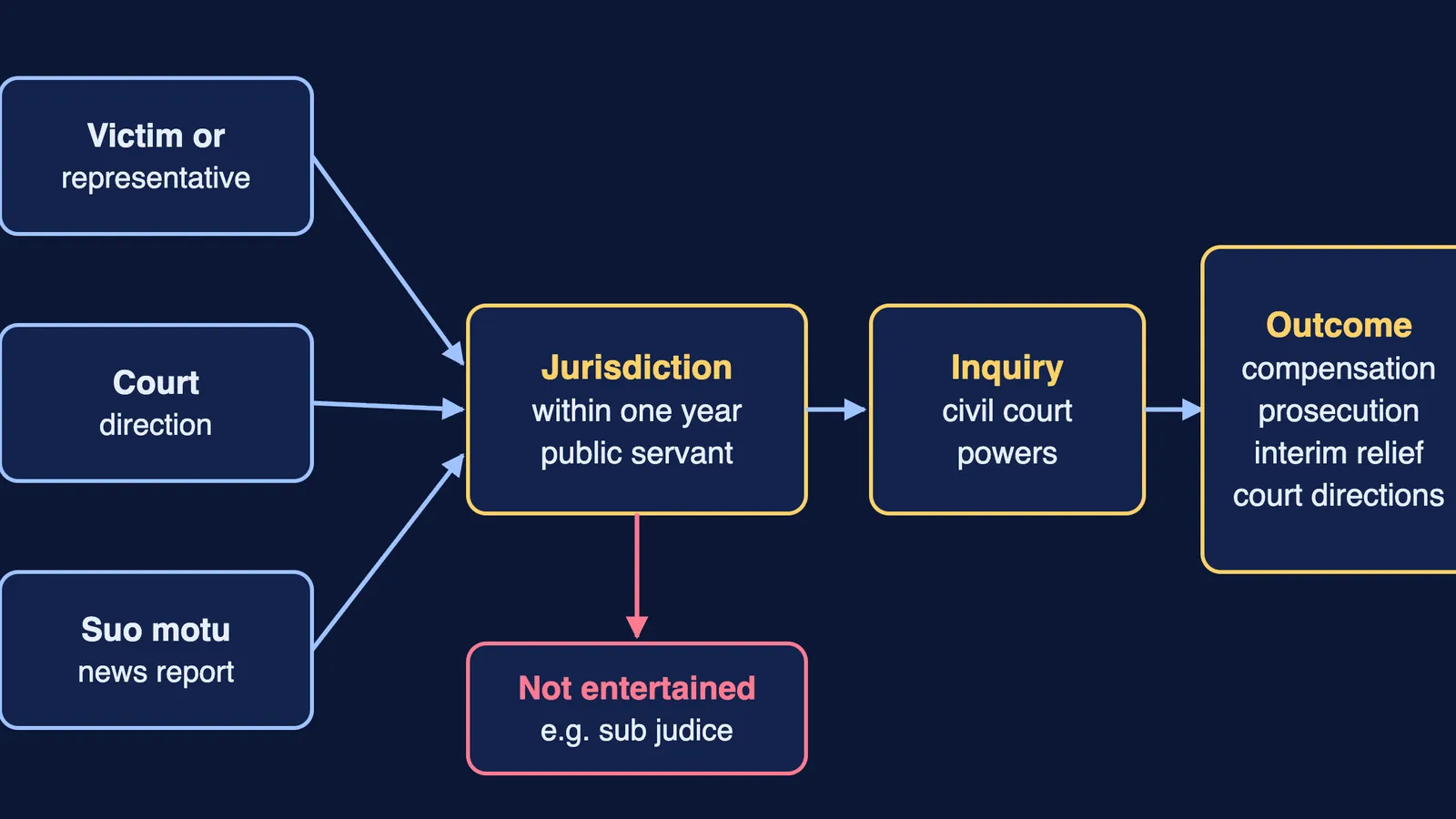
The victim, or someone acting for them, writes the complaint in English, Hindi or any Eighth Schedule language.
It is sent online, by post, fax or e-mail, preferably in the Commission's format. There is no fee.
It must allege a human rights violation, its abetment, or negligence in preventing it by a public servant, within one year.
The Commission may also act on a court's direction or suo motu, say on a news report.
During inquiry the Commission holds a civil court's powers: summoning witnesses, calling for documents and taking evidence on affidavit.
It can recommend compensation or prosecution, seek interim relief, or approach the Supreme Court or a High Court.
The book lists complaints the NHRC does not ordinarily entertain: vague or anonymous ones, matters pending before a court or another commission, property or contract disputes, service and labour matters, and allegations not against a public servant. The book's wording here is older: it names www.nhrc.nic.in for online complaints, and the NHRC home page now links to the HRCNet complaint portal.
The book describes the Chairperson as a former Chief Justice of India, with two human-rights members. The book's wording here is older. The NHRC's About page cites a 2019 amending law, the Protection of Human Rights (Amendment) Act, and its composition page now allows a former Chief Justice of India or Supreme Court judge as Chairperson, with three human-rights members, at least one a woman.
How do the other commissions take complaints?
National Commission for Minorities: set up under the National Commission for Minorities Act, 1992 for six religious minorities. It declines complaints unrelated to minority rights, sub judice matters, events over a year old and vague or anonymous complaints.
National Commission for Women: established in 1992; its founding law is the National Commission for Women Act, 1990. It looks into complaints, takes suo motu notice, inspects places of custody and can fund litigation affecting many women.
Commissions for Scheduled Castes and Scheduled Tribes: they inquire into complaints of denied constitutional safeguards and follow them up. The book places both under Article 338. The book's wording here is older: the NCST's own page says the Constitution (89th Amendment) Act, 2003 inserted Article 338A, creating separate commissions from 19 February 2004.
NCPCR: created under the Commission for Protection of Child Rights Act, 2005 for all children aged 0 to 18. Complaints are free, in any Eighth Schedule language, through its ebaalnidan.nic.in complaint site.
Practice questions in the 2026-27 sample paper formats
The 2026-27 sample paper uses 1-mark MCQ and assertion-reason items plus 2-, 3- and 5-mark answers. The questions below are ours.
(1 mark, MCQ) Which is not one of the book's examples of a quasi-judicial body? (a) A state human rights commission (b) An information commission (c) A consumer commission (d) The Supreme Court
(1 mark, assertion-reason) A: The NHRC can begin an inquiry with no complaint before it. R: It may take suo motu notice of a violation reported in the media.
(2 marks) A tenant writes to the NHRC asking it to make a private landlord return a security deposit. Using the book's NHRC guidelines, explain why the Commission would ordinarily decline it.
(3 marks) A children's shelter run by a state authority keeps residents in unsafe conditions. Name the commission best placed to act and two powers.
(5 marks) Compare the NHRC and NCW on their founding law, membership, complaint route and one power each.
Answers: 1 is (d); in 2 both are true and R explains A.
Planning tonight's revision? Fermi's AI tutor works out what you already know and builds a plan for the session.
Related: what Legal Studies covers in Class 11, the Alternative Dispute Resolution Class 12 guide and the Law of Torts Class 12 guide.