On this page
Care and Maintenance of Fabrics is Chapter 11 of NCERT's Human Ecology and Family Sciences Part II for Class XI (reprint 2026-27). It covers mending, stain removal, washing agents and methods, finishing, ironing, dry-cleaning, storage and the care label. Its Class 12 follow-on is Care and Maintenance of Fabrics in Institutions.
What does the 2026-27 syllabus include?
The CBSE Home Science (064) curriculum for Class XI, 2026-27 puts this chapter in Unit V, Adulthood, alongside Financial Management and Planning. Unit V carries 15 of the 70 theory marks, shared by both chapters; CBSE prints no separate figure for this chapter.
The curriculum's topic list follows the NCERT chapter, from mending to the care label. Practical 10 asks you to analyse a garment label, prepare one care label and test two fabric samples for colour fastness. In the practical exam, "prepare one care label of any garment" is offered as an OR choice in a 5-mark question.
How do you remove a stain from fabric?
NCERT defines a stain as an unwanted mark left by foreign matter that ordinary washing cannot shift. Identify it first by colour, smell and feel, because the type decides the treatment:
Vegetable (tea, coffee, fruit): acidic, so treat with an alkaline medium.
Animal (blood, milk, egg): protein, so use detergent and cold water only.
Oil (ghee, butter): grease solvents and absorbents.
Mineral (ink, rust, medicine): acid medium first, then alkaline.
Dye bleeding: dilute alkali or acid, depending on the fabric.
The four techniques are scraping, dipping, sponging over blotting paper, and the drop method over a bowl. Reagents fall into six groups: grease solvents, grease absorbents, emulsifiers, acids, alkalis and bleaches (oxidising or reducing).
Sunlight is a natural bleach, so the book suggests sun-drying curry-stained cotton; see why turmeric stains fade in sunlight.
How do soaps and detergents remove dirt?
Water wets the fabric, and the movement of its particles (pedesis) carries off loose, non-greasy dirt; warmer water does this better. But water alone cannot hold dirt in suspension, so it settles back, and that redeposition is the main reason fabrics turn grey over many washes.
Soaps and detergents are surfactants: they lower water's surface tension so it soaks in faster, break grease into tiny particles, and keep soil suspended until rinsing. Soap comes from oils or fats reacting with alkali; it is biodegradable but wasteful in hard water. Synthetic detergents are stronger and can be designed for specific tasks and machines.
NCERT lists four washing methods. Friction suits strong cottons. Kneading and squeezing protects wool, silk, rayon and coloured fabrics. Suction suits heavy items such as towels. Machines create agitation through a moving tub or central rod.
What happens after washing: finishing, ironing and dry-cleaning?
Blues counter the yellowing of white cotton but not greyness. Optical brighteners absorb shorter-wavelength light and re-emit it at a longer one, so they fight both; they are not bleaches.
Starch stiffens cotton and linen only (thin fabrics need more, thick ones less). Gum acacia gives light crispness for silk and fine cotton; a little borax in starch keeps crispness in humid weather.
Ironing needs heat, moisture and pressure. Laces are pressed (lift and place), not ironed.
Dry-cleaning uses a non-water liquid, such as perchloroethylene, so fibres do not swell, shrink or bleed; see why non-polar solvents lift oily stains.
Store clothes clean, dry, mended and loosely packed in low humidity.
How do you read a care label?
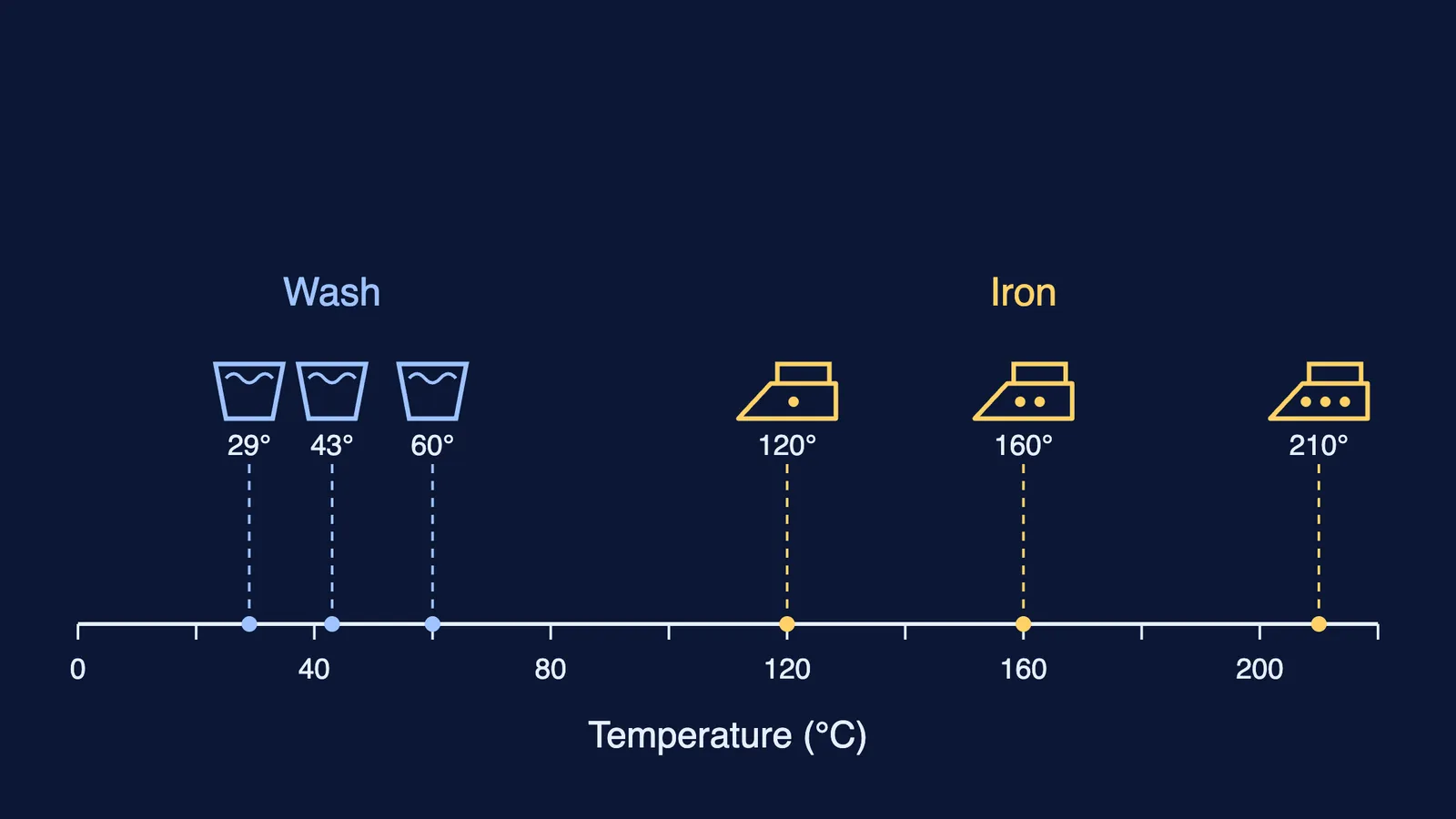
A care label is a permanent tag that must stay attached and readable for the garment's useful life. The NCERT table on page 217 gives these temperatures:
Wash tub: 29°C cold, 32-43°C warm, 60°C hot.
Iron: one dot 120°C (low), two dots 160°C (moderate), three dots 210°C (hot).
Circle A: all solvents; P: only white spirit or "choroethylene" (sic); S: white spirit only.
The label follows from fibre properties. Cotton is stronger wet and takes boiling. Wool weakens wet and felts with agitation, so it is washed cold and dried flat. Silk and nylon lose strength in sunlight. Yarn twist, weave, colour and finishes change care too.
What practice questions should you try?
The mark labels are our suggestion.
(1 mark) Which stain group needs cold water only, and why?
(2 marks) Give one difference between blueing and an optical brightener.
(3 marks) A silk dupatta has a lipstick mark. Choose a technique and reagent group, and say what to avoid.
(3 marks) Explain why white shirts grey after repeated washing in plain water.
(5 marks) Design a care label for a hand-knitted woollen sweater and justify each symbol from wool's properties.
Stuck on where to begin a revision session? Fermi's AI tutor works out what you already know and builds a plan for the session.