On this page
Chapter 8 of the Class 11 Home Science book follows children from birth to age 12 and asks, at each stage, what the child needs to eat and what keeps them well. It is in NCERT Human Ecology and Family Sciences Part II (Reprint 2026-27). The adolescent diet chapter, Food, Nutrition, Health and Fitness, is separate; this guide covers Chapter 8 only.
How many marks is Nutrition, Health and Well-being worth?
The CBSE Home Science curriculum for 2026-27 gives Unit 4, Childhood, 15 of the 70 theory marks. Those 15 marks are shared with Our Apparel, so Chapter 8 has no separate figure. The curriculum lists all three age bands: infancy (birth to 12 months), preschool (1-6 years) and school age (7-12 years).
What does the chapter say about infants?
The NCERT chapter notes that an infant's weight doubles by about 6 months and triples by one year, while length grows from 50-55 cm at birth to about 75 cm.
Colostrum and breast milk: the yellowish milk of the first 2-3 days is rich in antibodies. The book cites WHO's advice of exclusive breastfeeding for six months.
Low birth weight: below 2.5 kg at birth. These babies suck and swallow weakly yet need relatively many calories.
Complementary foods: added alongside breast milk by about 6 months, as liquid, semi-solid and solid foods. Low-cost home mixes such as Balahar and Poshak combine roasted cereals, pulses and groundnut in fixed ratios.
Rules: one new food at a time, small amounts first, no forcing, clean utensils.
Deficiency diseases named: protein energy malnutrition, anaemia (iron), nutritional blindness (vitamin A), rickets (vitamin D and calcium) and goitre (iodine).
How should meals be planned for preschool and school-age children?
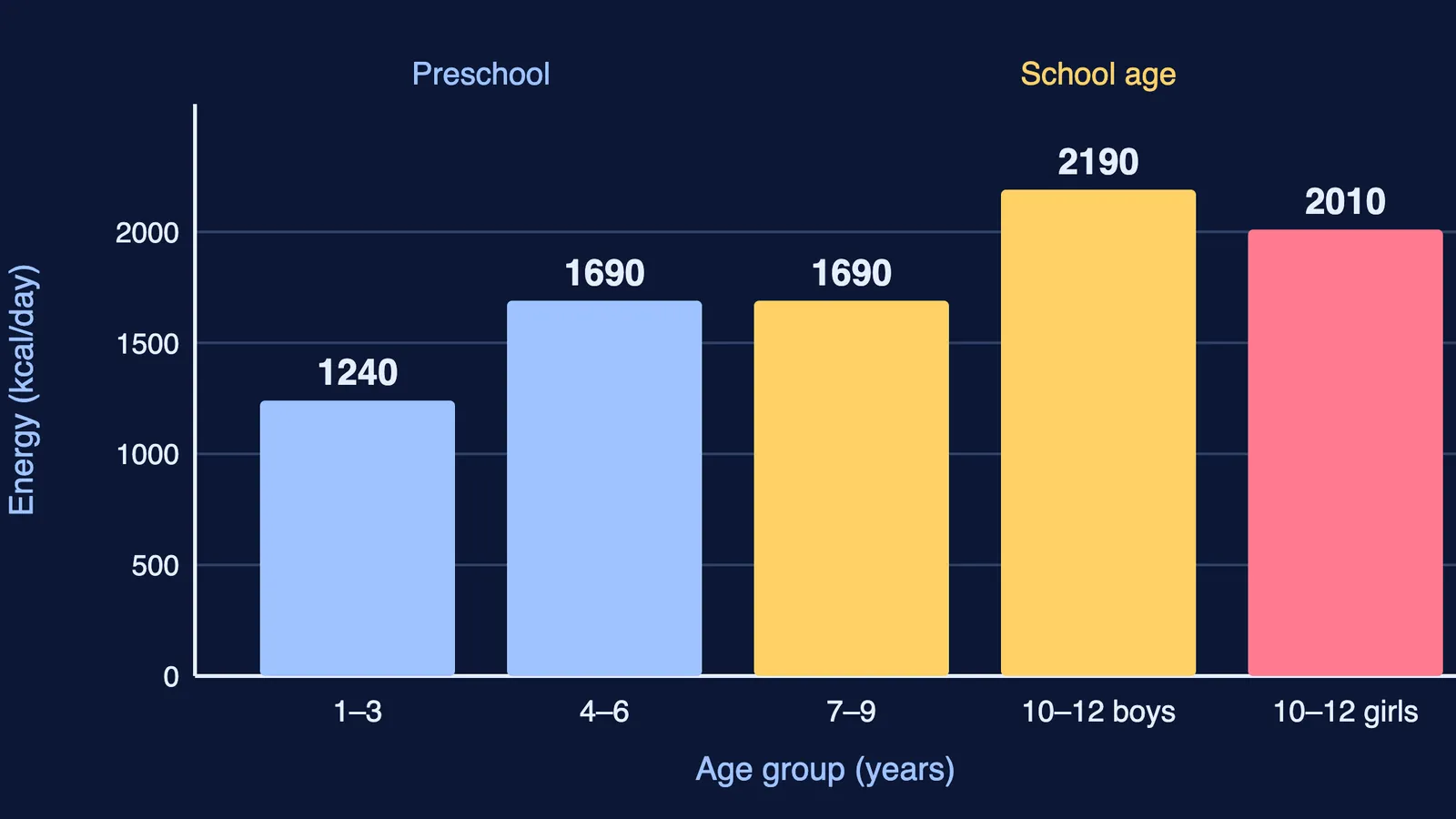
The book's ICMR 2010 table gives preschoolers 1240 kcal a day at 1-3 years and 1690 kcal at 4-6 years. Their diet should stress variety, balance and moderation across three meals and two snacks, since small children cannot eat enough in three sittings.
For children with special needs, the chapter rests on three ideas: observe how the child handles food, build self-feeding skills with patience and praise, and adapt textures or diets where needed.
After age 9, needs differ by sex. Boys of 10-12 need 2190 kcal and girls 2010 kcal, but girls need more iron (27 mg against 21 mg). The tips: variety, no skipped breakfast, fat at about 20 per cent of calories, and children helping plan meals. Family, media, peers, regional food culture and erratic appetite shape intake. The chapter closes on obesity and undernutrition existing side by side, and the mid-day meal scheme giving free lunch in Classes I-VIII.
What does the chapter say about immunisation?
A vaccine carries an inactive germ or toxin, so it cannot infect but makes the body produce antibodies. The book's tables list BCG, OPV and Hepatitis B at birth; OPV and Pentavalent at 6, 10 and 14 weeks; MR at 9 months; then boosters, MMR, typhoid and vitamin A drops in the preschool years.
Learn those tables for the exam, but the national schedule has since changed. The National Health Mission page on the Universal Immunization Programme records later additions such as IPV, rotavirus vaccine and PCV, two MR doses at 9-12 and 16-24 months, and Td replacing TT for adolescents.
Worked example: reading the infant RDA table
The book's ICMR 2010 values per kg of body weight are 108 kcal and 2.05 g protein up to 6 months, then 98 kcal and 1.65 g from 6 to 12 months. Our practice numbers:
Birth weight 3.2 kg: expect about 3.2 x 2 = 6.4 kg at 6 months and 3.2 x 3 = 9.6 kg at one year.
At 3 months, 5 kg: energy = 108 x 5 = 540 kcal a day; protein = 2.05 x 5 = 10.25 g.
At 9 months, 8 kg: energy = 98 x 8 = 784 kcal a day; protein = 1.65 x 8 = 13.2 g.
The per-kg rate falls after 6 months, but the daily total still rises because the baby is heavier.
Practice questions (mark labels are our suggestion)
(1 mark) Name the first milk after birth and give one reason it matters.
(2 marks) What birth weight marks low birth weight? Give two feeding problems these babies face.
(3 marks) A 5-year-old eats dal happily at a friend's house but refuses it at home. Explain using two factors from the chapter.
(3 marks) Find the daily energy and protein needs of a 7 kg, 8-month-old infant using the book's per-kg values.
(5 marks) Draw up a one-day vegetarian menu (three meals, two snacks) for a girl aged 10 and show how it meets her higher iron need.
In Class 12, this leads into Public Nutrition and Health, Clinical Nutrition and Dietetics and Early Childhood Care and Education.
Not sure where to begin this week's revision? Fermi's AI tutor works out what you already know and builds a plan for the session.