On this page
Criminal Laws in India is Chapter 4(C) of the CBSE Class 12 Legal Studies curriculum for 2026-27. It sits in Unit 4, Topics in Law II, which carries 10 marks shared with Chapter 4(A) Law and Sustainable Development and Chapter 4(B) Forms of Legal Entities; the curriculum gives no separate figure for this chapter. The prescribed text is the CBSE Legal Studies Class XII book, second edition 2023.
What is a crime, and what does criminal law aim to do?
The book treats a crime as an unlawful act that the State punishes. An act is not a crime unless a law forbids it. Ignorance of the law is no defence (*ignorantia juris non excusat*).
The book names five widely accepted objectives of punishment:
Retribution: the penalty balances out the wrong done.
Deterrence: punishment discourages the offender and others.
Incapacitation: the offender is kept apart from society.
Rehabilitation: the offender is reformed into a useful member of society.
Restoration: victim-focused; the offender repairs the harm, such as paying back embezzled money.
Which laws make up criminal law in the book?
The book names three statutes: the Indian Penal Code, 1860 (offences and punishments), the Code of Criminal Procedure, 1973 (how offences are investigated and tried), and the Indian Evidence Act, 1872 (how facts are proved in court). Special and local laws, such as the Arms Act, 1959, create other offences.
The commencement dates are in the Gazette of India notifications of 23 February 2024 (S.O. 850(E) for the BNS, S.O. 848(E) for the BNSS and S.O. 849(E) for the BSA), and a PIB release of 26 March 2025 states that the three older Acts have been repealed and replaced. The BNS and BNSS notifications hold back one provision, section 106(2) of the BNS. Section numbers in the book refer to the old Acts, so check the new Act before quoting one.
What are mens rea, actus reus and the stages of crime?
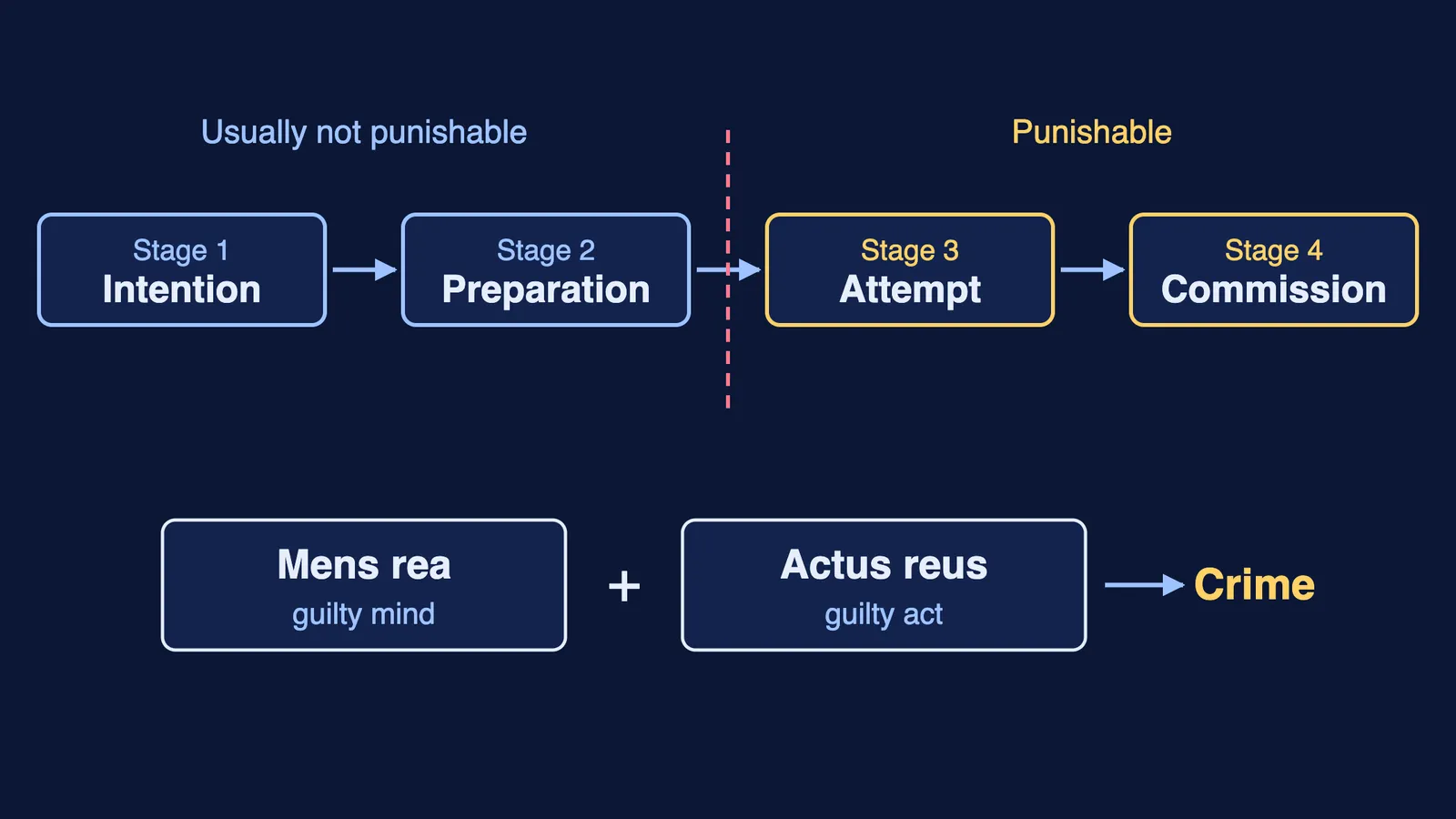
Per the book, a crime usually needs two elements together. Actus reus is the guilty act: a conduct, its result, and a legal ban on it. An illegal omission counts, but a purely moral one does not. Mens rea is the guilty mind. The book's case State of Maharashtra v. Mayer Hans George (1965) shows a statute can exclude mens rea.
Intention means acting knowingly and on purpose. Motive is the reason behind the act, and criminal law does not use it to decide guilt.
The four stages of crime, from the book:
Intention: a plan in the mind; not punishable on its own.
Preparation: arranging the means; usually not punishable, except for serious offences such as collecting arms to wage war or preparing for dacoity.
Attempt: a direct step towards the offence after preparation; punishable.
Commission: the offence is complete.
Our Law of Torts guide shows how a civil wrong differs from a crime.
How is a confession different from an admission?
The prosecution must prove guilt beyond reasonable doubt. In the book's account of the Indian Evidence Act, 1872, an admission is an oral, documentary or electronic statement suggesting an inference about a fact in issue or a relevant fact. A confession, as the book quotes it, is an admission by a person charged with a crime suggesting that they committed it. Per the book, a confession always goes against its maker, while an admission is wider and is not conclusive proof.
A judicial confession is made before a magistrate or court; an extra-judicial confession is made to anyone else. A dying declaration is a statement by a person about the cause or circumstances of their death. The book's cases say a court must scrutinise it strictly, but a true and voluntary one can support a conviction without corroboration.
Criminal courts are covered in our Class 12 Judiciary guide.
Practice questions in the 2026-27 pattern
The 2026-27 sample paper uses 1-mark MCQs (including assertion-reason), and 2, 3 and 5-mark answers. Our own questions:
(1 mark) Ravi buys a crowbar planning to break into a godown next week, but is caught at home. Which stage has he reached? (a) intention (b) preparation (c) attempt (d) commission
(1 mark) Assertion: a student who steals a textbook for a classmate who cannot afford one is still liable for theft. Reason: criminal law ignores motive when fixing liability.
(2 marks) Give two differences between a judicial and an extra-judicial confession.
(3 marks) A nurse on night duty sees a patient's oxygen supply fail and does nothing. A visitor nearby also does nothing. Who may face criminal liability, and why?
(5 marks) Using an example of your own, explain at which stage criminal liability usually begins, and why the law punishes some preparations.
Answers: 1 is (b); in 2, both are true and the reason explains the assertion.
New to the subject? See what Legal Studies covers.
This is a study summary, not legal advice.
Not sure where to begin tonight's session? Fermi's AI tutor works out what you already know and builds a plan for the session.