On this page
International Law is Unit 6 of the CBSE Legal Studies Class 12 textbook. This is a study summary, not legal advice.
What does International Law cover in the 2026-27 syllabus?
The CBSE Legal Studies curriculum for 2026-27 lists Unit 6, International Law, at 08 marks in the 80-mark theory paper, and the unit has only this chapter. Its eight topics are introduction, historical evolution, what international law is, sources, international human rights, international law and municipal law, international law and India, and dispute resolution.
The prescribed book is the CBSE Legal Studies Class XII textbook, second edition 2023, pages 161 to 180.
What is international law, and how is it different from domestic law?
In the textbook, international law is a framework of rules for relations between states and other recognised international entities. Jeremy Bentham coined the term in 1780.
Public international law governs how one state deals with another.
Private international law, or conflict of laws, decides which country's courts hear a case with a foreign element, and whose law applies, as in a marriage across jurisdictions.
The book calls it weak next to municipal (domestic) law: General Assembly resolutions are mostly recommendations, the ICJ needs states' consent in contentious cases, and there is no international police force. Oppenheim saw it as true law; Austin did not, since no superior authority enacts it.
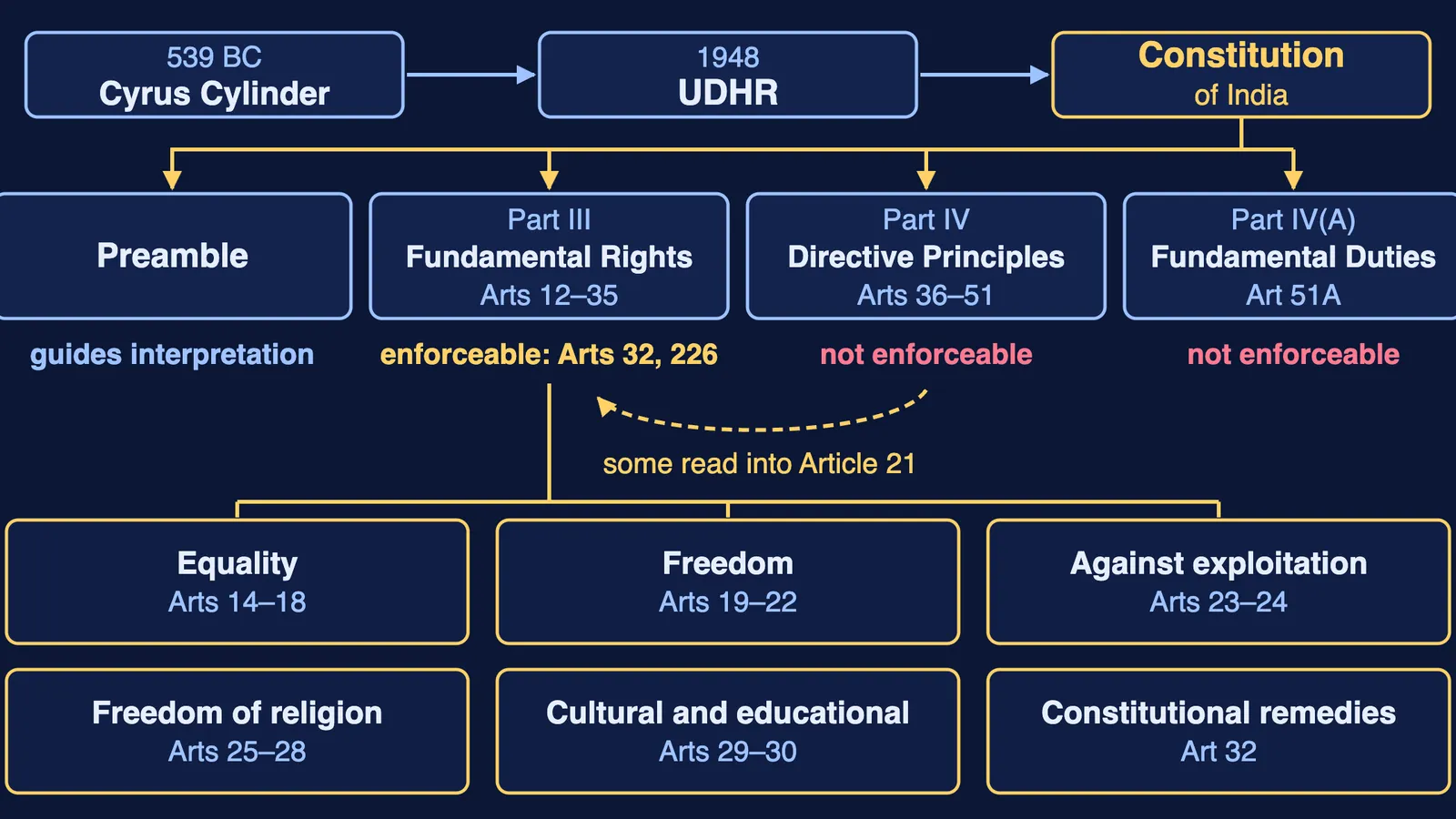
Jus cogens ("compelling law") are norms no treaty can set aside. Opinio juris is states' belief that a practice is legally required. On human rights, the book covers the Universal Declaration of Human Rights (not binding in itself), the ICCPR's non-derogable rights such as the right to life, and the 1993 Vienna Declaration.
What are the sources of international law?
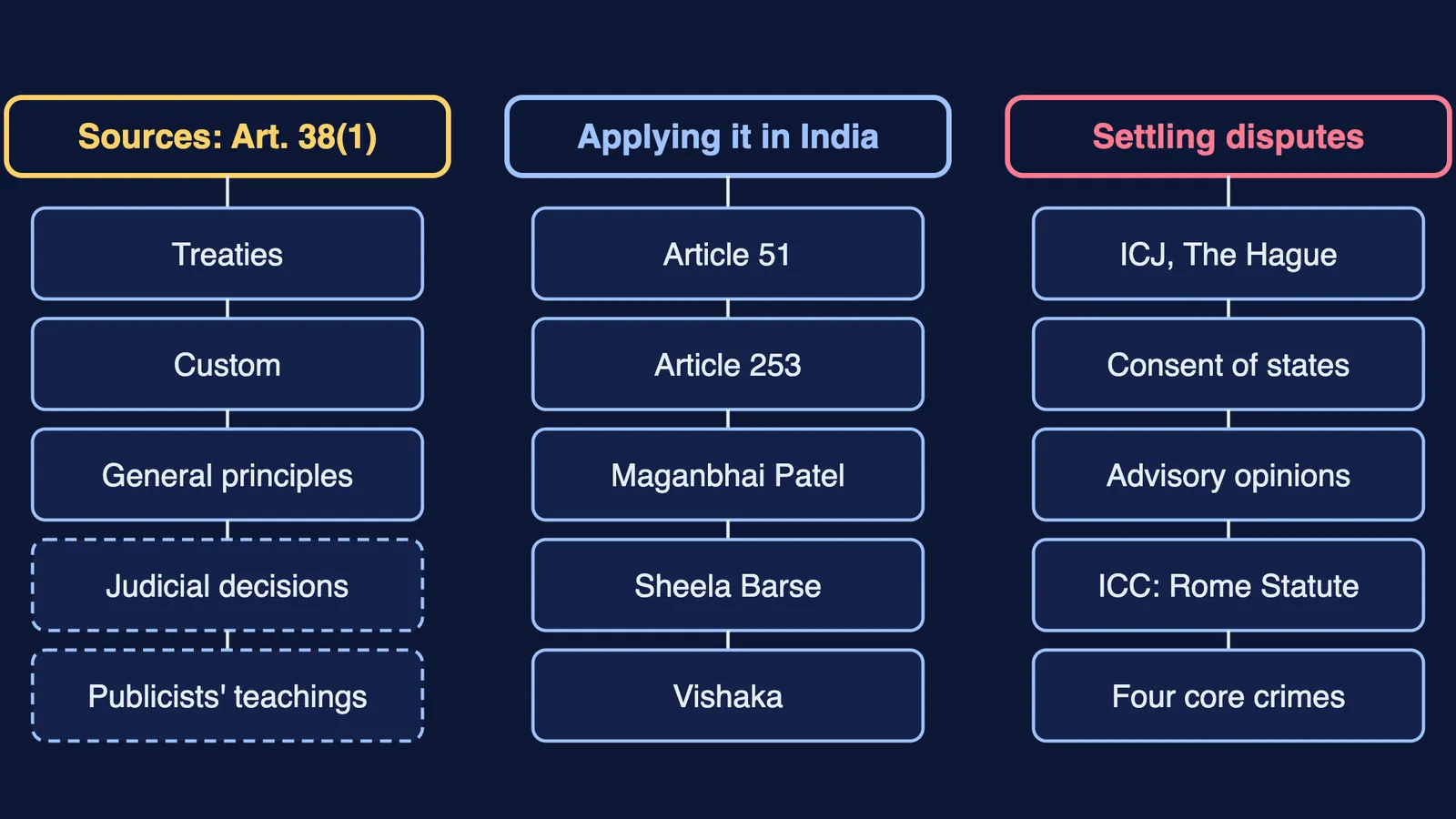
The book treats Article 38(1) of the ICJ Statute as the most authoritative list:
Treaties: written, binding agreements between states. A text is adopted by a two-thirds majority at a conference; a state then agrees to be bound by signature, exchange of instruments or ratification.
Custom: it needs state practice (objective) and opinio juris (subjective). The North Sea Continental Shelf cases (1969) confirmed both are needed, and that duration is not essential.
General principles of law: they fill gaps where treaties and custom are silent.
Judicial decisions and publicists' teachings: subsidiary means. Under Article 59, an ICJ decision binds only the parties to that case.
How does India apply international law?
Article 51 of the Constitution asks the State to encourage respect for international law and treaty duties. Article 253 lets Parliament legislate to implement treaties, even on state subjects. The book's cases:
Maganbhai Ishwarbhai Patel v Union of India (the book spells it Magan Bhai Patel): a treaty that restricts citizens' rights or changes the law needs legislation.
Sheela Barse v Secretary, Children's Aid Society: with no conflicting law, child-protection conventions India had ratified bound the State Government.
Vishaka v State of Rajasthan: courts used CEDAW to create binding duties on sexual harassment.
Kesavananda Bharati v State of Kerala (spelt Bharti in this passage of the book): the Constitution is to be read in light of the UN Charter.
So a treaty cannot by itself override Indian law, but where it adds to rights and nothing contradicts it, courts can apply it.
How are international disputes settled?
International Court of Justice: the UN's principal judicial organ, sitting at The Hague since 1946. Its judgments are final and binding on the parties; its advisory opinions (Articles 65 to 68) are not.
International Criminal Court: set up under the Rome Statute and working since 2002, for crimes against humanity, genocide, war crimes and aggression, complementing national courts.
Treaty mechanisms: mediation, arbitration or panels, such as the GATT dispute panel.
Practice questions in the 2026-27 sample paper formats
The 2026-27 sample paper uses 1-mark MCQs, including assertion-reason, plus 2-, 3- and 5-mark answers. These questions are ours.
(1 mark, MCQ) Under Article 38(1), which is a subsidiary means? (a) Treaties (b) International custom (c) General principles of law (d) Teachings of publicists
(1 mark, assertion-reason) A: Earlier ICJ judgments do not bind the Court in a later case. R: Under Article 59, a decision binds only the parties and that case.
(2 marks) Give two reasons the textbook offers for calling international law weaker than municipal law.
(3 marks) Explain three ways a state can agree to be bound by a treaty.
(5 marks) One ratified convention widens protection for factory workers and conflicts with no Indian law; another would stop some traders selling a product. Using the book's cases, explain how each takes effect in India.
Answers: 1 is (d); in 2 both are true and R explains A.
Planning tonight's revision? Fermi's AI tutor works out what you already know and builds a plan for the session.
Related: what Legal Studies covers in Class 11, the Alternative Dispute Resolution Class 12 guide and International Organizations in Class 12 Political Science.