On this page
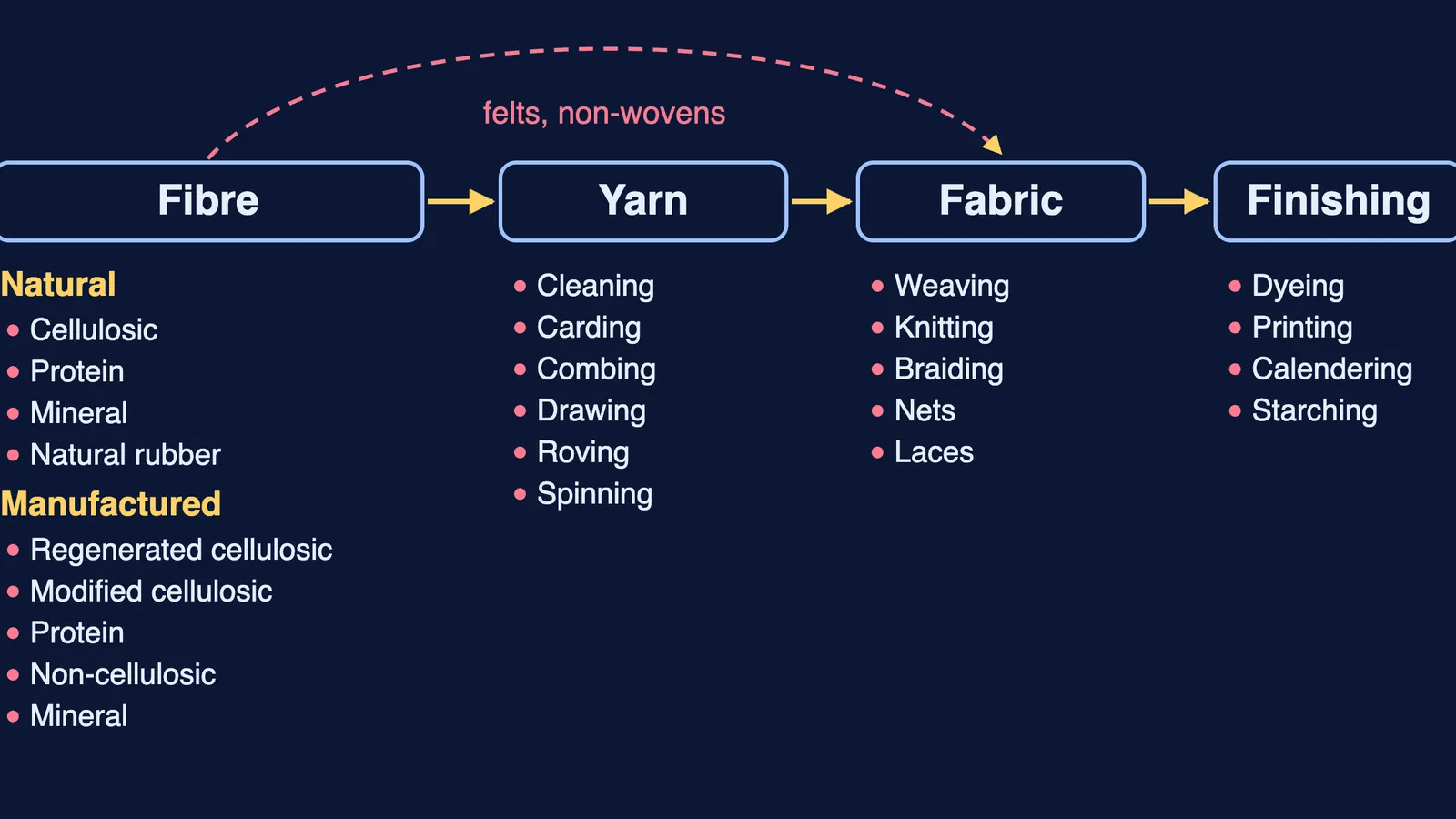
Chapter 5 of NCERT's Human Ecology and Family Sciences Part I (reprint 2026-27) is Fabrics Around Us. It follows one chain: fibres become yarn, yarn becomes fabric, and finishing makes the fabric ready to sell.
What does the 2026-27 syllabus include?
The CBSE Home Science (064) curriculum for 2026-27 lists this chapter (as "Fabric Around us") in Unit II, Understanding oneself: Adolescence. That unit carries 23 of the 70 theory marks, shared with four other chapters; CBSE prints no separate figure for this one.
The curriculum lists every section of the chapter, through to the nine important fibres. In the practical exam, one 5-mark question links fibre properties to use (thermal property and flammability; moisture absorbency and comfort), with preparing a care label as the alternative.
How are textile fibres classified?
A fibre is the hair-like unit inside a yarn, the basic building block of fabric. NCERT says the property that matters most is spinnability, which depends on a fibre's length, strength, flexibility and surface.
Fibres can be grouped by origin, chemical type, generic type or trade name. By length, a staple fibre is short (cotton) and a filament is long (silk, polyester).
Natural fibres come in four groups:
Cellulosic: seed hair (cotton, kapok), bast (flax, hemp, jute), leaf (pineapple, sisal), nut husk (coir)
Protein: animal hair (wool) and animal secretion (silk)
Mineral: asbestos
Natural rubber
Manufactured fibres are regenerated cellulosic (rayon), modified cellulosic (acetate), protein (azlon), non-cellulosic synthetics (nylon, polyester, acrylic, modacrylic, spandex, rubber) and mineral (glass, metallic). Rayon, the first, was produced commercially in 1895. Each starts as a spinning solution forced through a spinnerette, a nozzle with tiny holes, hardening into filaments.
How does fibre become yarn and then fabric?
Yarn is a continuous strand of fibres ready for weaving or knitting. For cotton, spinning runs in stages: cleaning into laps, carding and combing into a sliver, drawing out, roving, then final spinning with twist. A higher yarn number means a finer yarn, and twist is measured as twist per inch (t.p.i.).
Fabric methods:
Weaving: warp yarns are held on a loom and filling yarns pass over and under them at right angles. Warp runs along the selvedge, the strongest direction.
Knitting: loops of yarn interlock. Weft knits can be shaped while made; warp knits come in lengths you can cut. Knits stretch and breathe, suiting socks and sportswear.
Braiding (shoelaces, ropes), nets (knotted) and laces (twisted, looped and knotted).
Felts and non-wovens skip yarn altogether: fibres are matted and bonded.
Finishing changes appearance, texture or behaviour. Durable finishes such as dyeing survive washing; renewable ones such as starch do not. Colour can go in at fibre, yarn or fabric stage; printing places colour only within a design.
How do natural and man-made fibres compare?
Cotton: shortest fibre (1 to 5 cm), absorbs moisture and dries easily, so it suits summer
Linen: longer and finer than cotton, so stronger and more lustrous, but takes dye less readily
Wool: 4 to 40 cm with natural crimp; low strength, good elastic recovery, takes up water without feeling wet
Silk: a natural filament with sheen; one of the stronger fibres
Rayon: cotton-like but weaker; can be made from waste and looks like silk
Nylon: the first true synthetic; strong, resists abrasion, very elastic
Polyester: absorbs very little water, so less comfortable in hot, dry summers, but resists wrinkles
Acrylic: looks like wool, costs less, about as strong as cotton
Elastomeric: rubber and spandex, blended in for stretch
Worked example, fibre to use: a summer school shirt needs absorbency, so cotton; a travel kurta that should not crease suits a polyester blend; a winter cardigan on a budget suits acrylic.
The burning test separates groups: cellulosic fibres burn fast and smell of paper, wool and silk smell of hair and self-extinguish, nylon and polyester melt into a hard bead. NCERT says to do this only on a very low flame with a teacher present.
Practice questions
Our own questions; mark labels are our suggestion.
(1 mark) Jute belongs to which group? (a) seed hair (b) bast (c) leaf (d) nut husk
(1 mark) Which is a filament fibre? (a) cotton (b) wool (c) silk (d) linen
(2 marks) Give two differences between weaving and knitting.
(3 marks) A thread reel says 60 and another says 30. Which is finer, and what does loose twist do to a yarn?
(4 marks) Suggest fibres for a towel, a swimsuit, a rope and a winter blanket, with one reason each.
(5 marks) Explain how a manufactured fibre is produced, naming three types of manufactured fibre.
Answers: 1 (b). 2 (c). 4: the reel marked 60; loose twist gives a softer, more lustrous yarn.
Class 12 builds on this: Design for Fabric and Apparel and Care and Maintenance of Fabrics in Institutions. Also see what each BSc Home Science specialisation leads to.
Not sure where to begin tonight? Fermi's AI tutor works out what you already know and builds a plan for the session.