On this page
Unit 8 of CBSE Class 12 Legal Studies asks one question: what happens when someone has a case but cannot pay for a lawyer?
What does Legal Services carry in the 2026-27 syllabus?
The CBSE Legal Studies curriculum for 2026-27 gives Unit 8 (Legal Services) 08 marks out of an 80-mark theory paper. Its seven topics run from the history of legal aid through criminal law, the Constitution, NALSA and the 1987 Act to legal aid as part of social justice and human rights.
The prescribed book is the CBSE Legal Studies Class XII textbook (2023), pages 195 to 205.
The 2026-27 sample paper uses 1-mark MCQs (including assertion-reason) and answers of 2 marks (up to 40 words), 3 marks (100 words) and 5 marks (140 words).
How did free legal aid develop in India?
1958: the 14th Law Commission Report on judicial reform proposed State-funded legal aid.
1960: a National Legal Aid Scheme began, then lapsed for want of funds.
1973: a Justice Krishna Iyer committee proposed district, state and central legal aid committees.
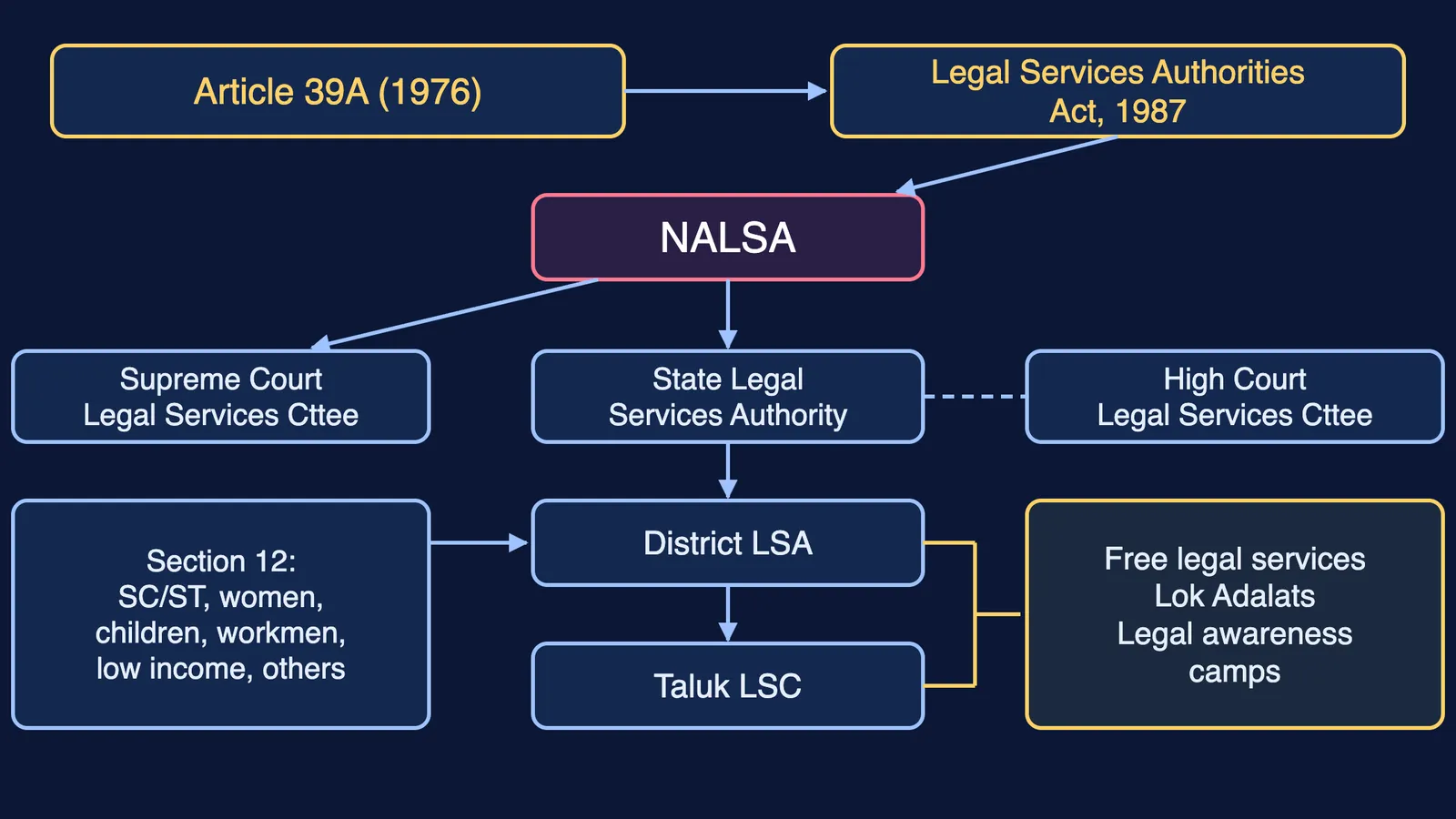
1976: the 42nd Amendment inserted Article 39A, directing the State to provide free legal aid so poverty or other disability does not shut anyone out of justice.
1980: CILAS, chaired by Justice P.N. Bhagwati, began monitoring legal aid nationally.
1987: Parliament passed the Legal Services Authorities Act; the book says it came into force on 9 November 1995.
The book also links legal aid to Articles 14 and 22(1), the M.H. Hoskot (1978) judgment, the ICCPR and Article 8 of the UDHR.
Who is entitled to free legal services?
Section 12 of the 1987 Act, as the book prints it, covers SC/ST members, victims of trafficking or begar, women and children, persons with disability, victims of disasters or caste atrocity, industrial workmen, people in custody, and people below an income ceiling. The book prints that ceiling as an annual income below Rs 9,000 for courts other than the Supreme Court (or a higher amount set by the State Government) and below Rs 12,000 for the Supreme Court (or a higher amount set by the Central Government). These are the book's figures and may since have been revised.
Free legal services include court fees, a lawyer, certified copies and appeal papers. The book splits them into pre-litigation services (education, advice, awareness, settlement) and post-litigation services (an advocate's work once a case is filed).
Aid can be refused to someone ineligible, or withdrawn later for fraud, sufficient means, non-cooperation, hiring another lawyer or abuse of process.
How is NALSA organised, and what are Permanent Lok Adalats?
NALSA, set up under the 1987 Act, lays down policy and schemes for legal aid across India. Below it sit State, District and Taluk bodies, High Court committees and a Supreme Court Legal Services Committee. They give free legal services, hold Lok Adalats and run rural legal awareness camps.
The NALSA Regulations, 2010 (made under Section 29) govern panel lawyers. A lawyer needs at least three years at the bar, the panel is redone every three years, and a panel lawyer may take no fee from the person helped.
The 2002 amendment created Permanent Lok Adalats for public utility services such as transport, telephone, power, water, hospitals and insurance. They first try conciliation; if the parties do not agree, they decide the dispute. The award is final and treated as a civil court decree.
What has changed since the book was printed?
The book cites Section 304 of the CrPC, 1973 for a State-paid lawyer in sessions trials, and says Permanent Lok Adalats are not bound by the Code of Civil Procedure or the Indian Evidence Act. According to the Press Information Bureau, the BNS, BNSS and BSA came into effect from 1 July 2024, replacing the IPC, CrPC and Indian Evidence Act. Learn the book's references for the exam; the newer codes have taken their place for new matters.
Practice questions for Unit 8
Mark labels follow the 2026-27 sample paper's question types. The questions are our own.
(1 mark) A patient disputes a hospital bill before any case is filed. Which body under the Legal Services Authorities Act can conciliate and, failing that, decide it?
(2 marks) Is each a pre-litigation or post-litigation service: (a) a village legal awareness camp; (b) an advocate arguing an aided person's appeal?
(3 marks) Place the 1958 Law Commission report, CILAS and Article 39A in order and state one contribution of each.
(5 marks) A shopkeeper who got free legal aid under the income category inherits a large sum while her case is running. Can aid be withdrawn? Explain with two other grounds for withdrawal.
Also revise Alternative Dispute Resolution in Class 12 Legal Studies for Lok Adalats, the Class 11 Political Science guide to the judiciary, and our overview of Legal Studies as a CBSE subject.
Not sure where to begin tonight? Fermi's AI tutor works out what you already know and builds a plan for the session.