On this page
Unit 2 of CBSE Class 12 Legal Studies asks a practical question: if courts are slow and costly, how else can people settle a dispute? It compares two styles of trial, then covers arbitration, mediation, conciliation, Lok Adalats and ombudsman bodies.
What does ADR carry in the 2026-27 syllabus?
The CBSE Legal Studies curriculum for 2026-27 gives Unit 2 (ADR in India) 08 marks out of an 80-mark theory paper. It lists eight topics: adversarial and inquisitorial systems, meaning and scope of ADR, arbitration, mediation, conciliation, Lok Adalat, ombudsman, and Lokpal and Lokayukta.
The prescribed book is the CBSE Legal Studies Class XII textbook (2023). Its Unit 2 outcomes mention tribunals, but the 2026-27 curriculum does not list them in Unit 2; it places Tribunals under Unit 1, Judiciary.
The 2026-27 sample paper has 1-mark MCQs (including assertion-reason) and answers of 2 marks (up to 40 words), 3 marks (100 words) and 5 marks (140 words). Many are short case situations.
Adversarial or inquisitorial: what is the difference?
Adversarial: each side's lawyer builds the case, gathers evidence and cross-examines the other side's witnesses. The judge stays fairly passive. The book places India here, with other common law countries such as the UK and US.
Inquisitorial: the judge leads, fixes the facts and issues, and decides how evidence comes in. The book links it to civil law countries of continental Europe.
For a 3-mark answer, pair an advantage with a drawback. Cross-examination tests witnesses well, but costs fall on the parties, so richer litigants can afford stronger lawyers. An active judge can prevent delay, but may stop being neutral once acting as investigator.
How do arbitration, mediation and conciliation differ?
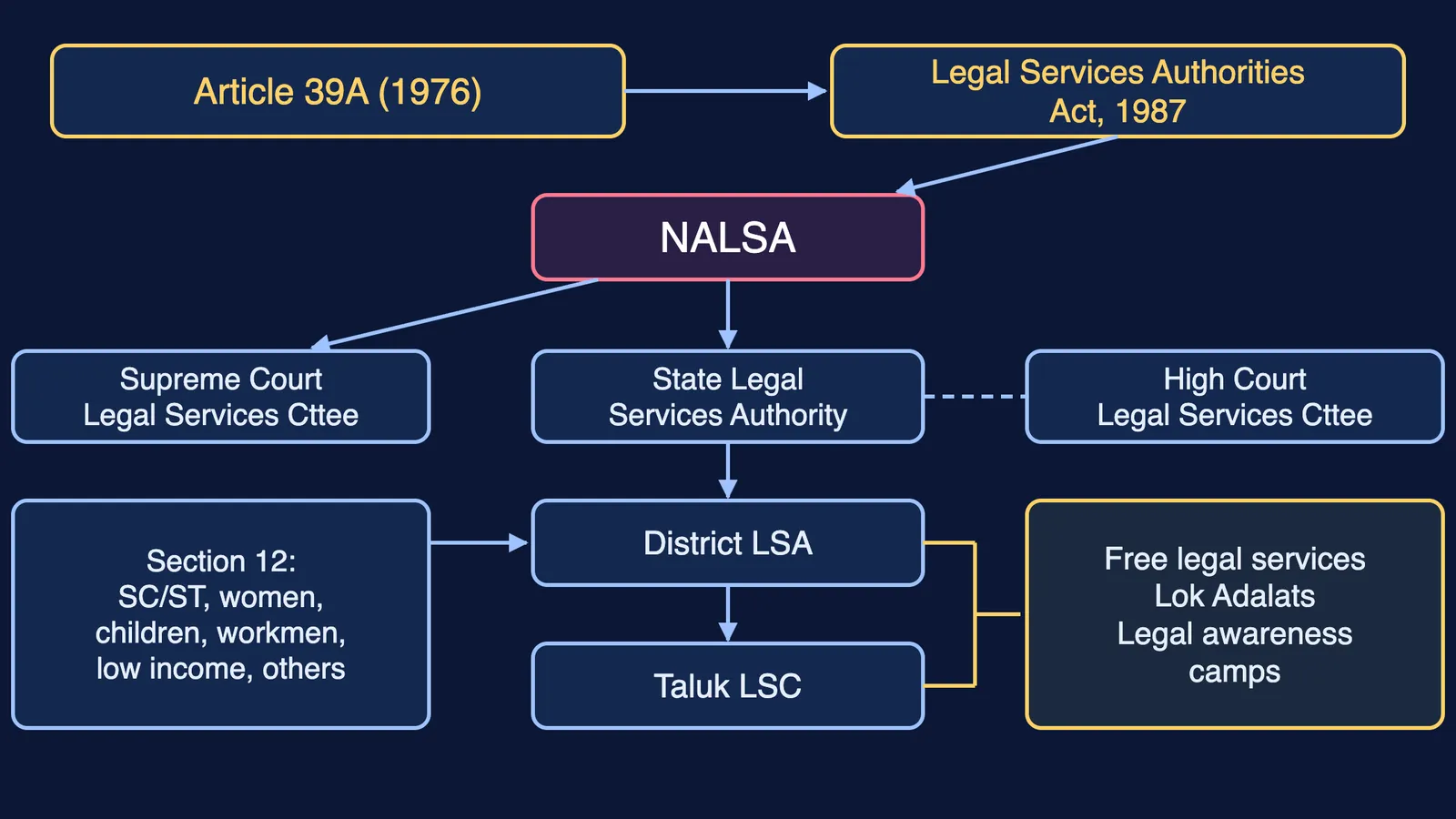
The book defines ADR as non-adversarial ways of settling disputes outside the usual court route. It names the Arbitration and Conciliation Act, 1996, the Legal Services Authorities Act, 1987 and Section 89 of the CPC (1908), which lets a court refer a case to arbitration, conciliation, judicial settlement (including a Lok Adalat) or mediation.
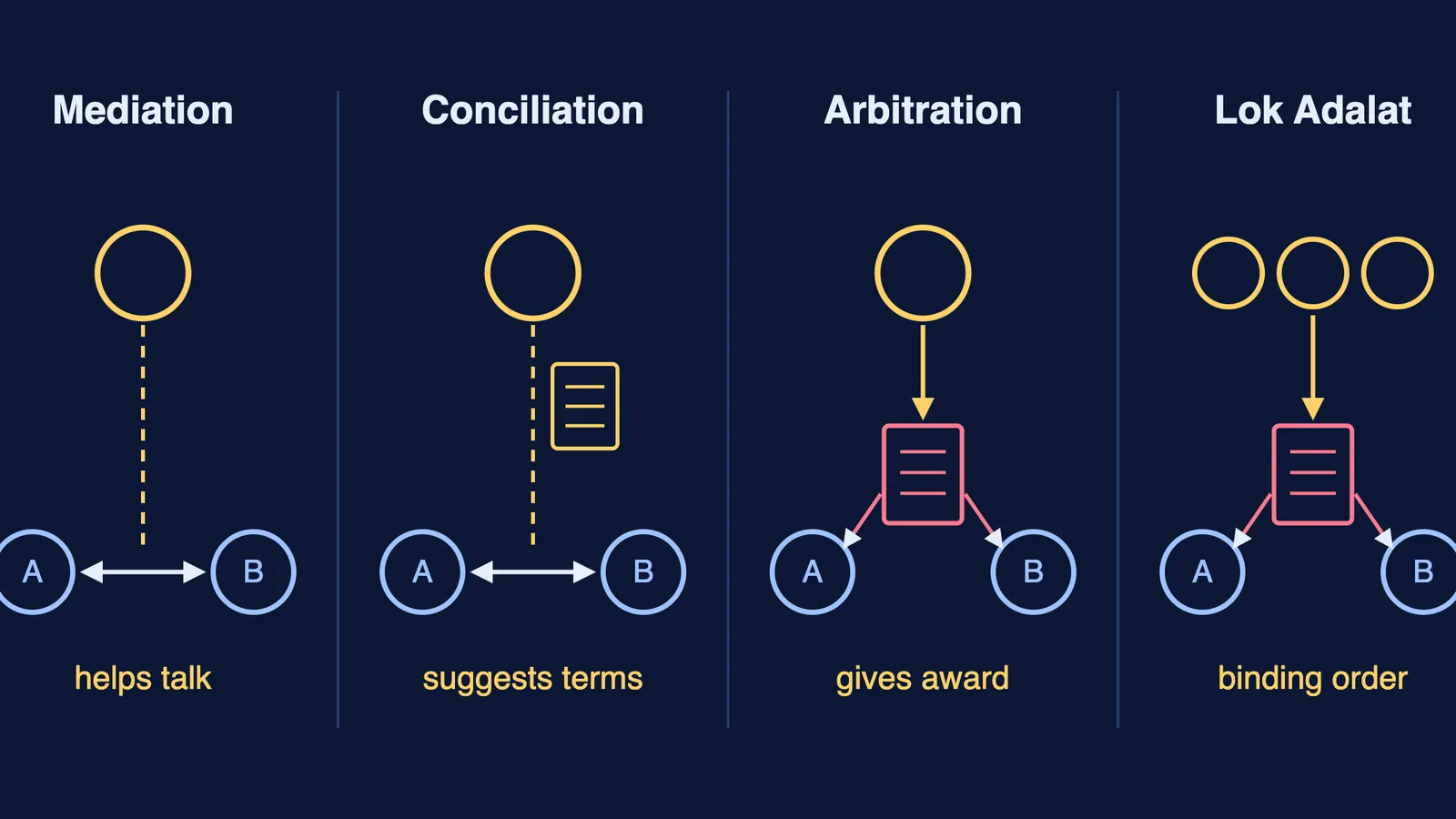
Tell them apart by what the neutral person does.
Mediator: helps the parties talk and reach their own deal. The outcome is not binding like an award, although the parties can turn it into a binding contract.
Conciliator: goes further and may propose solutions. A settlement the parties sign is final and binding, with the same effect as an arbitral award.
Arbitrator: hears both sides in a confidential process and gives a binding arbitral award, enforced like a court decision. Courts can set it aside only on limited grounds, such as bias.
Also learn the types: domestic, foreign, ad hoc, institutional, statutory and international commercial arbitration; evaluative, facilitative, transformative, mediation-arbitration and online mediation.
What makes a Lok Adalat different?
A Lok Adalat, or people's court, is an Indian institution. A sitting or retired judicial officer presides, usually joined by a lawyer and a social worker. It can take up pending cases and disputes not yet filed, civil or compoundable criminal. There is no court fee, any fee already paid is refunded if the matter settles, and its decision binds the parties. The book records that the first Lok Adalat sat on 14 March 1982 at Junagarh in Gujarat.
The unit ends with ombudsman bodies: the Central Vigilance Commission, banking and insurance ombudsmen, and the Lokpal and Lokayuktas Act, 2013. The Lokpal has at most 8 members, half of them judicial, and Maharashtra set up the first Lokayukta in 1971.
What has changed since the book was printed?
The 2023 book says India had no law yet for pre-litigation mediation. Parliament later passed the Mediation Act, 2023 (Act 32 of 2023), which received the President's assent on 14 September 2023. Section 5 lets parties choose, voluntarily and by mutual consent, to try mediation before filing a civil or commercial case. Section 30 allows online mediation with the parties' written consent, and section 31 provides for a Mediation Council of India. Its provisions apply from dates the Central Government notifies. Learn the book's content for the exam.
Practice questions for Unit 2
Mark labels follow the 2026-27 sample paper's question types. The questions are our own.
(1 mark) A tailor and a fabric shop in Kochi ask a retired textile engineer to hear both sides and give a decision they will follow. Which ADR method is this?
(2 marks) State two features that make a Lok Adalat cheaper for litigants than a regular court.
(3 marks) A housing society and a resident ask a neighbour to help them talk and suggest a repair-cost split, which both sign. Name the method and the legal effect of the signed paper.
(5 marks) Compare the adversarial and inquisitorial systems with two advantages and two disadvantages of each.
Next, read our overview of Legal Studies as a CBSE subject, the Class 11 Judiciary guide and Consumer Education and Protection, Class 12 Home Science.
Short on time this week? Fermi's AI tutor works out what you already know and builds a plan for the session.