On this page
Media and Communication Technology is Chapter 6 of the NCERT Human Ecology and Family Sciences Part I textbook for Class 11 (reprint 2026-27). It explains how messages travel, the kinds of media around you, and the technologies that carry them.
How many marks is Media and Communication Technology worth?
The CBSE Home Science (064) curriculum for 2026-27 gives Unit II, Understanding Oneself: Adolescence, 23 of the 70 theory marks. Five chapters, this one included, share those marks; the curriculum prints no separate figure for this chapter.
It lists all three parts of the chapter (communication, media, communication technology) and no practical for it. Note that NCERT numbers this unit as Unit I.
What is communication and how is it classified?
NCERT traces the word to the Latin communis, meaning common. Communication works when sender and receiver share one meaning. The chapter sorts it four ways (NCERT Chapter 6):
By interaction: one-way, where the receiver cannot reply at once (a lecture), and two-way, where both sides exchange ideas (a phone call).
By level: intra-personal (with yourself), inter-personal (face to face), group, mass, intra-organisational and inter-organisational. NCERT rates inter-personal as most effective: closeness helps persuasion and feedback is instant. Mass audiences are large, mixed and anonymous, so feedback is slow.
By mode: verbal (speech, song, tone of voice) and non-verbal (gestures, eye contact, posture, clothing, symbols). NCERT reports that people spend about 70 per cent of their active time communicating verbally.
By senses: audio (radio), visual (posters, print) and audio-visual (television, internet). NCERT's figures show recall rising with the senses used: about 10% of what people read, but 90% or more of what they see, hear and do.
What is the SMCRE model of communication?
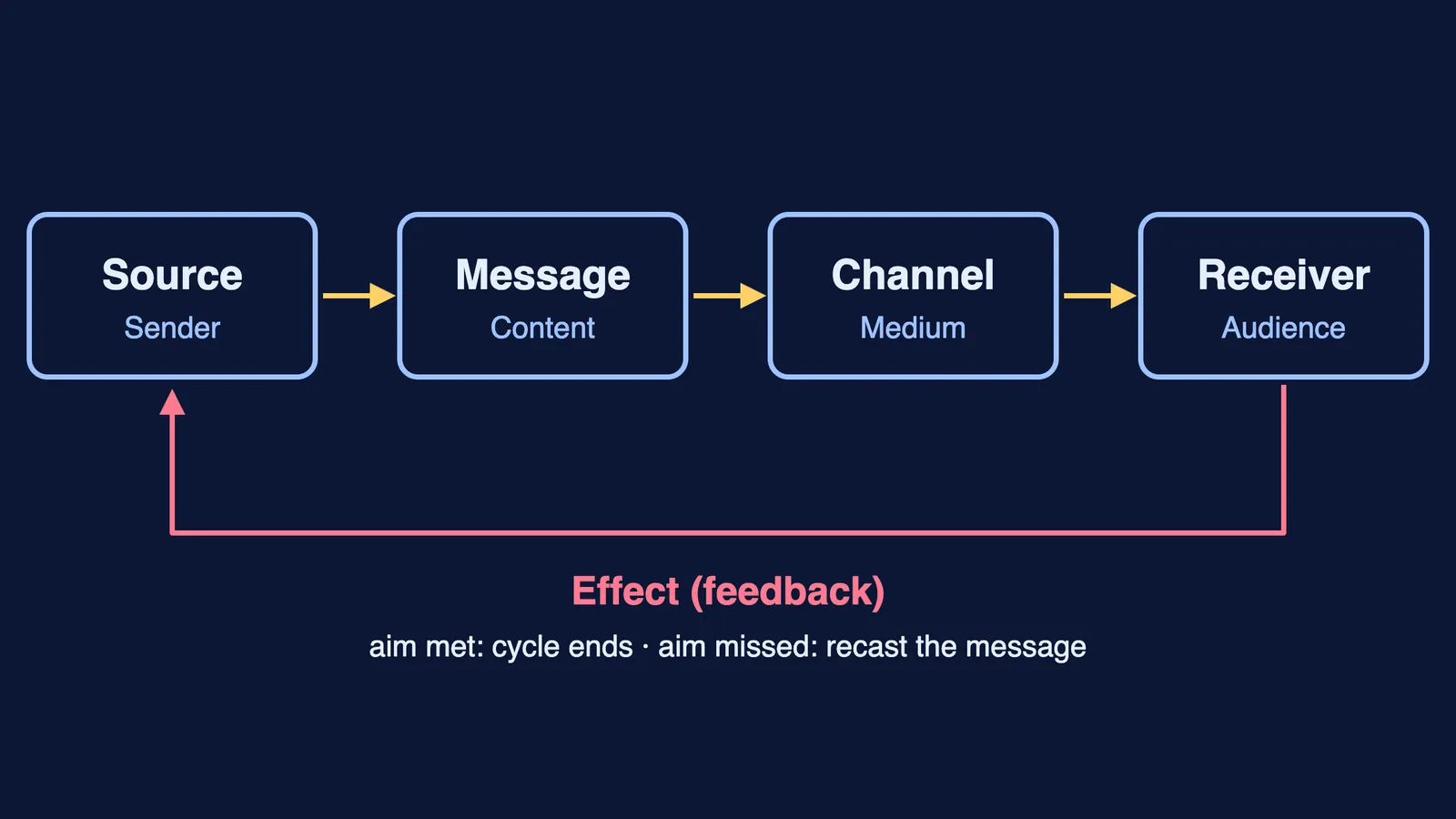
NCERT breaks the process into the SMCRE model:
Source: whoever starts the message, such as a teacher, parent or extension worker.
Message: the content. A good one is simple, clear, specific, timely and suited to channel and audience.
Channel: the route the message takes, either inter-personal (individuals and groups) or mass media (satellite, wireless).
Receiver: the intended audience. The more alike the group, the better the odds of success.
Effect (feedback): the audience's response. If it matches the aim, the cycle ends; if not, the message is reworked and the process repeats.
What are the types and functions of media?
If communication is the process, media is the means that carries it (NCERT Chapter 6).
Traditional media: folk theatre, puppetry, folk songs and dances, fairs, festivals and rituals. NCERT's examples include Jatra (Bengal), Nautanki (Uttar Pradesh), Tamasha (Maharashtra) and Yakshagana (Karnataka). NCERT adds that inter-personal communication is still the most used medium in rural and remote areas.
Modern media: radio, satellite television, films, mobile phones and video conferencing.
NCERT lists nine functions of media: information, persuasion or motivation, entertainment, interpretation, transmission of values, education or training, coordination, behavioural change and development.
What is communication technology?
Communication technology is the set of tools that handle information and aid communication, sending data as analogue or digital signals. NCERT groups it in two:
Cable (land) based: cheaper and simpler, such as a landline or a computer without internet.
Wireless: needs less infrastructure but can cost more to use, such as radio, microwave, satellite telephony and Bluetooth.
Television reached India in 1959, mainly for education and rural development, and NCERT notes that Pij village in Gujarat got India's first TV transmitter. For extension work NCERT lists microcomputers, video text, e-mail, interactive video and teleconferencing.
Practice questions for Media and Communication Technology
Mark labels are our suggestion; the questions are ours.
(1 mark) A student silently weighs the pros and cons of joining a coding club. Which level of communication is this?
(1 mark) Comments posted under a school's online notice belong to which element of the SMCRE model?
(1 mark) Give one example each of a cable-based and a wireless communication technology.
(3 marks) Suggest one traditional and one modern medium for a health worker promoting iodised salt in a village, with reasons.
(3 marks) Why is feedback from mass communication slower than feedback from inter-personal communication?
(5 marks) Apply the SMCRE model to a road-safety drive in your town, naming each element and what follows if the aim is missed.
Answers: Q1 intra-personal. Q2 effect (feedback). Q3 for example, a landline and Bluetooth.
Next, see Development Communication and Journalism Class 12, or explore BSc Home Science career options and journalism and mass communication after 12th.
Planning this week's revision? Fermi's AI tutor works out what you already know and builds a plan for the session.