On this page
If you took PCM or PCB in Class 12 and want to report or make news, you have not picked the wrong stream. The main entrance routes into journalism and mass communication do not ask what you studied in Class 12, and the habits science builds (checking claims, reading numbers, explaining hard ideas simply) are ones newsrooms need. What matters more is that you start writing now.
Can you study journalism and mass communication after 12th science?
Yes. The CUET (UG) 2026 Information Bulletin says candidates may choose up to five subjects "irrespective of the subjects opted in class XII".
Mass Media/Mass Communication is one of the 23 domain subjects on the official CUET (UG) 2026 syllabus page, listed alongside Physics, Chemistry, Biology and Mathematics.
The same bulletin adds a caution: choose subjects based on the eligibility criteria of the programme you want. Read each university's prospectus before you pick your five.
Some private universities run their own tests. The Symbiosis Entrance Test (SET) programme list shows that the BA (Mass Communication) at Symbiosis Centre for Media and Communication, Pune, asks for Class 12 or equivalent with at least 50% marks (45% for SC/ST), with no stream named.
Which entrance tests do mass communication courses use?
There are three kinds you are likely to meet.
CUET UG. In the 2026 cycle, the CUET (UG) bulletin listed 37 subjects, each paper with 50 compulsory questions in 60 minutes, five marks for a correct answer and one deducted for a wrong one. The General Aptitude Test covers general knowledge, current affairs, mental ability, numerical and quantitative skills, and logical reasoning. Applications ran from 3 to 30 January 2026, so watch the official CUET site for the next cycle.
A university test plus a writing round. At SCMC Pune, the SET programme list says selection uses SET (General), a Personal Interaction and a Writing Ability Test.
A postgraduate route after a science degree. You can do a BSc first and switch later. The IIMC Admission Prospectus 2026-27 says its PG Diplomas are open to "graduates in any discipline", with most of them filled through CUET-PG in Mass Communication and Journalism. It listed 632 PG Diploma seats across its campuses, with a maximum age of 25 on 1 August 2026 for general-category candidates.
If you are weighing CUET subjects alongside a science degree, our guide to CUET UG for science students explains where the test fits.
What does a science background give you?
A beat. Health, climate, space and technology stories need reporters who can read a study, notice a missing control group and turn a graph into one clear sentence. Our piece on how to become a science writer or communicator maps that path in more detail.
Accuracy is the price of entry. Before you explain a concept in print, make sure you could teach it. The Fermi Concept Library has a lesson for every concept in physics, chemistry, biology, mathematics and computing, so you can check an idea before you write about it.
How do you build clips and a portfolio before college?
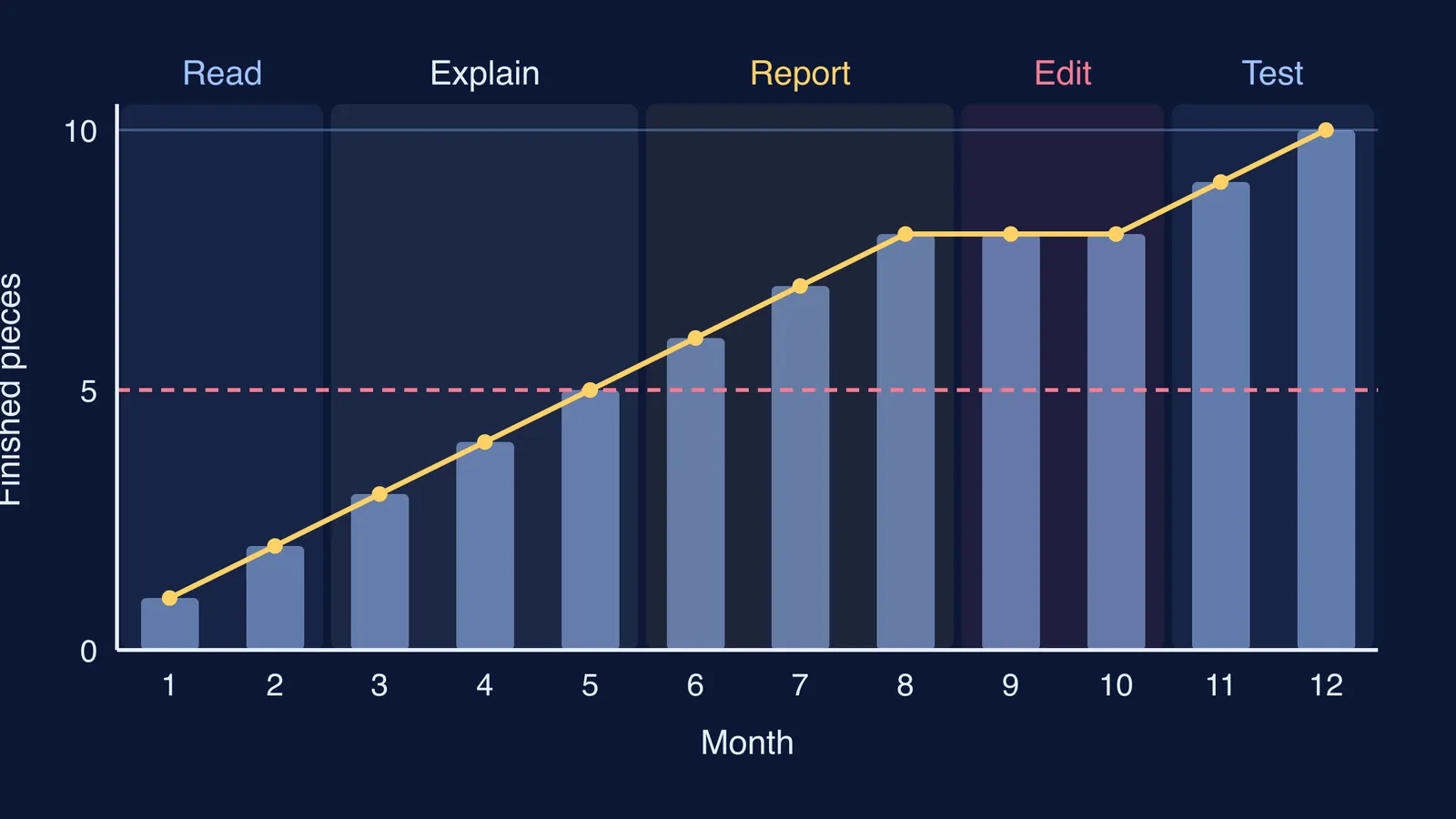
A clip is a piece that someone other than you agreed to publish: the school magazine, a local paper's student page, a community newsletter, a college fest website. Aim for about ten finished pieces in a year, and keep your best five.
Months 1-2: Read. Read one newspaper every day. Each week, rewrite one story's opening paragraph in 40 words. Finish two short pieces.
Months 3-5: Explain. Write one 400-word explainer a month on a science idea in the news, such as why a heatwave warning was issued. Submit each one somewhere.
Months 6-8: Report. Do one reported story a month. Talk to at least two people, note who said what, and check every number. Local stories (a water shortage in your housing society, a school science fair) are fine.
Months 9-10: Edit. Write nothing new. Pick your best five and rewrite them using a teacher's comments.
Months 11-12: Test. Practise timed writing: 300 words in 30 minutes on a topic picked at random. Finish two last pieces.
If you want your own site as well, read our advice on whether students should start a blog before you set one up.
What should go in a mass communication portfolio?
Five pieces, best first, each with where and when it appeared
At least one reported story with named sources, and one explainer
A one-line note on your role in each: reported, wrote, photographed or edited
One piece that uses a number or graph correctly
A short bio: who you are, what you want to cover and how to reach you (a parent's email is fine)
Keep it as a single PDF or a simple web page you can link in an application. Start this month: write one piece and send one pitch.