On this page
Kiran Mazumdar-Shaw trained to make beer, struggled to get a brewing job, and used the same science to build Biocon, which the Science History Institute calls India's largest producer of insulin. Her story is worth knowing if you study biology or chemistry, because almost every turn in it comes back to one idea from your syllabus: getting living cells to make a molecule for you.
Who is Kiran Mazumdar-Shaw?
She grew up in Bangalore, where her father was the brewmaster at United Breweries, according to the Science History Institute. She earned a BSc in zoology from Bangalore University in 1973 and qualified as a master brewer at Ballarat University in Australia in 1975, her WIPO Magazine profile records.
Back in India, she had difficulty getting a brewery management job because she was a woman, the Science History Institute notes. A chance meeting with Leslie Auchincloss, founder of the biotechnology company Biocon Biochemicals, changed her direction.
How did Biocon start with enzymes?
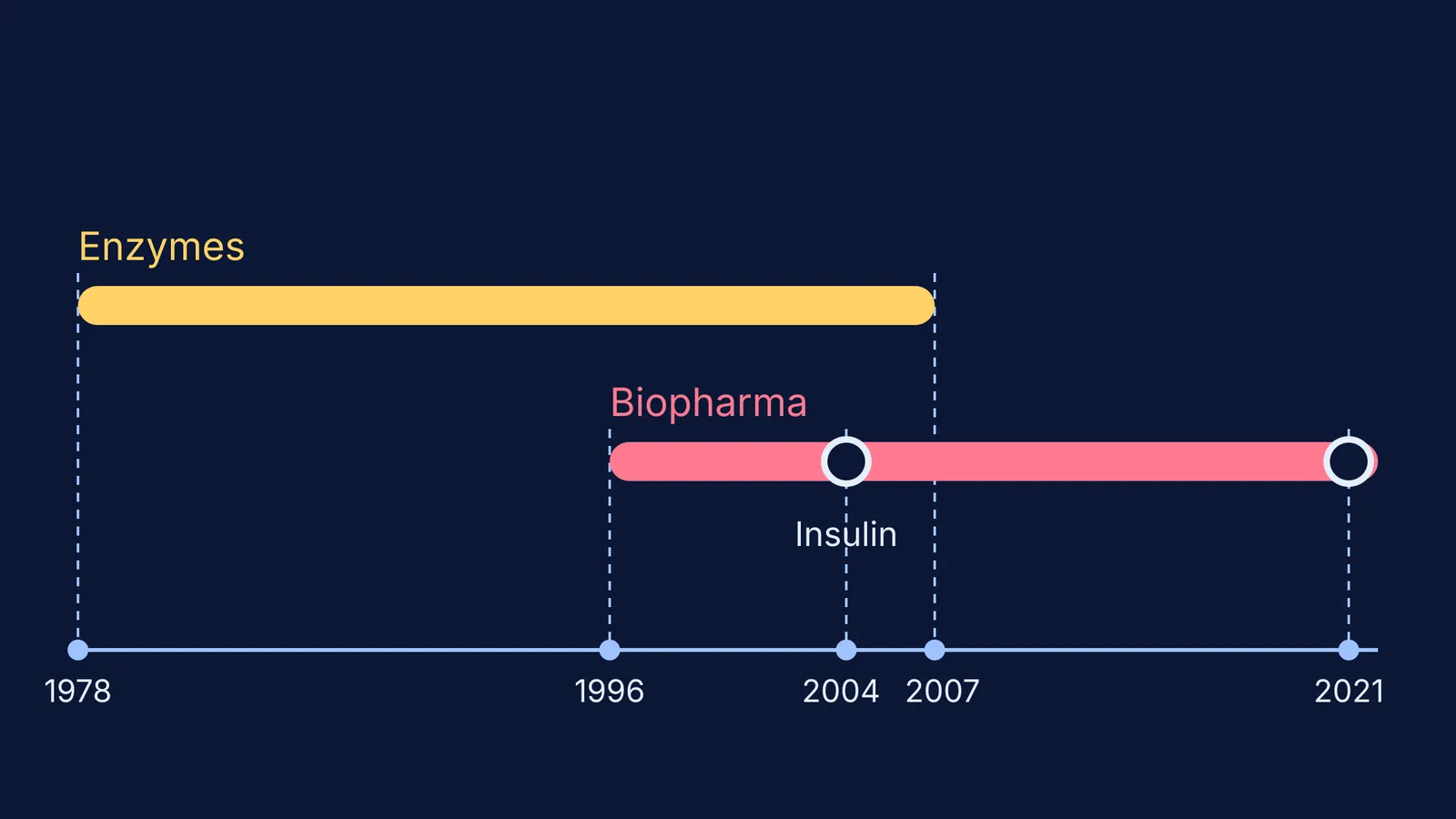
Biocon India was incorporated on 29 November 1978 as a joint venture between Biocon Biochemicals Ltd of Ireland and Mazumdar-Shaw, according to Biocon's own history page. She was 25, and she began making enzymes out of her garage, says WIPO Magazine.
She later described the start on the *WTF is with Nikhil Kamath* podcast, as reported by Business Today: "I was 25 years old, I was a young woman, I had no business experience, I had Rs 10,000 in my bank and I was trying to start a strange business called biotech which nobody understood." Hiring was hard too: "my first two employees were retired tractor mechanics who needed a job desperately."
An enzyme is a protein that speeds up one particular chemical reaction without being used up. Biocon's first was papain, "a proteolytic enzyme extracted from the papaya fruit, which prevents chilled beer from turning hazy" (WIPO Magazine). Proteolytic means it breaks down proteins, and proteins are a main cause of the haze that forms in cold beer. She also developed and patented a new enzyme to clarify tea.
In 1979, Biocon became the first Indian company to manufacture and export enzymes to the USA and Europe, its history page records.
How did an enzyme company end up making insulin?
Step by step, using what it already knew. Biocon's timeline shows the path:
1990: it scaled up its own solid substrate fermentation technology from pilot to plant level.
1996: it used that platform to enter biopharmaceuticals and statins.
2001: it became the first Indian company approved by the US FDA to make lovastatin, a cholesterol-lowering drug.
2003: it became the first company worldwide to develop human insulin on a *Pichia* expression system. *Pichia* is a yeast.
2004: it launched Insugen, its insulin brand, and listed on the stock market.
2007: it sold its enzymes division to Novozymes for USD 115 million to focus on biopharmaceuticals.
Recombinant insulin is made by cells that carry the gene for human insulin, so the cells produce the same protein your pancreas makes. WIPO's case study calls Insugen "the world's first human insulin to use pichia yeast." In July 2021 the US FDA approved Semglee, an insulin glargine from Biocon Biologics and its partner Viatris, as the first interchangeable biosimilar (Biocon Biologics and Viatris). Interchangeable means a pharmacist can substitute it for the original brand "without the intervention of the prescriber" (RAPS).
What can a biology student take from her story?
Her career is a clear example of skill transfer: the training stayed the same while the product changed. You can map your own path the same way.
Write your core skill in one line. Hers: grow microbes in a tank so they make a product.
List three products that skill could make. Hers: beer, enzymes for beer and tea, then medicines.
Find the concepts that link them. For her, enzymes and recombinant DNA, both in your Class 11 and 12 biology.
Pick the next small step. Biocon made one enzyme first, not a drug.
Here is the same map for a student who loves biology but feels stuck between NEET and "something else". Core skill: understanding how cells make proteins. Possible products: diagnostics, vaccines, enzymes for detergents, crop science. Linking concepts: enzyme action, gene cloning, fermentation. Seeing the links is what turns a chapter into a career idea.
If a link in that chain is fuzzy, such as how a gene gets into yeast, the Fermi Concept Library covers every concept in biology and chemistry, each with its own lesson and its place in the map, so you can see where it fits.
The lesson in her record is simple: start with a product you can actually make, sell it, and let the science carry you to the next one.