On this page
In Class 12 chemistry, the Rosenmund reduction usually appears as a single line: an acid chloride, hydrogen, palladium on barium sulphate, and out comes an aldehyde. Behind that line is a Berlin-born chemist, a 1918 paper, and a clever idea. Sometimes the way to get the product you want is to make your catalyst worse on purpose.
Who discovered the Rosenmund reduction?
Karl Wilhelm Rosenmund, a German chemist, discovered the reaction. According to his Wikipedia biography, he was born in Berlin on 15 December 1884, earned his PhD at the University of Berlin in 1906 for work with Otto Diels, and died in Kiel on 8 February 1965.
Rosenmund described the method in 1918 in a paper titled "Über eine neue Methode zur Darstellung von Aldehyden. 1. Mitteilung" ("On a new method for preparing aldehydes. First communication"), in Berichte der deutschen chemischen Gesellschaft, volume 51, pages 585 to 593 (Crossref record, DOI 10.1002/cber.19180510170).
He kept working on the catalyst. In 1921, he and F. Zetzsche, both of the Pharmaceutical Institute of the University of Berlin, published "Über Katalysator-Beeinflussung und spezifisch wirkende Katalysatoren" ("On influencing catalysts, and catalysts that act specifically") (DOI 10.1002/cber.19210540310).
Two other methods carry his name. The Rosenmund–von Braun reaction turns an aryl bromide into an aryl nitrile, and the Rosenmund–Kuhnhenn method is used to find the iodine value of conjugated systems (Wikipedia).
What does the Rosenmund reduction do?
A review chapter in Organic Reactions, by Erich Mosettig and Ralph Mozingo, says the Rosenmund reduction "consists in the selective hydrogenation of an acid chloride in the presence of a suitable catalyst, usually supported palladium to the corresponding aldehyde" (Organic Reactions).
The NCERT Class 12 chemistry textbook teaches it in Unit 8, section 8.2.2, using the example of benzoyl chloride reacting with hydrogen over Pd–BaSO4 to give benzaldehyde (NCERT, Aldehydes, Ketones and Carboxylic Acids).
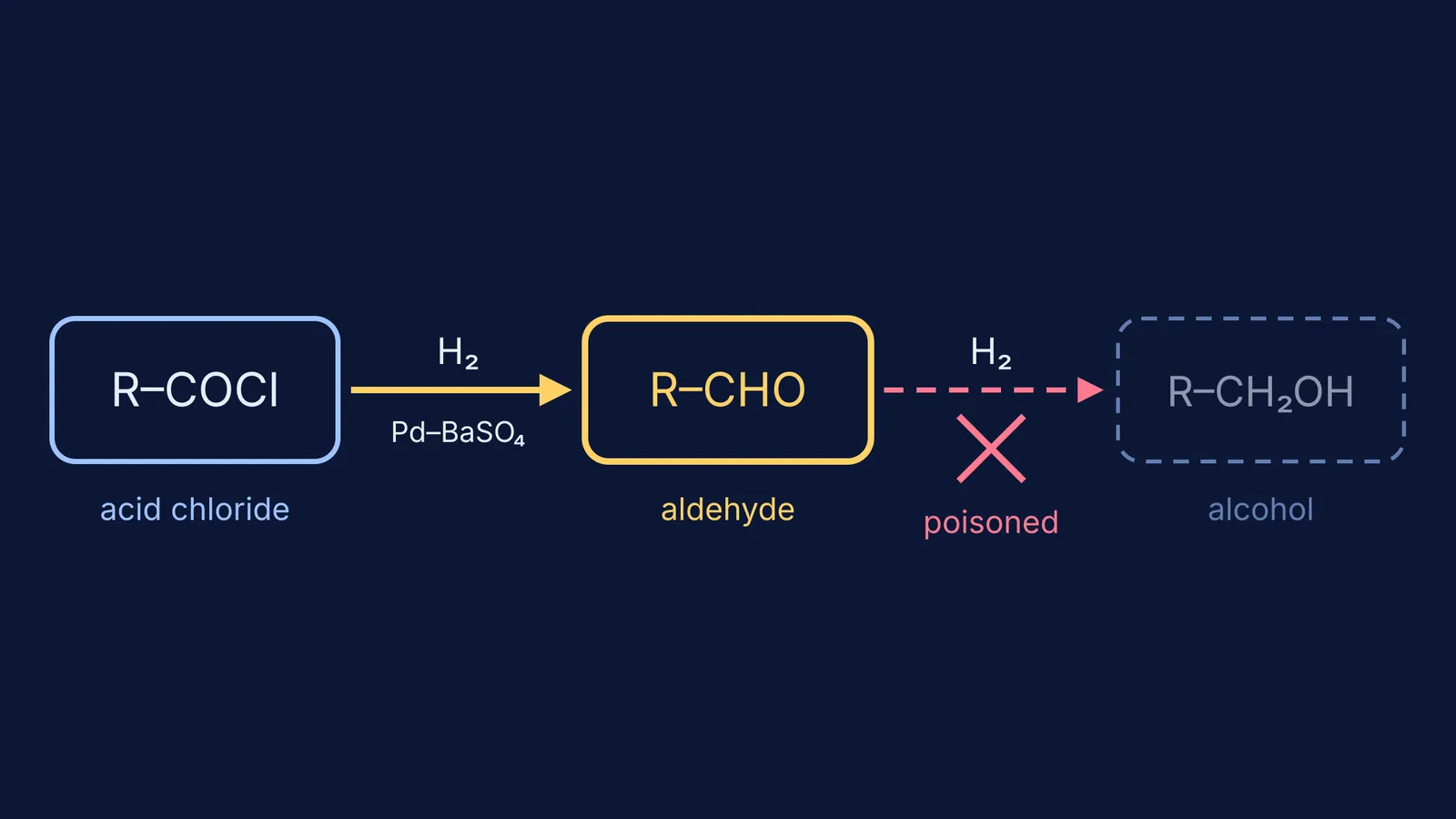
In general form: R–COCl + H2 → R–CHO + HCl. The chlorine leaves as hydrogen chloride, and a hydrogen takes its place on the carbonyl carbon.
Why is the palladium catalyst poisoned?
The trouble is that the aldehyde can be reduced too. As Wikipedia's account of the reaction puts it, the system "must reduce the acyl chloride but not the subsequent aldehyde". If the aldehyde is reduced further, it gives a primary alcohol. That alcohol then reacts with leftover acid chloride and gives an ester.
The fix is to weaken the palladium. The same source explains that barium sulphate has a low surface area, which lowers the palladium's activity. For some reactive acid chlorides the activity has to be lowered further with an added poison: originally thioquinanthrene, though thiourea has also been used.
Keep one limit in mind for MCQs: this route cannot give formaldehyde (methanal), because formyl chloride is unstable at room temperature (Wikipedia).
How do you answer Rosenmund questions in exams?
A common question asks you to convert one compound into another. Here is a worked example built from steps in the NCERT chapter (NCERT).
Question: Convert benzoic acid into benzaldehyde.
Turn the acid into the acid chloride. Section 8.9.2 shows that RCOOH + SOCl2 gives RCOCl + SO2 + HCl. Thionyl chloride is preferred because the other two products are gases and escape, which makes purification easier.
Reduce the acid chloride. Benzoyl chloride + H2 over Pd–BaSO4 gives benzaldehyde (section 8.2.2).
Say why you didn't take a shortcut. Section 8.9.3 shows LiAlH4 or diborane reduces a carboxylic acid all the way to a primary alcohol. That is exactly the over-reduction Rosenmund's weakened catalyst avoids.
Before you write a reagent, check it against the aldehyde methods NCERT lists in section 8.2.2:
Starting from an acid chloride: H2, Pd–BaSO4 (Rosenmund reduction)
Starting from a nitrile: SnCl2 and HCl, then hydrolysis (Stephen reaction), or DIBAL-H
Starting from toluene: chromyl chloride (Etard reaction)
Starting from benzene: CO and HCl with anhydrous AlCl3 or CuCl (Gattermann–Koch reaction)
If you keep mixing up which named reaction starts from which compound, practise the method, not just the names. The Fermi Problem Library has worked problems with a step-by-step solver that explains the reasoning rather than printing an answer. If the gap is the idea underneath, such as what a catalyst does or what a catalyst poison changes, the Fermi Concept Library gives each chemistry concept its own lesson and its place in the map.
Next time you write Pd–BaSO4 above an arrow, remember the 1918 idea behind it: a catalyst tuned to stop at the aldehyde.